
 Worksheets
WW1 and WW2
Total questions: 81
Worksheet time: 43mins
Which was not a MAIN cause of WW1?
In what year did World War 1 officially start?
1812
1492
1914
1917

The belief that a country needs a strong army is called
Imperialism
Militarism
Nationalism
Socialism

WW I began when Austria-Hungary declared war on Serbia one month after:
Serbia tried to take more of Austria-Hungary's land.
Austria-Hungary annexed Bosnia and Herzegovina.
Archduke Ferdinand and his wife were assassinated.
The creation of the Black Hand movement
On which continent did World War 1 mainly occur?
Asia
Europe
Africa
Australia
Most of the fighting in WW1 was ________ Warfare
Air
Trench
Submarine
Tank
________ of people died in WW1
Thousands
hundreds
millions
billions
When did ANZAC soldiers land at Gallipoli?
20 April 1916
28 July 1914
24 February 1915
25 April 1915
The Gallipoli campaign is considered ______ however forged Australia's national identity
successful
unsuccessful
good fun
a victory
What challenges did ANZAC soldiers face when landing at ANZAC cove?
Soldiers were reluctant to fight
ANZAC soldiers deserted their army
There were land mines along the landing beach
The Turkish occupied higher ground
Select the two significant battles of the Gallipoli campaign
Battle of the Dardanelles
Battle of the Field
Battle of the Nek
Battle of Lone Pine
The first news reports on the Gallipoli Campaign presented...
Details of the terrain at ANZAC Cove
Negative accounts of the weakness of Australian men
Specific numbers of deaths
Positive accounts of the courage and strength of Australians
The League of Nations was a proposal created by
Teddy Roosevelt
William H Taft
Archduke Franz Ferdinand
Woodrow Wilson
What issues led to the American involvement in WW1?
Yellow Journalism, DeLome Letter, Sinking of the USS Maine
Sinking of the Lusitania, Zimmerman Note, Unrestricted submarine warfare
The invasion of Poland, Soviet Non Aggression Pact, Pearl Harbor, Munich Conference
Criticism of the draft was NOT protected by the First Amendment, because
it created a clear and present danger to American interests.
The government's use of Japanese internment camps during World War II was Constitutional.
An employer may not refuse to hire women with pre-school-age children while hiring men with such children.
An employer may not refuse to hire women with pre-school-age children while hiring men with such children.
Why did the US reject the Treaty of Versailles?
It required reparations and the US could continue to be involved in European affiars.
It divided Germany into four zones.
It included the League of Nations.
it created Poland
The assassination of the heir to the Austrian throne
Is considered the "spark" of the start of WW1
was the last shot fired in WW1
was the main reason the US entered the war
forced Russia into joining the war
T or F: New countries were created after WW1
True
False
During World War I, the western front in Europe was characterized by
destroyed villages and cities
trenches
submarines
cargo ships

Alvin York
Earned a purple heart
Was given a Congressional Medal of Honor
is buried at Arlington National Cemetery
was never found
One of Wilson's 14 Points included
the defeat of Japan
the collection of reparations
freedom of the seas
the division of Germany

Secret agreements between countries is called:
Militarism
Alliances
Imperialism
Nationalism

Who was the commander of the American Expeditionary Force?
Teddy Roosevelt
Alfred T Mahan
John J Pershing
Henry Johnston
Criticism of war-time efforts are NOT protected by the 1st amendment because
The sinking of the USS Maine
The assassination of the Archduke Franz Ferdinand
the government used internment camps during WW2
Supreme Court ruled against Charles Schenck

One of the reasons for US entry into WW1:
Germany invaded Belgium, a neutral country
Germany began unrestricted submarine warfare
Germany refused to pay reparations
Germany built up their military

The protester of the draft was
Jim Crow
Charles Schenk
Millard Fillmore
Woodrow Wilson
Soldiers in WW1 sometimes developed
malaria
scurvy
trenchfoot
lice
What country was allowed to create its own form of government in Wilson's 14 Points?
Germany
Poland
Russia
Yugoslavia
After the WW1 demobilization (troops come home), what happened to the American (African Americans and women) workforce?
Thousands of people lost their jobs as returning servicemen reentered the work force.
War-time production led to a more diverse workforce as women and African-Americans entered jobs that were previously unavailable to them.
The GI Bill enabled many former American soldiers to start their own businesses
Members of labor unions were viewed as disloyal
Attempts to stop criticism against the war led to creation of
Monroe Doctrine
The Espionage and The Sedition Acts
The 14th Amendment
Eminent Domain
This new technology broke the stalemate of WW1
Tanks
Submarines
Airplanes
Flame throwers
Demobilization is the period after war when
government payed factories to create war-time products
minority groups entered the workforce
factories began to produce consumer goods again
Congress raises tariffs to strengthen American businesses
Archduke Franz Ferdinand was the heir of what country?
Serbia
Germany
Austria-Hungary
Britain
What are the four main causes of the war?
Militarism, Assassination, Imperialism, Nationalism
Imperialism, Alliances, Marxism, Nationalism
Militarism, Alliances, Internationalism, Nationalism
Alliances, Militarism, Nationalism, Imperialism
Of the follow nations, which was the first to get involved in the War?
Canada
Britain
France
Italy
At the start of WW1, many soldiers assumed the war would be over by:
Summer, 1916
Christmas, 1914
Easter, 1917
Hanukkah, 1918
Which Canadian political leader did NOT support Canada joining the War?
Wilfred Laurier
Henri Bourassa
Lester B. Pearson
Robert Borden
A primary source from WW1 must be made by:
An expert on WW1
Someone living during WW1
Someone studying WW1
A person whose parents were alive during WW1
Germany invaded Belgium because of what plan?
Schlieffen plan
Wilcox Plan
Schnitzel plan
Weimar Plan
Which of the following was NOT a criteria for becoming a solider?
Must be 5”3 or taller
Must be 18years or older
Must have good teeth
Must weigh at least 140lbs
Must have god eyesight
True or False: Canada volunteered to participate in the war
True
False
True or False: French Canadians were enthusiastic for Canada to join the war
True
False
The M in MAIN stands for
Militarism
Money
Media
Mainstream
At this battle, Germany gave Great Britain/France time to regroup and attack. Germany would lose this battle and have to fight war on two fronts
Battle of Gallipoli
Battle of the Marne
Battle of the Somme
Battle of Tannenberg


In __, __ Germany, Japan and Italy formed the "Axis Powers".
October 1936
November 1936
March 1935
March 1936

In an attempt at not getting involved in another European war, the United States passed the Neutrality Act in __.
1937
1930
1935
1938

By choosing __ rather than action, Britain and France actually __ Hitler's power and __ more military actions.
surrender, increased, enabled
surrender, decreased, stopped
appeasement, strengthened, encouraged
appeasement, expanded, stopped

The United States tried to remain __, not getting involved in Europe's political and military troubles, by passing the __ Acts.
neutral, Isolation
isolated, Neutrality
neutral, Nationalism
isolated, Militant
Who was the leader of Germany during WWII?
Benito Mussolini
Joseph Stalin
Adolf Hitler
Franklin D. Roosevelt
WWII started in 1939 and ended in _________.
1940
1952
1945
1930
The two alliances of WWII were called the ___________ Powers and the _____________ Powers.
Allied & English
Allied & Axis
Axis & American
American & Japanese
Poland, Austria, Denmark, Norway, Belgium, the Netherlands, Luxembourg, France, Yugoslavia, and Greece were conquered and occupied by what country?
Italy
Germany
Spain
Finland
The genocide of six million Jews committed by the Nazis was called the __________________.
Black Plague
Apartheid
Reign of Terror
Holocaust
The event that brought the U.S. into WWII was the Japanese attack on __________________________.
Washington, DC.
New York City, New York
Atlanta, Georgia
Pearl Harbor, Hawaii
In August of 1945, the U.S. dropped the first atomic bombs on two cities in Japan. These cities were called ______________________________.
Hiroshima & Tokyo
Osaka & Tokyo
Okinawa & Iwo Jima
Hiroshima & Nagasaki
Japan and Germany were similar in what ways? (Select all that apply)
Their people revolted and won the right to have democratic elections determine their next leader.
They were expanding their militarys.
They both became members to the League of Nations to help promote world peace.
They were expanding their empires by invading neighboring nations to gain resources.
Germany's approach to defeat enemies early in World War II was called _________, which means "lightening war".
Lebensraum
Anschluss
Kristallnacht
Blitzkrieg
Britain and France both gave into Hitler's request to occupy the Rhineland and Sudetenland in order to avoid an outbreak of war. This policy is known as _________.
Appeasement
Non-aggression
Blitzkrieg
Luftwaffe
What event caused Great Britain and France to declare war on Germany (sparking World War II)?
The invasion of the Rhineland
The invasion of Poland
The invasion of Russia
Signing a non-aggression pact with Russia
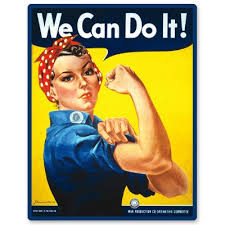
Who is this a image of and what did she a symbol of .....
June the Fighter symbol of women's suffrage
Susan the solider symbol of women working on airplanes
Rosie the Riveter symbol of women working in factories during the war.

What battle is the pacific theater was vital to gain in order the bomb Japan
Okinawa
Iwo Jima
Normandy
Midway
What industry manufactured about 1/3 of military equipment during WWII
steel industry
ship-industry
intercultural sector
automobile industry
The American program to build an atomic bomb was known as the
Manhattan Project
Operation overlord
New York Project
Operation A-bomb
What is another name for the Invasion of Normandy?
Battle of France
Battle of the Bulge
D-Day
V-E Day

What was President Roosevelt referring to in this speech?
The victory at Normandy and liberation of France.
the Japanese bombing of Pearl Harbor.
The Battle of Britain.
Define Facism
a system of government that is centralized and dictatorial and requires complete subservience to the state
a form of far-right, authoritarian ultranationalism, characterized by dictatorial power, forcible suppression of opposition, and strong regimentation of society and the economy
government by a dictator
the belief or desire of a government or people that a country should maintain a strong military capability and be prepared to use it aggressively to defend or promote national interests
1. During the Holocaust, the Nazis systematically execute:
2 million Jews and 4 million other “non-Aryans.”
10 million Jews and 8 million other “non-Aryans.”
6 million Jews and 5 million other “non-Aryans.”
7 million Jews and 9 million other “non-Aryans.”
2. Hitler orders all “non-Aryans” to be removed from government jobs and begins a campaign for:
Mind purity
Soul purity
Human purity
Racial purity
3. What did the Nazis NOT take away from the Jews?
Citizenship
Jobs
Property
Hope
4. What's the meaning of Kristallnacht?
Nazis attack Jewish on the street, roads, etc.
Nazis attack Jewish homes, businesses, and synagogues.
Nazis attacked Jewish while they were sleeping.
Nazis attack Jewish for a whole week.
5. By 1938, how many refugees were in France and Britain?
10 000 & 30 000 respectively.
20 000 & 40 000 respectively.
40 000 & 80 000 respectively.
50 000 & 90 000 respectively.
6. What was The Plight of St. Louis?
Ships with refugees could only unship half of the passengers.
Ships with refugees were shut down as they approached the US coast.
Ships with refugees had to fight to be unshipped.
Ships with refugees had to go back and later were killed.
7. What genocide means?
Deliberate, systematic killing of rebels.
Deliberate, systematic killing of an entire population.
Deliberate, systematic killing of governments.
Deliberate, systematic killing of other country's militia.
8. What did the Jews NOT do after all this Holocaust?
They were forced into ghettos.
They became part of the German army.
They formed resistance movements.
They maintain Jewish culture.
9. What is NOT true about the concentration camps?
Prisoners were given little food.
Prisoners had to work 7 days per week
Weak prisoners were killed.
Prisoners could run away.
10. In 1942, Hitler and top officials used the last weapon in the Holocaust: poison gas. What is NOT true about this?
Those who couldn't work immediately were sent to the gas chamber.
Bodies were buried in pits.
Bodies were cremated to cover up evidence.
Those who ran away were killed in from of their relatives.

