
 Worksheets
11MAG - Graphs and network
Total questions: 140
Worksheet time: 3hrs 37mins

Is this diagram correctly labelled?
Yes
No

What is the degree of Vertex A?
2
3
4
5
What is the degree of Vertex C?
2
3
4
5
What is the degree of Vertex E?
2
3
4
5

Determine the adjacency matrix for this network:


In a network a Walk is any route taken through a network, including routes that repeat edges and vertices. What is a Trail?
A walk in which no vertices are repeated, except possibly the start and finish
A walk in which no edges are repeated
What is a Eulerian Path?
A path in a graph that visits every edge exactly once and returns to the start.
A path in a graph that visits every vertex exactly once and returns to the start.
A path beginning and ending at the same vertex.
What is a Hamiltonian Path?
A path in a graph that visits every edge exactly once and returns to the start.
A path in a graph that visits every vertex exactly once and returns to the start.
A path beginning and ending at the same vertex.
How do you determine whether a graph is Eulerian?
All vertices are even
One odd vertex
Two odd vertices
Three odd vertices

This graph has a Hamiltonian Circuit. True or False?
False
True
In a network a Walk is any route taken through a network, including routes that repeat edges and vertices. What is a Path?
A trail in which no vertices are repeated, except possibly the start and finish
A trail in which no edges are repeated

In this graph, what is the smallest weight?
2
4
5
9
no clear answer
Start at J. Walk all 7 streets. Return to J with minimal backtracking. The numbers on each edge represent the length, in hundreds of meters, of each street. What is the shortest length to start and end at vertex J?
35
44
43
26
46

Construct one route through each edge exactly one time with minimal back tracking. Indicate the MINIMUM time it will take to travel this route.
313
320
354
330
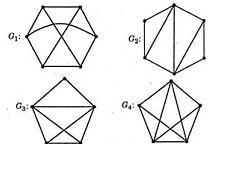
Which of the above graphs is/are NOT planar?
G1
G2
G3
G4
State meaning of weighted graph
A graph in which the edges have direction
A join or relationship between nodes or corner
A graph that has a data or numerical value labelled on each edge
An object in a graph and also known as node

Find a length of a shortest path between a -- g
7
10
5
9
at adjacent point
similar loop

Is the graph is planar or not?
Planar
Not planar
A path is .... ?
An edge that starts and end at same vertex
A connection between two vertices
A complete graph
A series of consecutive edges which has no repeated edge

Count number of edges
3
4
5
6

A bridge exists between two vertices. Which vertices are they?
(a)

The graph has (a) edges.

The graph has (a) edges.

What is the degree of vertex C?
(a)

What is the degree of vertex B?
(a)

The graph has (a) edges.

The graph has (a) odd vertices.

Which graph is not isomorphic to the others?
(a)

Which graph is not isomorphic to the others?
(a)

Which graph represents the following adjacency matrix?


Which graph represents the following adjacency matrix?


Which graph represents the following adjacency matrix?

Is this graph conntected?
Connected
Not Connected

Is this graph conntected?
Connected
Not Connected

A bridge exists between two vertices. Which vertices are they?
(a)

The graph has (a) edges.

What is the degree of vertex F?
(a)

The graph has (a) even vertices.

A bridge exists between two vertices. Which vertices are they?
(a)

What is the sum of the degrees of the vertices of the following graph?
(a)

What is the sum of the degrees of the vertices of the following graph?
(a)

What is the sum of the degrees of the vertices of the following graph?
(a)

State the value of f
(a)

Is the graph in Planar Form?
Planar Form
Not Planar Form

Is the graph in Planar Form?
Planar Form
Not Planar Form
Is the graph in Planar Form?
Planar Form
Not Planar Form

Is the graph in Planar Form?
Planar Form
Not Planar Form

Is the graph in Planar Form?
Planar Form
Not Planar Form

State the value of f
(a)
For a planar connected graph, find f given v = 3 and e = 8
(a)
For a planar connected graph, find f given v = 1 and e = 7
(a)
For a planar connected graph, find e given f = 6 and v = 9
(a)
For a planar connected graph, find e given f = 3 and v = 10
(a)
For a planar connected graph, find v given e = 10 and f = 5
(a)
For a planar connected graph, find v given e = 8 and f = 5
(a)

Is the graph in Planar Form?
Planar Form
Not Planar Form

Find the shortest path from Bartow to Kenton in the network shown
B−S−O−K
B−S−M−O−K
B−S−M−K
B−C−M−K

Find the shortest path from Kinglake to Healesville in the network shown
K-S-Y-H
K-T-H
K-Y-H
K-T-Y-H
Find the shortest path from Croghon to Stratmoore in the network shown
C−B−S
C−O−S
C−M−S
C−M−O−S

Find the shortest path from A to F in the network shown
A–B–E–F
A–C–D–F
A–B–D–F
A–C–B–E–F

Find the shortest path from A to D in the network shown
A–B–D
A–C–D
A–E–D
A–B–C–D
Find the shortest path from A to D in the network shown
A–B–D
A–C–D
A–E–D
A–B–C–D

What distance is travelled on the path A–B–E–H–I?
(a)
What distance is travelled on the circuit F-E-D-H-E-A-C-F?
(a)

How long will it take to drive from C to D via B?
(a)

How far is the drive from Nhill to Horsham via Natimuk?
(a)
Find the shortest distance between Nhill and Donald
(a)

Determine whether the graph has a Eulerian trail, a Eulerian circuit or neither
Eulerian Trail
Eulerian Circuit
Neither

Determine whether the graph has a Eulerian trail, a Eulerian circuit or neither
Eulerian Trail
Eulerian Circuit
Neither

Determine whether the graph has a Eulerian trail, a Eulerian circuit or neither
Eulerian Trail
Eulerian Circuit
Neither

Determine whether the graph has a Eulerian trail, a Eulerian circuit or neither
Eulerian Trail
Eulerian Circuit
Neither

Determine whether the graph has a Eulerian trail, a Eulerian circuit or neither
Eulerian Trail
Eulerian Circuit
Neither

Identify the walk in each of the graphs below as a trail, path, circuit or walk only
Trail
Path
Circuit
Walk Only

Identify the walk in each of the graphs below as a trail, path, circuit or walk only
Trail
Path
Circuit
Walk Only

Identify the walk in each of the graphs below as a trail, path, circuit or walk only
Trail
Path
Circuit
Walk Only

Identify the walk in each of the graphs below as a trail, path, circuit or walk only
Trail
Path
Circuit
Walk Only

Identify the walk in each of the graphs below as a trail, path, circuit or walk only
Trail
Path
Circuit
Walk Only
Choose the correct term to match each definition: Lines or curves that connect vertices.
Regions
Vertices
Edges
Paths
An edge that begins and ends at the same vertex.
Multiple edges
Vertices
Loop
Node
Links that connect the same two vertices to one another.
Multiple edges
Vertices
Loop
Nodes
When the edges have a numerical representation (to indicate length, time, capacity etc.).
Multiple edges
Weighted graph
Complete graph
Directed graph
No arrows are shown on the edges.
Directed graph
Weighted graph
Simple graph
Undirected graph
An undirected and unweighted graph with no multiple edges.
Undirected graph
Unweighted graph
Incomplete graph
Simple graph
A sequence of vertices for which each vertex in the sequence is joined to the next vertex in the sequence by an edge.
Walk
Closed walk
Path
Trail
A walk that doesn’t finish at the starting vertex.
Walk
Closed walk
Open walk
Trail
A walk that has no repeat use of edges or vertices (except perhaps to end at the starting vertex).
Path
Closed walk
Open walk
Trail
Every path is a trail.
TRUE
FALSE
A walk that has no repeated edges (but can
revisit vertices).
Path
Trail
Eulerian trail
Hamiltonian circuit

Every vertex in this network is (blank) to every other vertex.
adjacent
connected
planar
disconnected
Two vertices are called (blank) if they are attached directly by at least one edge.
adjacent
connected
planar
complete
If it is possible to create a walk from one vertex to any other vertex, the network must be ...
connected
planar
complete
disjoint
Every vertex is connected to every other vertex by a single edge.
Connected graph
Planar graph
Complete graph
Disjoint graph
If a (blank) is removed, it will leave the graph disconnected.
node
region
bridge
loop
A graph that can be drawn in 2D without crossing of edges.
bipartite
connected
complete
planar
A connected graph that does not contain a cycle.
path
walk
circuit
tree
A graph in which the vertices can be split into two groups such that every edge joins a vertex from one group to a vertex from the other group.
bipartite
connected
complete
planar
If a network can be drawn without taking the pen off the page and without going over the same edge twice it is ...
Eulerian
Hamiltonian
traversable
semi-Hamiltonian
Which of the following best describes an Eulerian graph?
Covers every edge once and starts and ends at same vertex.
Includes every vertex exactly once and starts and finishes at same vertex.
Includes every vertex exactly once. Starts and finishes at different vertex.
Covers every edge once and starts and ends at different vertex.
Which of the following best describes a Hamiltonian trail?
Covers every edge once and starts and ends at same vertex.
Includes every vertex exactly once and starts and finishes at same vertex.
Includes every vertex exactly once. Starts and finishes at different vertex.
Covers every edge once and starts and ends at different vertex.

The following undirected graph shows six houses in a village. A salesperson needs to visit all
the houses starting from house A and finishing at house F. Calculate the shortest distance in km.
3.05
3.08
3.30
3.68

The directed graph on the right shows the
roads connecting Lani’s house at A to the
school at E. Suggest the shortest route
that Lani can choose to cycle to school.
A > C > D > E
A > B > C > E
A > D > E
A > B > E
You are required to construct a graph with 20 edges and each vertex with a degree of 4. How many vertices do you need to have on the graph?
8
10
12
15

Which set represents the vertices of the graph?
{1,2}, {2,3}. {2,4}, {4,5}, {4,6}
{1, 2, 3, 4, 5, 6,}
{1, 2, 3, 4, 5, 6, 7}
{1,2}, {2,3}. {2,4}, {4,5}, {4,6}, {6,7}

What is the degree of vertex 4?
3
4
5
7

Which vocabulary term is illustrated through the diagram?
Minimal Spanning Tree
Four Color Theorem
Cycle
Vertices

What is the weight of the shortest path from A to F?
5
7
9
11

Which vertices are adjacent to E?
B and C
B, C, D, and A
B
A, B, C, D, F, G

Which describes the edges of the graph?
{A,B}, {A,C}, {A, E}, {B,C}, {B,E}
A, B, C, D, E
{A,B}, {A,C}, {A, E}, {B,C}, {B,E}, {C,D}
{A,B}, {A,C}, {A, E}
Every path is a trail.
TRUE
FALSE
A walk that has no repeated edges (but can
revisit vertices).
Path
Trail
Eulerian trail
Hamiltonian circuit
Two vertices are called __________ if they are attached directly by at least one edge.
adjacent
connected
planar
complete
If it is possible to create a walk from one vertex to any other vertex, the network must be ...
connected
planar
complete
disjoint
If a __________ is removed, it will leave the graph disconnected.
node
region
bridge
loop
If a network can be drawn without taking the pen off the page and without going over the same edge twice it is ...
Eulerian
Hamiltonian
traversable
semi-Hamiltonian
A loop has a degree of 2.
True
False
The number of edges will always equal half the number of degrees.
True
False
How many edges does a graph with a sum of degrees = 30 have?
15
17.5
30
60

Identify the number of edges that connect vertex A and vertex C
0
1
2
3
True or False.
Graphs & networks are essentially the same thing.
True
False
In a graph modelling social relationship, a person is represented as ______________ while friendship is represented as ______________.
vertex, edge
edge, vertex
vertex, dot
circle, entity
If a path is closed, it is called a...?
Cycle
Circuit
Closed path
Trail
A closed trail is called...?
Cycle
Circuit
Closed trail
Path

By looking at the pattern of the numbers in the table, determine the number of edges for a complete graph to be drawn from 9 nodes given.
28
36
45
55
If the number of edges of a complete graph can be drawn from n nodes given is 91. What is the value of n?
12
13
14
15
You are required to construct a graph with 20 edges and each vertex with a degree of 4. How many vertices do you need to have on the graph?
8
10
12
15

The graph shown contains NO cycles.
True
False

The graph shown contains NO cycles.
True
False
Which of the following statements are TRUE about a minimal spanning tree?
Each branch has a weight.
Contains no cycles.
All vertices are connected.
The path results in the minimum total weight.

Create a minimal spanning tree, then find the minimum total cost.
30
39
47
50

Create a minimal spanning tree, then find the minimum total cost.
20
21
22
23

Using Kruskal’s algorithm, which edge should you choose second?
AE
BD
DE
AB

Using Kruskal’s algorithm, which edge should you choose fourth?
AB
BC
BD
DE

Find the minimum spanning tree (MST) using Kruskal’s algorithm and provide the overall weight.
20
25
28
30

Find the minimum spanning tree (MST) using Kruskal’s algorithm and provide the overall weight.
20
25
28
30
A cycle is...
A path that starts and ends at different vertices.
A path that starts and ends at the same vertex where backtracking is allowed.
A path that starts and ends at the same vertex and uses every edge exactly once.
A path that starts and ends at the same vertex and does not use any edge more than once.
Create a minimal spanning tree, then find the minimum total cost.
20
21
22
23

Create a minimal spanning tree, then find the minimum total cost.
21
22
23
24

Create a minimal spanning tree, then find the minimum total cost.
32
33
34
35

