Worksheets
Force and Motion Halloween Escape
Total questions: 32
Worksheet time: 16mins
What are forces (select 2)
pushes
pulls
slides
jumps

This fisherman is using force to change the ___ of the fish.
position
speed
direction
shape
Mass is the same thing as weight.
true
false

On Pluto I would weigh less, but my mass would be the same.
true
false

balanced or unbalanced
balanced
unbalanced
Friction is a non-contact force.
true
false
Which is NOT a type of non-contact force?
electrostatic
wind
magnetism
gravity

Which type of non-contact force is demonstrated?
electrostatic
friction
magnetism
gravity

We add grease to bike gears to reduce friction. This is called ____.
lubrication
surface area
friction
gravity

A parachute slows a person down because of increased _____ that increases friction.
lubrication
surface area
friction
gravity
Which of these is an example of uniform motion?
someone moving on a Merry-Go-Round
someone slowing down for a red light
someone driving on a straight road with their car set on cruise control of 65 mph
someone sprinting faster at the end of a race
Objects can slow down, speed up, or change direction on their own.
true
false
An object at rest stays at rest unless acted on by an unbalanced force, and an object in motion stays in motion unless acted on by an unbalanced force. This is called ____.
acceleration
uniform motion
Newton's 3rd law of motion
inertia
Which of these is an example of acceleration?
speeding up
slowing down
changing direction
all of these
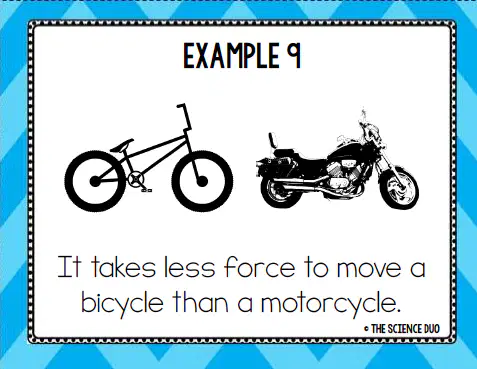
If I use the same force on an empty shopping cart and a full shopping cart, which statement below is true?
The full cart will be harder to start moving, but easier to stop.
The full cart will be easier to start moving, but harder to stop.
The full cart will be harder to start moving, and harder to stop.
The full cart will be easier to start moving, and easier to stop.
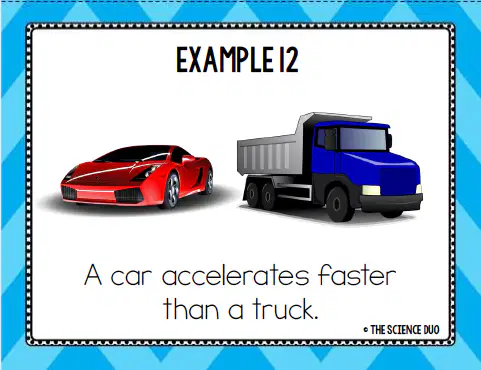
If I have two shopping carts that are equally full and have the same mass, but I push each of them with a different force, which is true?
The cart that gets a bigger force will go faster and farther.
The cart that gets a bigger force will go slower and less far.
Both carts will move at the same speed and travel the same distance.
The carts will move at a different speed, but will stop at the same distance.
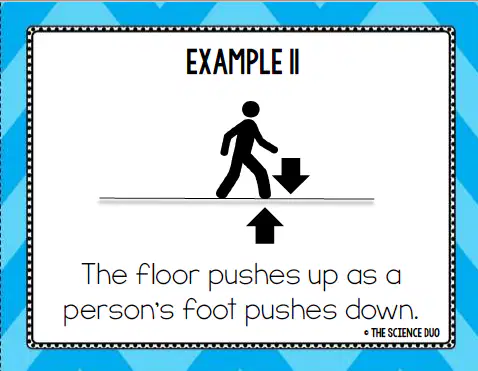
Which of these is an example of Newton's 3rd Law?