wayground logo

Free Printable Worksheets

Font size

S
M
L
XL
Worksheets

Atomic Structure

Total questions: 27

Worksheet time: 16mins

Name
Class
Date
1.
Which subatomic particle has a positive (+) charge?
a)
Neutron
b)
Proton
c)
Electron
2.

True or False - Protons and Neutrons have the same mass.

a)
True - They have about the same mass
b)
False - They do not have about the same mass
3.
Which subatomic particle has a negative (-) charge?
a)
Proton
b)
Electron
c)
Neutron
4.
Which subatomic particle has a neutral or no charge?
a)
Proton
b)
Electron
c)
Neutron
5.
Which two subatomic particles make up the nucleus of an atom?
a)
Protons and Electrons
b)
Neutrons and Electrons
c)
Electrons and Protons
d)
Protons and Neutrons
6.

The name of this particle means indivisible and is one of the fundamental building blocks of matter

a)

molecule

b)

compound

c)

atom

d)

isotope

7.

The mass of an atom is

a)

equal to the number of protons

b)

the protons + electrons

c)

the protons + neutrons

d)

the protons + neutrons + electrons

8.

In a electrically neutral atom,

a)

protons = electrons

b)

protons = neutrons

c)

neutrons = electrons

d)

protons = neutrons = electrons

9.
Value representing the number of protons in an element
a)
Atomic Mass
b)
Mass Number
c)
Valence Electrons
d)
Atomic Number
10.
All ____________ are made up of two or more atoms bonded together.
a)
atoms
b)
molecules
c)
electrons
d)
elements
11.
What is the mass number?
a)
the number of protons
b)

the number of protons plus neutrons

c)
the number of neutrons
d)

the number of protons plus electrons

12.
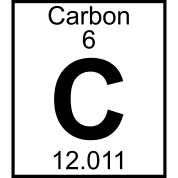
What does the C represent?
a)
atomic mass
b)
atomic number
c)
element name
d)
chemical symbol 
13.
what does the 6 represent?
a)
Atomic mass
b)
atomic number
c)
chemical symbol
d)
element name
14.
How is the number of neutrons in the nucleus of an atom calculated?
a)
Add the number of e- and p+ together
b)
Subtract the number of e- from p+
c)
Subtract the number of p+ from the mass number
d)
Add the mass number to the number of e-
15.

What is the smallest unit of matter that retains the properties of the substance?

a)

cell

b)

nucleus

c)

atom

d)

electron

16.

What is the center of an atom containing protons and neutrons?

a)

nucleus

b)

neutron

c)

proton

d)

electron cloud

17.
What electrical charge does a proton have?
a)
+1
b)
0
c)
-1
d)
+2
18.

What mass does a neutron have?

a)

1 amu

b)

0 amu

c)

-1 amu

d)

+2 amu

19.

Which element has an atomic # of 13?

a)

Nitrogen

b)

Yttrium

c)

Aluminum

d)

Carbon

20.

Which element has an atomic # of 20?

a)

Neon

b)

Fluorine

c)

Calcium

d)

Iodine

21.

Which of the following best describes the density of an atom?

a)

most of the mass occupies the large electron cloud

b)

most of the mass occupies the very small nucleus

c)

the mass is evenly split between the electron cloud and the nucleus

d)

it depends

22.

Calculation used to find the number of neutrons in an atom

a)

Mass Number- Atomic Number

b)

Atomic Number - Mass Number

c)

Mass Number - Electrons

d)

protons = electrons = neutrons

23.
How many neutrons does a sodium atom have? (Use the image to help you)
a)
23
b)
11
c)
12
d)
34
24.
How many protons does this atom have?
a)
2.5
b)
6
c)
5
d)
10.811
25.
Which particle makes up the ATOMIC NUMBER of an element? 
a)
Protons
b)
Electrons
c)
Protons and Neutrons
d)
Neutrons
26.

The scientist in the 1800s who developed the atomic theory was named:

a)

Wilhelm Roentgen

b)

John Dalton

c)

Marie Curie

d)

John John

27.

All atoms of different elements share the same mass and properties

a)

True

b)

False