
 Worksheets
Unit 1: Practice Quiz Newton's Laws
Total questions: 30
Worksheet time: 44mins
What unit is Force measured in?
Newtons
Joules
m/s^2
Kilograms
Letting go of a balloon full of air is demonstrating which Newton's Laws of Motion because the air comes out of the back and the balloon moves forward.
1st law of motion
2nd law of motion
3rd law of motion
None of the answers.
A soccer ball is sitting in the middle of a field. The ball will remain at rest until an outside force like a player's foot or the wind acts upon it. Which of Newton's laws is represented by this?
1st
2nd
3rd
Think about pushing a shopping cart vs a car. If you apply the same amount of force to both, the shopping cart will travel faster and the car will hardly move. To move the car you would need a larger force. Which of Newton's laws is being represented?
1st because inertia is a measurement of force
2nd because the amount of force and needed to move a car is dependent on the mass.
3rd the act of pushing a cart builds muscles which makes it easier to push the car.
Sally jumps on her bed and with each jump she exerts a force on the bed. The bed in turn exerts an equal but opposite force back on Sally. This represents Newton's:
Law 1
Law 3
Law 2

Which way would a swimmer push to move forward in the water?
To the left
Forward
Backward
"A body at rest tends to remain at rest, and a body in motion, tends to remain in motion, unless acted upon by an unbalanced force."
This is describing the law of
forces
inertia
velocity
gravity
The force of an object, with a certain mass accelerating at a certain rate, can be determined by the equation below:
force = mass x acceleration
Which object would have the greatest force?
a 5-kg object accelerating at 100 m/s
a 5-kg object accelerating at 20 m/s
a 20-kg object accelerating at 4 m/s
a 20-kg object accelerating at 3 m/s
What explains a quantity that has BOTH speed and direction?
Inertia
Force
Speed
Velocity
The force that prevents a ball rolling on the ground from continuing on it's path forever is...
Friction
Gravity
Inertia

Two identical trucks are next to each other at a traffic light. One truck is empty while the other is fully loaded. When the light turns green, the lighter truck increases speed more quickly. Which of these best explains this situations
Newton's first law because the heavier truck has less resistance to change.
Newton's second law because the difference in mass and having equal forces leads to faster acceleration
Newton's third law the action is the mass and the reaction is gravity
While you’re ice-skating with your friends, you push off from one end of the rink and slide forward. Based on Newton’s first law of motion, what is true?
You will lose your balance and fall over before your reach the middle of the ice rink.
You will continue to slide across the ice until a force makes you stop or change direction.
The force of gravity will make you keep your velocity until your friends make you stop.
The size of your ice skates will determine how quickly or slowly you travel across the ice.
Your friend kicks a soccer ball, and it stops a few feet from you. What needs to happen to it in order for it to return to your friend?
Friction has to be applied to the ball.
Force has to be applied to the ball.
Speed has to be applied to the ball.
Inertia has to be applied to the ball.
How is velocity different from speed?
Velocity is when an object goes in reverse.
Velocity is the direction an object moves in, and it has nothing to do with speed.
Velocity is speed and direction together.
Velocity is not at all different from speed.
Every time your cat’s paw hits her toy string, it swings away from her. How does this demonstrate Newton’s third law of motion?
Objects with mass, such as your cat's paw and toy string, will require inertia.
Objects in action, such as the string toy, will experience force.
For every motion from your cat's paw, there is unbalanced inertia from the string.
For every action your cat makes, there is an equal and opposite reaction from the string.

According to Newton's 2nd law of motion, what will happen to the object shown here if the pushing force were doubled?
The acceleration of the object will also double
The acceleration of the object will decrease by 1/2
The object will stop
The object's mass will decrease
Isaac Newton proposed three laws of motion. Which one of the following statements best explains why a person is propelled forward when a car suddenly stops?
Acceleration is proportional to the net force on an object
An increase in force will result in a decrease in acceleration
The stopping car is an action that results in a person moving forward (reaction)
An object in motion stays in motion until an unbalanced force acts on it
What would be the mass of an object that has a force of 88 N and an acceleration of 12 m/s^2?
1056 kg
7.33 kg
176 kg
0.14 kg
Kara pushes her big brother on the swing at the playground. After he gets off the swing, her little brother gets on. Kara finds that it is easier to push her little brother than it was to push her big brother. What is the most likely reason for this?
smaller mass always moves faster than larger mass
smaller mass always moves slower than larger mass
less force is needed to move a larger mass
more force is needed to move a larger mass

A performer pulls a tablecloth out from under a complete set of dinnerware as shown in the illustration. Which of the following best explains the performer’s success at leaving the dinnerware on the table?
the inertia of the dinnerware
the large mass of the tablecloth
the placement of the dinnerware
the rough material of the tablecloth
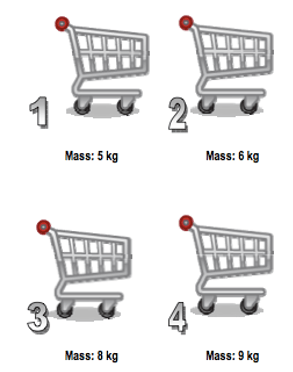
If each wagon is given the same push, which wagon should go the fastest?


A teacher leaves a coffee mug on top of a car. The teacher drives the car in a straight line and then stops suddenly. What happens to the coffee mug when the car stops?
the mug moves forward
the mug moves backward
the mug moves side to side
the mug stays in the same position
___ refers to how fast an object is moving.
Speed
Velocity
Acceleration
Motion
Which two factors does speed depend on?
distance and direction
direction and time
distance and time
distance, time and direction
Which is an example of speed?
A car driving 55 miles per hour south.
A bicyclist traveling 10 meters per hour toward the next town.
A roller coaster is traveling 10 meters per second.
A rocket blasting off at 2,500 meters per second toward space.
Which is an example of velocity?
A car driving 55 miles per hour south.
A bicyclist traveling 10 meters per hour.
A roller coaster is traveling 10 meters per second.
A rocket blasting off at 2,500 meters per second.
Which is NOT an example of Acceleration?
An object speeds up
An object slows down
An object changes direction
An object is in constant motion.

