
NEW
Font size
 Worksheets
Relative Dating and Principles of Geology
Total questions: 25
Worksheet time: 30mins

The science of determining the relative age of rock layers and/or fossils
within those rock layers based on the comparative positions of those rock layers.
Layer Dating
Relative Dating
Absolute Dating
Radiometric Dating

Which of the following states that sediment is deposited horizontally or in “flat rows” due to gravity.
Over time, the sediment is compacted to form sedimentary rock.
Relative Dating
The Law of Superposition
Principle of Horizontality
Cross-cutting Relationships
According to the Law of ______________, sedimentary rock
layers are laid down on top of each other. In
order for the rock layer to form, a layer of rock must have existed below it.
Superposition
Horizontality
Unconformities
Uniformitarianism

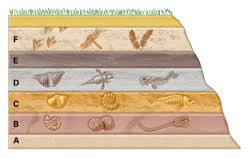
Which layer is the oldest?
A
B
C
D

Which layer is the youngest?
D
C
A
B

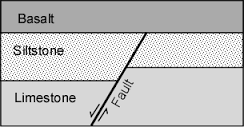
Which of the following is true?
A fault is younger than the rock layers that it goes through.
A fault is older than the rock layers that it goes through.
The rock layers are younger than the fault that cuts through it.
Which of the following is true?
An igneous intrusion is older than the rock layers that it goes through.
An igneous intrusion is younger than the rock layers that it goes through.
The rock layers are younger than the intrusion that cuts through it.


Which layer is OLDER? Fault E or Intrusion D?
Fault E
Intrusion D

Which layer is OLDER? Intrusion M or Layer D?
Intrusion M
Layer D


Layer B on side #1 (left) is a match to which layer on side #2 (right)?
z
y
w
there is no match


A fault or intrusion is younger than the unit it cuts across.
Law of Superposition
Inclusions
Principle of Cross-Cutting Relationships
Priniciple of Orignial Horizontality

Which of the fossils is the oldest?
Dinosaur
Bird
Shell
Ammonite

Which rock layer is oldest from Site 1?
G
B
A
E

Which is the youngest rock layer?
Siltstone
Conglomerate
Mudstone
Limestone
Certain fossils can be used to help determine the age of the rock layer in which the fossils are found. Which type of fossil is BEST to use when making this determination?
marine mammal fossil
swamp fern fossil
trace fossil
index fossil

The diagram shows fossils and rock features...
Which is younger than the clam fossil?
Layer Z
Broadleaf
Reptile bone
Intrusion X
Which of the following is an example of a trace fossil?
A skeleton preserved in a tar pit
A footprint of an extinct animal
A mummy buried in ice
An insect preserved in amber
Layer B on side #1 (left) is a match to which layer on side #2 (right)?
z
y
w
there is no match
Which layer is OLDER? Intrusion M or Layer D?
Intrusion M
Layer D

