
 Worksheets
Egyptian Religion & Social Structure
Total questions: 40
Worksheet time: 22mins

Which group of people belongs to the top tier of the social pyramid in Egypt?
Vizier
Pharaoh
Priest
Nobles
Soldiers

Which group of people or occupations belongs to the second tier or ruling class of the social pyramid in Egypt? (multiple answers)
Vizier
Merchant
Nobles or Government Officials
Traders
Priest

Which group of people or occupations belongs to the third tier or middle class of the social pyramid in Egypt? (multiple answers)
artisans or craftsmen
doctor
soldier
merchants & traders
scribes

Which group of people or occupation belongs to the fourth tier or lower class of the social pyramid in Egypt?
Craftsmen
Peasant Farmers
doctors
traders
slaves

Which group of people or occupations belongs to the 5th tier or lowest class of the social pyramid in Egypt? (multiple select 1 answers)
Peasant Farmer
Servants
Laborers
Slaves
Traders
How were social classes organized in Egypt?
by geography
by religious beliefs
by achievements
by occupation
Which of the below occupations is being described? Performed religious ceremonies to keep the gods happy and embalmed the death for the afterlife
Priest
Pharaohs
Doctors
Merchants
Government Officials
Which of the below occupations is being described? Collected taxes, enforced laws, supervised public construction projects, and supervised food production
Soldiers
Pharaohs
Vizier
Nobles or Government Officials
Priest
Chief advisor to the pharaoh and 2nd most powerful person in Egypt
Government Officials
Visier
Priest
Nobles
Military Leaders
Most powerful person in Egypt. His subjects believe he is the son of the god Ra or the human body of Horus. He had absolute control of Egypt.
Pharaoh
Vizier
Priest
Government Officials
People who own shops and trade goods
Craftsmen
Artisans
Servants
Merchants
Worked the land assigned to them and gave three-fifths of what they grew as a tax and helped Egypt to become a wealthy kingdom
slaves
peasant farmer
artisans
servants
People who traveled to foreign places to trade and bring back exotic goods that only the wealthy could afford.
Merchants
Traders
Nobles
Craftsmen
Viziers
People who have no rights, money, or education. They helped plant and harvest crops.
Slaves
Servants
Peasant Farmers
Laborers
Vizier
Skilled workers that crafted many different objects out of different materials. Most of the goods they made could only be afforded by the ruling class. Examples are Metal Workers, Carpenters, Stone Mason, Potters
Slaves
Artisans or Craftsmen
Nobles
Servants
Vizier
People who could write and record information such as tax collection
visier
artisans
servants
scribes
Treated the sick and wounded
Doctors
Visier
Artisans
Priest
Pharaohs
Dedicated their life defending Egypt from domestic and foreign enemies.
Vizier
Peasant Farmers
Slaves
Soldiers
Pharaohs
Ancient Egyptians believe the soul had two parts known as the _________ and the _________
Ra & Set
Ka & Ba
Anubis & Horus
Ma and La
Egyptians perfected this skill so the two parts of the soul could reunite and have a body in the afterlife.
Mummifying the body of the dead
Saying prayers and performing death rituals
Building pyramids
Reading from the Book of the Dead
Why was it so important for the two parts of the soul to reunite?
so it could seek revenge on people who wronged the person the soul belonged to.
to prevent the soul from dying
So it can travel to the underworld and be judged to determine its worthiness
So it could reincarnate and have a new body and live on the earth again
Why was mummification important?
Because it was an organ transplant surgery that help preserve and save lives.
It was used to preserve the heart because the heart was the only part of the body needed to gain an afterlife.
Is the written language used by scribes to write the Book of the Dead so people could know secret spells in the afterlife.
It prevented the body from decaying so the soul could have a body in the afterlife .
What type of religion did Egyptians practice?
polytheistic
monotheistic
theocracy
sarcophagus

What was the responsibility of Thoth?
He was the god of writing that wrote down the judgments of the god of the underworld.
He was the creature that was part crocodile, lion, and hippo that ate the hearts of those that were evil and did not deserve an afterlife.
He was the sky god that took the souls to the afterlife, Field of Reeds
He was the god of embalming that placed the heart on scales to be weighed against the feather of truth
He was the god of the underworld that determined if a person deserved an afterlife

What was the responsibility of Anubis?
He was the sun god that used his barge to carry the dead to the underworld to be judged
He was the god of writing that wrote down the judgments of the god of the underworld.
He was the creature that was part crocodile, lion, and hippo that ate the hearts of those that were evil and did not deserve an afterlife.
He was the god of embalming that placed the heart on scales to be weighed against the feather of truth
He was the sky god that took the souls to the afterlife, Field of Reeds

What was the responsibility of Ra?
He was the god of writing that wrote down the judgments of the god of the underworld.
He was the sky god that took the souls to the afterlife, Field of Reeds
He was the creator and sun god that used his barge to carry the dead to the underworld to be judged
He was the god of the underworld that determined if a person deserved an afterlife
He was the creature that was part crocodile, lion, and hippo that ate the hearts of those that were evil and did not deserve an afterlife.

What was the responsibility of Osiris?
He was the god of the underworld that determined if a person deserved an afterlife
He was the sun god that used his barge to carry the dead to the underworld to be judged
He was the god of embalming that placed the heart on scales to be weighed against the feather of truth
He was the sky god that took the souls to the afterlife, Field of Reeds
He was the god of writing that wrote down the judgments of the god of the underworld.

What was the responsibility of Ammut or Ammit ?
He was the god of writing that wrote down the judgments of the god of the underworld.
He was the sun god that used his barge to carry the dead to the underworld to be judged
He was the god of the underworld that determined if a person deserved an afterlife
He was the god of embalming that placed the heart on scales to be weighed against the feather of truth
He was the creature that was part crocodile, lion, and hippo that ate the hearts of those that were evil and did not deserve an afterlife.

What was the responsibility of Horus?
He was the sun god that used his barge to carry the dead to the underworld to be judged
He was the god of embalming that placed the heart on scales to be weighed against the feather of truth
He was the sky god that took the souls to the afterlife, Field of Reeds
He was the god of the underworld that determined if a person deserved an afterlife
He was the god of writing that wrote down the judgments of the god of the underworld.
What happened if a person's heart was lighter than the Feather of Truth
The person would be reincarnated and be reborn as a new person on earth.
The person would become a god.
The person's heart would be fed to a mythical creature and not receive an afterlife.
The person would receive an afterlife.
What happened if a person's heart was heavier than the Feather of Truth?
The person's heart would be fed to a mythical creature and would not receive an afterlife.
The person would receive an afterlife.
The person would become a god.
The person would be reincarnated and be reborn as a new person on earth.

What was the purpose of a Pyramid?
A place of worship
A tomb for the pharaoh and his possessions
A place to bring offerings to the gods
A palace for the pharaoh.
The pharaoh is a king and thought to be a god. What type of government does this scenario create?
monarchy
democracy
theocracy
polytheism
What is a pharaoh?
top advisor to the king of Egypt
King of Egypt
king of Mesopotamia
King and religious leader of Egypt
Correctly Reorder the following steps of Mummification
Wash body
Remove organs except for heart amd place in jars. Throw brain away
Cover body with natron(salt) for 40 to 70 days
Stuff body with linen or sand
Oil body & wrap body in linen bandages covered with resin
Which occupation has the largest population?
Artisans
Peasant Farmers
soldiers
Servants
How did the concept of dynasties preserve the power of pharaohs in Ancient Egypt?
Dynasties prevented individuals from gaining wealth.
Dynasties created governments that did not need leaders.
Dynasties ensured that new pharaohs were chosen from the same family.
Dynasties ensured that new pharaohs were elected from the entire population.
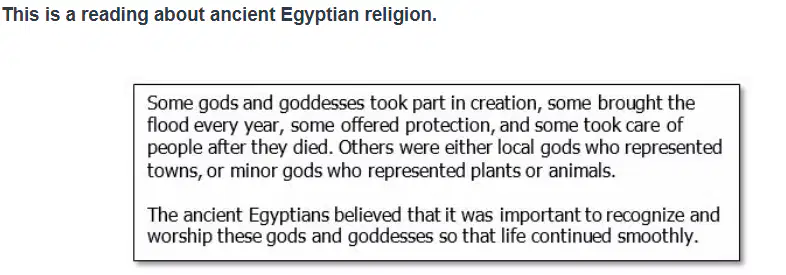
According to the reading, what is true about Egyptian religion
The Egyptians practiced polytheism in their civilization.
The Egyptians believed gods lived alongside humans in society.
The Egyptians practiced monotheism in their civilization.
The Egyptians did not place an importance on religion.

Based on this chart, which statement is true?
Ancient Egyptian gods did not influence society.
Ancient Egyptian gods did not have human qualities.
Ancient Egyptian gods were combined into one singular being.
Ancient Egyptian gods controlled different aspects of life.
How did the Ancient Egyptian civilization develop a large slave population?
Egyptian religious leaders forced Hindus into slavery.
Egyptian laws forced all common citizens into slavery.
Egyptian traders bought slaves from North America.
Egyptian armies enslaved people who were defeated in battle.

