
 Worksheets
5.1 Gas
Total questions: 17
Worksheet time: 51mins
Which is NOT true about the gas particles for an ideal gas according to Kinetic Molecular Theory?
Volume is significant
They are in constant, random, straight-line motion.
They don't attract or repel each other.
They have elastic collisions.

Select the correct theory regarding ideal gas according to kinetic molecular theory
Gas particles are elastic and do not attract each other.
The kinetic energy of gas is dependent on temperature
Energy is not lost when gas particles collide with each other or with the walls of the container.
volume of gas is significant
Gas pressure is caused by
Gas molecules heating up
Gas molecules reacting with other gas molecules
Gas molecules hitting the walls of a container
Gas molecules hitting other gas molecules
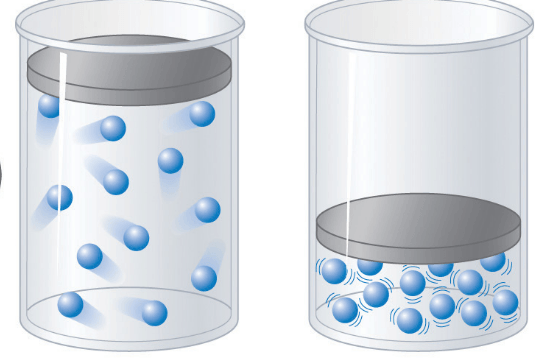
Which container will have a lower pressure exerted by gas particles?
left container
right container
they both have the same pressure
I don't know

Choose the correct statement
this is a graph representing Boyle's law
this is a graph representing Charles's law
A relationship between volume of gas with the number of mole of gas at constant Temperature and Pressure describes the gas law of
Boyle's
Charles
Avogadro's
In CHARLES' LAW, at constant pressure, what happens to temperature of a gas when the volume doubles?
The temperature also doubles.
The temperature decreases to half of its original volume.
The temperature doesn't change.
The temperature quadruples.
What does R stand for
Ideal gas constant
Real gas constant
Temperature constant
Ideal gas law
Which of the following is the correct gas constant (R) value that we used in ideal gas law equation?
8.314
0.08206
62.36
100 atm
Choose the INCORRECT statement.
Boyle 's Law states that the volume of the gas is directly proportional to its pressure
Kinetic theory of gases postulates that the volume of the gas particle is too small hence it can be ignored.
Larger value of a, in the van der Waals equation for a real gas, indicates a stronger attractive force between gas molecules.

