
Font size
 Worksheets
EKG Sinus Rhythm Review
Total questions: 83
Worksheet time: 46mins
What typically happens to the rhythm after a pause in sinus arrest?
Cardiac Arrest
Usurpation
Escape
Ventricular Fibrillation
What is the difference between sinus arrest and sinus block?
The rate
The width of the P waves
The number of pauses in the rhythm
The number of skipped P waves
A normal sinus rhythm may be characterized by which of the following characteristics?
P wave duration more than 110 milliseconds
P wave that is rounded and downright
P wave with an amplitude of less than 2.5 mm
A wide QRS Complex
A normal sinus rhythm may be characterized by which of the following characteristics?
P wave duration less than 110 milliseconds
P wave that is rounded and downright
P wave with an amplitude of more than 2.5 mm
A wide QRS Complex
A normal sinus rhythm may be characterized by which of the following characteristics?
P wave duration more than 110 milliseconds
P wave that is rounded and downright
P wave with an amplitude of more than 2.5 mm
A narrow QRS Complex
A normal sinus rhythm may be characterized by which of the following characteristics?
P wave that is rounded and upright
P wave that is rounded and downright
P wave with an amplitude of more than 2.5 mm
A wide QRS Complex
When should a medical professional be concerned with sinus arrest?
When it lasts less than 6 seconds
When it lasts more than 6 seconds
When it lasts more than 10 seconds
When it lasts less than 10 seconds
A patient with hyperthyroidism or exercising normally may experience
Sinus Bradycardia
Sinus Tachycardia
Sinus Dysrhythmia
Sinus Arrest
A patient with hypothyroidism or a sedentary lifestyle might have an EKG reading of
Sinus Bradycardia
Sinus Tachycardia
Sinus Dysrhythmia
Sinus Arrest
This is a slight irregularity in the EKG rhythm associated with normal breathing patterns?
Sinus Bradycardia
Sinus Tachycardia
Sinus Dysrhythmia
Sinus Arrest
This is a normal EKG rating but the heart rate is greater than 100 BPM?
Sinus Bradycardia
Sinus Tachycardia
Sinus Dysrhythmia
Sinus Arrest
This is a normal EKG rating but the heart rate is less than 60 BPM?
Sinus Bradycardia
Sinus Tachycardia
Sinus Dysrhythmia
Sinus Arrest
This is considered a break in the normal EKG pattern where the SA node failed to fire
Sinus Bradycardia
Sinus Tachycardia
Sinus Dysrhythmia
Sinus Arrest
Which of the following is a characteristic of the sinoatrial (SA) Node?
It can spontaneously generate an electrical impulse.
It has an intrinsic rate of 40 to 60/min.
It is located at the atrioventricular (AV) junction.
It allows time for the ventricles to fill.
Which of the following should an EKG technician evaluate first when determining EKG rhythm and regularity?
P-P interval
PR interval
QRS complex
QT interval
which of the following is the normal QRS interval
0.12-0.20 MM of voltage
0.12 -0.20 per second
0.16 -0.20 MM of voltage
0.06- 0.10 per second

Identify this rhythm
Supra-ventricular tachycardia
Atrial fibrillation
Sinus tachycardia
Atrial flutter

Identify this rhythm
Sinus bradycardia
1 degree heart block
Normal Sinus Rhythm
2nd Degree Type I heart block

Identify this rhythm
Sinus tachycardia
Normal Sinus Rhythm
Supraventricular Tachycardia
Atrial fibrillation
Identify this rhythm
Sinus bradycardia
1 degree heart block
Normal Sinus Rhythm
2nd Degree Type I heart block
Identify this rhythm
Sinus tachycardia
Normal Sinus Rhythm
Supraventricular Tachycardia
Atrial fibrillation
A sinus rhythm has a rate of
60-100
less than 60
101-180
Varies
Sinus Bradycardia has a rate of
60-100
less than 60
101-180
Varies
Sinus Tachycardia has rate of
60-100
less than 60
101-180
Varies
Sinus Arrhythmia has rate of
60-100
less time 60
101-180
Varies
Sinoatrial block has rate of
60-100
less than 60
101-180
Varies
Sinus Arrest has a rate of
60-100
less than 60
101-180
varies
A P-Wave must be ______ and precede each _____ (2)
Negative
Positive
PR interval
QRS complex
ST segment
The duration of the PR interval must fall in between what TWO numbers
0.12 seconds
0.10 seconds
0.20 seconds
0.25 seconds
0.11 seconds
The QRS duration must be ___ seconds or less
0.11
0.12
0.13
0.20
0.25
Which applies to Sinus Rhythm?
Regular rhythm
60 bpm to 100 bpm
Irregular rhythm
less than 60 bpm
101 bpm - 180 bpm

Name this rhythm...
Normal SInus Rhythm
Sinus Bradycardia
Sinus Tachycardia
Atrial Flutter

Name this rhythm...
Normal Sinus Rhythm
2nd degree heart block
Sinus Bradycardia

Name this rhythm...
Normal Sinus Rhythm
Sinus Tachycardia
Supraventricular Tachycardia
Normal PR Interval
Normal QRS Interval
P wave is upright and uniform.
There is one p wave before each QRS complex.
Rhythm is regular.
Rate is 72.
sinus rhythm
sinus tachycardia
sinus bradycardia
sinus arrhythmia
Normal PR Interval
Normal QRS Interval
P wave is upright and uniform.
There is one p wave before each QRS complex.
Rhythm is regular.
Rate is 122.
sinus rhythm
sinus tachycardia
sinus bradycardia
sinus arrhythmia
Normal PR Interval
Normal QRS Interval
P wave is upright and uniform.
There is one p wave before each QRS complex.
Rhythm is irregular.
Rate is 65.
sinus rhythm
sinus tachycardia
sinus bradycardia
sinus arrhythmia
Normal PR Interval
Normal QRS Interval
P wave is upright and uniform.
There is one p wave before each QRS complex.
Rhythm is regular.
Rate is 48.
sinus rhythm
sinus tachycardia
sinus bradycardia
sinus arrythmia
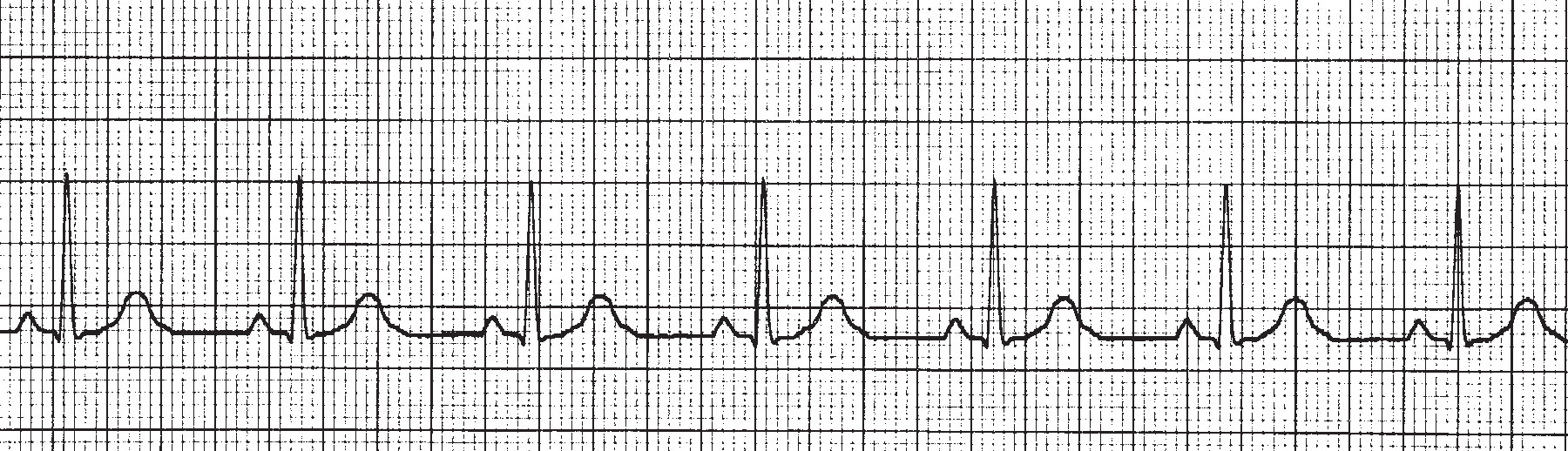
What is the hear rate of this ECG rhytm?
40
70
100
130

This ECG would be interpreted as
sinus rhythm
sinus tachycardia
sinus bradycardia
sinus arrhythmia

This rhythm would be interpreted as
sinus rhythm
sinus tachycardia
sinus bradycardia
sinus arrhythmia

This rhythm would be interpreted as
sinus rhythm
sinus tachycardia
sinus bradycardia
sinus arrhythmia
I am a rhythm with a rate of 104. I am irregular and my p waves are missing. Who am I?
sinus rhythm
sinus tachycardia
sinus bradycardia
sinus arrhythmia
none of the above
I am a rhythm with a rate of 94. I am irregular. My PR interval is normal. There is a QRS after each P wave. Who am I?
sinus rhythm
sinus tachycardia
sinus bradycardia
sinus arrhythmia
none of the above
I am a rhythm with a rate of 113. I am regular. My PR interval is 0.12 seconds. There is a QRS is 0.08 and there is a QRS complex after each P wave. Who am I?
sinus rhythm
sinus tachycardia
sinus bradycardia
sinus arrhythmia
none of the above
I am a rhythm with a rate of 53. I am regular. My PR interval is 0.14 seconds. There is a QRS is 0.10 seconds and there is a QRS complex after each P wave. Who am I?
sinus rhythm
sinus tachycardia
sinus bradycardia
sinus arrhythmia
none of the above
I am a rhythm with a rate of 73. I am regular. My PR interval is 0.18 seconds. There is a QRS is 0.10 seconds and there is a QRS complex after each P wave. Who am I?
sinus rhythm
sinus tachycardia
sinus bradycardia
sinus arrhythmia
none of the above

Identify the following rhythm.
Sinus tachycardia
Junctional
Atrial flutter
Supraventricular tachycardia

An ECG rhythm strip shows a ventricular rate of 46, a regular rhythm, a PR interval of 0.14 second, a QRS duration of 0.06, and one upright P wave before each QRS. This rhythm is:
Sinus rhythm
Sinus bradycardia
Sinus arrest
Sinoatrial block
An ECG rhythm strip shows a ventricular rate of 128, a regular rhythm, a PR interval of 0.16 second, a QRS duration of 0.08, and one upright P wave before each QRS. This rhythm is:
Sinus arrhythmia
Sinus bradycardia
Sinus rhythm
Sinus tachycardia

Sinus Rhythm
Sinus Brady
Junctional
WPW

what is this rhythm
Supraventricular Tachycardia
Atrial Flutter
Sinus Tachycardia
Sinus Rhythm

Identify the following rhythm
Normal sinus rhythm
Sinus bradycardia
Sinus tachycardia
Junctional
The key clinical question when determining steps to take for the patient with symptomatic bradycardia is:
Is the bradycardia reversible?
Does the patient respond to medications?
Are the symptoms caused by bradycardia or some other illness?
Is the patient a DNR?

Sinus bradycardia
Mobitz I
Mobitz II
3rd degree heart block

The following strip is a 6 second strip. What EKG rhythm is displayed here?
Atrial Fibrillation
Asystole
Normal Sinus Rhythm
Sinus Tachycardia

Identify the following cardiac rhythm strip
Sinus Bradycardia
Atrial Flutter
Asystole
Normal Sinus Rhythm

Identify the cardiac rhythm strip pictured above
Asystole
Premature ventricular contraction
Sinus Bradycardia
Sinus Tachycardia

Identify the cardiac rhythm strip pictured above
Ventricular Tachycardia
Normal Sinus Rhythm
Atrial Fibrillation
Sinus Tachycardia

Identify the cardiac rhythm strip pictured above
Ventricular fibrillation
Ventricular Tachycardia
Atrial Fibrillation
Sinus Tachycardia
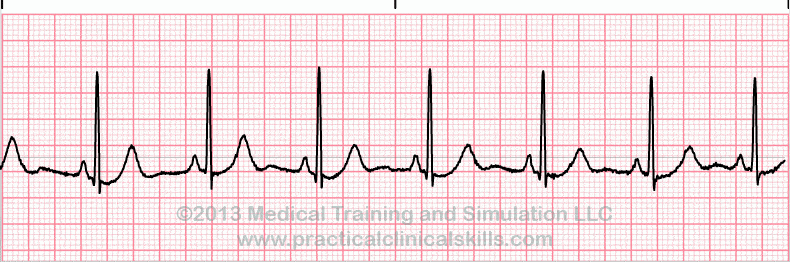
What is the ECG showing
Atrial Fibrillation
Ventricular Fibrillation
Normal Sinus Rhythm
Premature Ventricular Contraction
Heart Block


EKG Strip?
Sinus Arrest
Sinus Arrhythmia
Uni-focal pvcs
Multi focal pvcs

EKG Strip?
Sinus Arrest
Sinus Arrhythmia
Atrial Flutter
Atrial Fib.
If the sinus node losses control, what node will pick up?
AV node
Bundle of His
Purkinje Fibers
Sinus Arrhythmia rate changes with what?
respiration pattern
activity
rest
A client is admitted to the emergency department reporting chest pain and shortness of breath. The nurse notes an irregular rhythm on the bedside electrocardiograph monitor. The nurse counts 9 RR intervals on the client’s 6-second rhythm tracing. The nurse correctly identifies the client’s heart rate as...
100 bpm
90 bpm.
80 bpm
70 bpm.
The client has just been diagnosed with a arrhythmia. The client asks the nurse to explain normal sinus rhythm. What would the nurse explain is the characteristic of normal sinus rhythm?
Heart rate between 60 and 150 beats/minute.
Impulse travels to the atrioventricular (AV) node in 0.15 to 0.5 second.
The ventricles depolarize in 0.5 second or less.
The sinoatrial (SA) node initiates the impulse.
A nurse is caring for a client who's experiencing sinus bradycardia with a pulse rate of 40 beats/minute. The client's blood pressure is 80/50 mm Hg and the client reports dizziness. Which medication does the nurse anticipate administering to treat bradycardia?
Atropine
Dobutamine
Amiodarone
Lidocaine
The nurse documents that a client is having a normal sinus rhythm. What characteristics of this rhythm has the nurse assessed?
Heart rate between 60 and 150 beats per minute.
Impulse travels to the atrioventricular (AV) node in 0.15 to 0.5 seconds.
The ventricles depolarize in 0.5 seconds or less.
The sinoatrial (SA) node initiates the impulse.
The nurse analyzes a 6-second electrocardiogram (ECG) tracing. The P waves and QRS complexes are regular. The PR interval is 0.18 seconds long, and the QRS complexes are 0.08 seconds long. The heart rate is calculated at 70 bpm. The nurse correctly identifies this rhythm as
normal sinus rhythm.
sinus tachycardia.
junctional tachycardia.
first-degree atrioventricular block
A client is diagnosed with a dysrhythmia at a rate slower than 60 beats/minute with a regular interval between 0.12 and 0.20 seconds. What type of dysrhythmia does the client have?
sinus bradycardia
atrial bradycardia
heart block
none
none
After performing an ECG on an adult client, the nurse reports that the PR interval reflects normal sinus rhythm. What is the PR interval for a normal sinus rhythm?
0.05 and 0.1 seconds.
0.12 and 0.2 seconds.
0.15 and 0.3 seconds.
0.25 and 0.4 seconds.
The nurse reads an athletic client's electrocardiogram. What finding will be consistent with a sinus bradycardia?
PR interval of 0.24 seconds.
Heart rate of 42 beats per minute (bpm).
QR interval of 0.25 seconds.
P-to-QR ratio of 1:2.
P-to-QR ratio of 1:2.
With premature atrial complexes, what is coming early?
P wave
ORS complex
U wave
T wave
If our patient's heart rate is 75bpm, rhythm is regular, P-R interval is normal, QRS is normal, then our diagnosis is
Sinus tachycardia
Sinus dysrhythmia
normal sinus rhythm
Sinus arrest

Interpret this EKG strip
Sinus Rhythm, Hr.70
Sinus Rhythm, Hr.90
Sinus Bradycardia, Hr.50
Sinus Tachycardia, Hr. 110

Interpret this Rhythm:
Normal sinus rhythm
Ventricular fibrillation
Sinus Brady with PAC's
Sinus Bradycardia
Identify the cardiac rhythm strip pictured above
Ventricular Tachycardia
Normal Sinus Rhythm
Atrial Fibrillation
Sinus Tachycardia
Medical condition where SA node ceases to generate the electrical impulses that normally stimulate the tissues for heart conduction.
Sinus Arrhythmia
1st Degree AV Block
Sinus Arrest
Sino-Atrial Block
Represents the delay or interruption, intermittent or permanent, of the electrical impulse from SA node to the atria.
1st Degree AV Block
Sinus Pause
Sino-Atrial Block
Sinus Arrest

