Worksheets
Protein Synthesis, Meiosis, and Mutations
Total questions: 39
Worksheet time: 1hrs 9mins
The mutated DNA segment is TTCGCAAG. This is an example of ___ mutation.
GAG-CTC-GAC-AGA
Mutant
GAG CTC-CAC-AGA

The bottom DNA sequence in the image has been altered by this type of mutation
substitution
insertion
deletion
translocation

chromosomal mutations cause a segment of the chromosome to repeat itself during replication.
inversion
duplication
translocation
deletion
What situation causes a translocation mutation?

Why must transcription occur in the nucleus?
because DNA can't leave the nucleus
because ribosomes are in the nucleus
because DNA polymerase is found there
because helicase unzips the DNA
What is a gamete?
Normal body cell
Mutated body cell
Sex cell
Copy of a chromosome
What is the process by which sex cells are formed?
Meiosis
Mitosis
Protein Synthesis
Transcription
How many times does the cell divide in Meiosis?
1
2
3
4
Are gametes haploid or diploid?
Haploid
Diploid
A biologist finds 4 chromosomes in a Fruit Fly's egg cell. How many chromosomes are in the Fruit Fly's body cells?
2
8
16
12
How many cells are formed after meiosis?
1
2
3
4
What is it called when homologous chromosomes or sister chromatids don't separate evenly during meiosis?
Nondisjunction
Separation anxiety
Separatist Disorder
That's normal. It's supposed to happen.

The diagram below represents a change that occurred in a pair of chromosomes during the formation of an egg cell. The alteration that occurred will most likely be passed on to every cell that develops from the egg cell. Why would this type of alteration result in offspring with combinations of traits that differ from those found in either parent?
It converts sex cells into body cells.
It results in the formation of diploid gametes.
. It results in new combinations of genes on each chromosome.
It changes the chromosome number of the body cells that develop from the egg cell.
The process of "crossing over" occurs in what phase of meiosis?
anaphase 1
prophase 1
prophase 2
telophase 2
In what process is mRNA synthesized?
Transcription
Translation
DNA Replication
Mitosis
Which organelle contains rRNA and reads the mRNA to synthesize a protein?
Ribosome
Nucleus
Cytoplasm
Nucleotide

What brings the amino acids to the ribosome to assemble a protein?
DNA

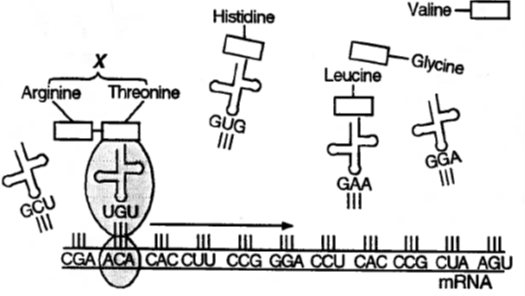
Which process does this diagram illustrate?
transcription
DNA replication
translation
What determines the shape and function of a protein?
The sequence of amino acids
The type of ribosome that assembles the protein
The cell that manufactures the protein
Which of the following is the complementary mRNA sequence to this DNA strand: AACTGAA
UUGACUU
TTGACTT
AACTGAA
AACUGAA
What is the correct order of the Central Dogma?
DNA-->RNA--> Proteins
DNA-->Proteins-->RNA
Protein--->DNA--->RNA
Protein Synthesis--> Transcription-->Translation
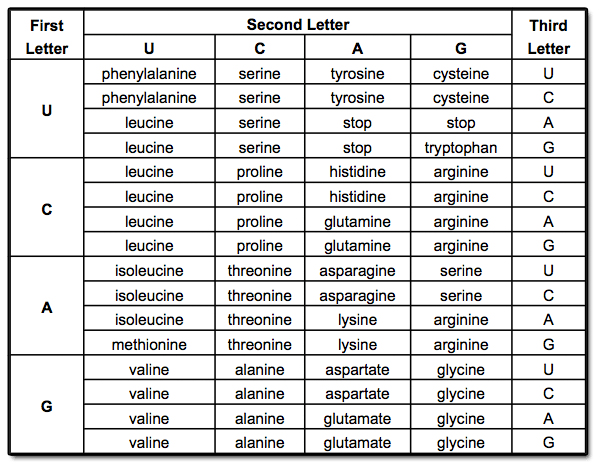

Starts with 1 strand of DNA and creates 1 strand mRNA.
replication
transcription
translation
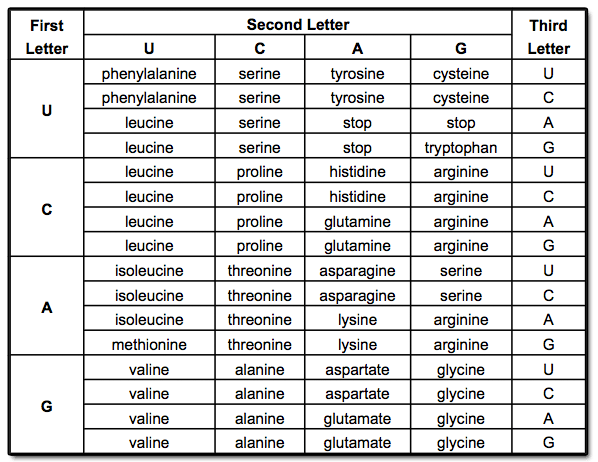

Where does translation happen?
Inside the Nucleus
Outside the Nucleus in the Cytoplasm
Are all genes "turned on" in all cells?
yes
no

Even though this process occurs in every cell in our body, not every cell synthesizes the same proteins. Which of the following best explains why different cells produce different types of proteins?
Cells express different genes that code for specific proteins.
Cells are unable to regulate the types of proteins produced from translation.
Errors often occur during transcription that creates variations in the produced proteins
Cells can only use available amino acids to assemble proteins and in some cells these may be limited.
Which of the following best explains why a cell in the human stomach lining only manufactures a certain type of protein?
The cell contains the entire human DNA sequence.
The cell has limited access to amino acids in the region it is located.
Even though the cell contains all of a human's genes, it only expresses some and these code for a specific protein.
Acids in the stomach have mutated in the cell's DNA, causing it to only make one type of protein.
DNA is controlled and only certain genes in the DNA are "turned on" in specific cells. This regulated process is known as-
Gene expression
Mutation
Differenatiation
The cell cycle
How would differentiation be affected if gene expression were not regulated?
Differentiation would still occur as a result of response to environmental factors.
All traits of an organism would be present in all cells.
An organism would have cells that produce all necessary proteins for survival.
An organism would lack the specialized cells it needs to survive
New DNA: CAT AT
What mutation occurred?