wayground logo

Free Printable Worksheets

Font size

S
M
L
XL
Worksheets

Biology

Total questions: 121

Worksheet time: 1hrs 20mins
Name
Class
Date
1.
The leaf has a shiny, waxy cuticle around it to
a)
increase the rate of photosynthesis
b)
attract more light
c)
control water loss
d)
stop carbon dioxide and oxygen gases escaping
2.
Most of the chloroplast cells are found in the
a)
upper epidermis
b)
pallisade mesophyll layer
c)
lower epidermis
d)
stomata
3.
The water needed for photosynthesis comes into the leaves through the
a)
upper epidermis
b)
stomata
c)
guard cells
d)
xylem cells
4.
The important gases, carbon dioxide and oxygen, enter and leave the leaf through the
a)
upper epidermis
b)
phloem
c)
stomata
d)
guard cells
5.
The reactants needed for photosynthesis to occur are:
a)
carbon dioxide & water
b)
carbon dioxide & oxygen
c)
oxygen & water
d)
carbon dioxide, oxygen & water
6.
The role of the guard cell is to
a)
help control the temperature of the plant
b)
control how much water enters the leaf
c)
control how much glucose is stored
d)
control the movement of water vapour & gases 
7.
Plants need to take in oxygen gas for respiration
a)
only at night 
b)
only during the day
c)
both during the day & the night
8.
Transpiration helps the plant
a)
make more sugars at night
b)
move water from the roots to the stem and leaves
c)
move sugars from the leaf to be stored in the stem & roots
d)
make more chloroplasts
9.
Water & soluble nutrients move through the plant in 
a)
the phloem cells
b)
the xylem cells
c)
the root hair cells
d)
palisade mesophyll layer
10.
Sugar and the products of photosynthesis move through the plant in 
a)
the phloem cells
b)
the xylem cells
c)
the root hair cells
d)
palisade mesophyll layer
11.
The leaf has a shiny, waxy cuticle around it to
a)
increase the rate of photosynthesis
b)
attract more light
c)
control water loss
d)
stop carbon dioxide and oxygen gases escaping
12.
Most of the chloroplast cells are found in the
a)
upper epidermis
b)
pallisade mesophyll layer
c)
lower epidermis
d)
stomata
13.
The water needed for photosynthesis comes into the leaves through the
a)
upper epidermis
b)
stomata
c)
guard cells
d)
xylem cells
14.
The important gases, carbon dioxide and oxygen, enter and leave the leaf through the
a)
upper epidermis
b)
phloem
c)
stomata
d)
guard cells
15.
The reactants needed for photosynthesis to occur are:
a)
carbon dioxide & water
b)
carbon dioxide & oxygen
c)
oxygen & water
d)
carbon dioxide, oxygen & water
16.
The role of the guard cell is to
a)
help control the temperature of the plant
b)
control how much water enters the leaf
c)
control how much glucose is stored
d)
control the movement of water vapour & gases 
17.
Plants need to take in oxygen gas for respiration
a)
only at night 
b)
only during the day
c)
both during the day & the night
18.
Transpiration helps the plant
a)
make more sugars at night
b)
move water from the roots to the stem and leaves
c)
move sugars from the leaf to be stored in the stem & roots
d)
make more chloroplasts
19.
Water & soluble nutrients move through the plant in 
a)
the phloem cells
b)
the xylem cells
c)
the root hair cells
d)
palisade mesophyll layer
20.
Sugar and the products of photosynthesis move through the plant in 
a)
the phloem cells
b)
the xylem cells
c)
the root hair cells
d)
palisade mesophyll layer
21.

Where does Photosynthesis take place in a plant cell?

a)

Nucleus

b)

Chloroplast

c)

cytoplasm

d)

mitochondria

22.

What are the two products of photosynthesis?

a)

oxygen and carbon dioxide

b)

sunlight and carbon dioxide

c)

suagr and oxygen

d)

water and oxygen

23.

Pigment in green plants that capture the energy in sunlight is called __________

a)

Greenplasts

b)

chlorophyll

c)

stomata

d)

chloroplasts

24.

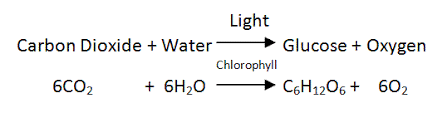
Which of the following is the correct equation for photosynthesis?

a)

CO2 + light + H2O ---> O2 + Sugar

b)

CO2 + sugar + water --> O2 + light

c)

O2 + light + water ---> sugar + CO2

d)

CO2 + O2 + light ---> sugar + water

25.

The following are the raw materials needed for photosynthesis: Sunlight, Carbon dioxide and water

a)

False

b)

True

26.

Identify this molecule

a)

Oxygen

b)

carbon dioxide

c)

water

d)

glucose

27.

What is the purpose of Photosynthesis?

a)

to release energy

b)

for growth

c)

to create glucose

d)

to get oxygen for respiration

28.

Which of these are limiting factors for Photosynthesis?Choose three..

a)

Carbon dioxide concentration

b)

light intensity

c)

Water

d)

temperature

29.

Plants or plant like organisms that make their own food using energy from the sunlight -

a)

Heterotrophs

b)

autotrophs

c)

saprophytes

d)

chemotrophs

30.

Plant leaves appear green due to the presence of

a)

xanthophyll

b)

carotene

c)

chlorophyll

d)

pigmentation

31.
What is diffusion?
a)
when molecules move 
b)
when molecules move from a high concentration to a low.
c)
no movement 
d)
molecules move everywhere
32.
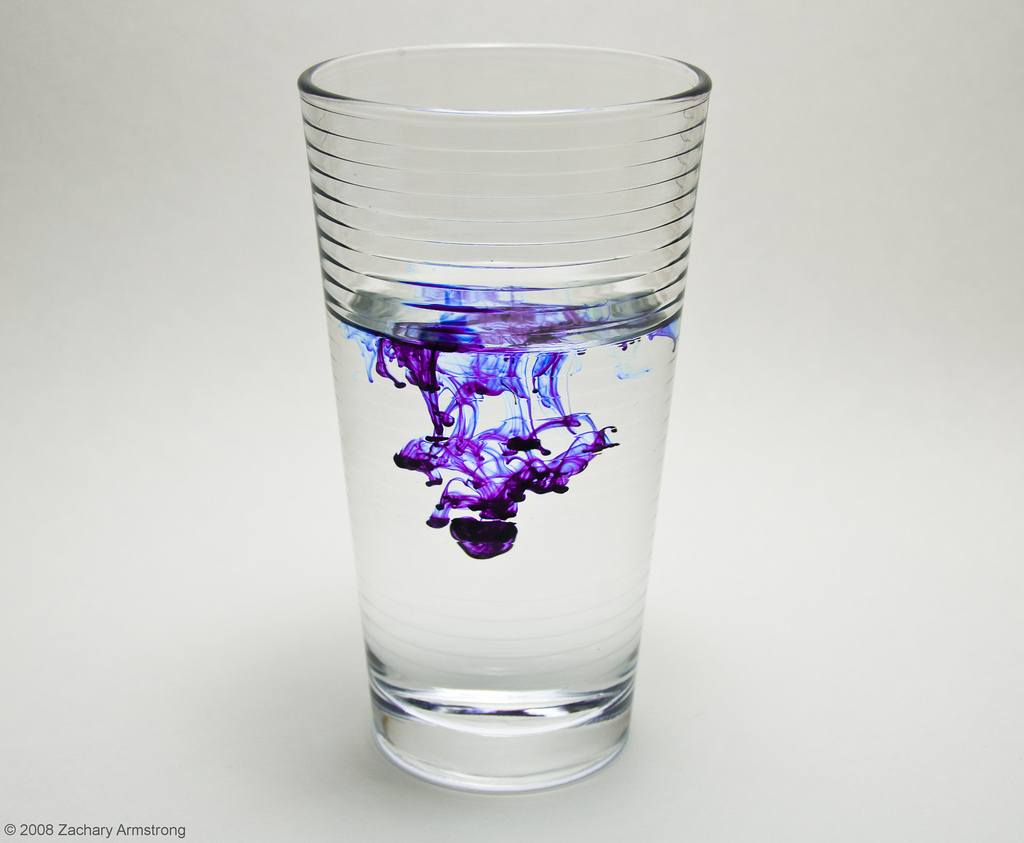
Where is there a low concentration of dye?
a)
at the bottom of cup
b)
in the color
c)
at the top of cup 
d)
no concenteraion gradient
33.
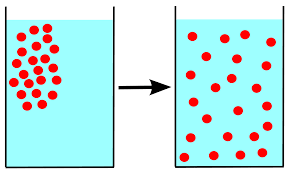
The picture below is an example of _________________.
a)
osmosis
b)
isotonic
c)
diffusion
d)
active transport
34.
Osmosis is the movement of _____ across a membrane.
a)
food
b)
energy
c)
oxygen
d)
water
35.
During osmosis
a)
water moves from high to low concentration
b)
large or oddly shaped molecules move across a cell membrane
c)
water moves when energy is used
d)
proteins are built
36.
Permeable means
a)
things can pass through
b)
the concentration levels are different
c)
it is permanent
d)
things are stuck
37.
The diffusion of water through a semi-permeable membrane is called?
a)
Osmosis
b)
Cell wall
c)
Diffusion
d)
Respiration
38.
Where is there a high concentration of water?
a)
in the flower
b)
cannot be determined by picture.
c)
in the vase
d)
in the leaves
39.
Where is there a low concentration of perfume?
a)
in the bottle
b)
on the hand
c)
in the room
d)
in the top
40.
What is the definition of  Selective Permeability?
a)
The movement of materials across the cell membrane that requires NO ENERGY from the cell.
b)
The movement of materials through (or across) the cell membrane
c)
The ability of the cell membrane to allow some things to pass through while preventing other things from passing through.
d)
The movement of molecules from an area of high concentration to a area of low concentration 
41.
What a cell needs to transport particles by active transport?
a)
Sun
b)
Wind
c)
Energy
d)
Channels
42.
When both inside and outside of a cell have the same amount of water it is said that the cell has reached a state of
a)
Osmosis
b)
Diffusion
c)
Equilibrium
43.
A person would never have pure water put into their veins in a hospital because their cells would...
a)
Shrink/Dehydrate
b)
Expand
44.
A person should never drink salty water because their cells would
a)
shrink
b)
expand
45.
If there is 5 percent water inside a cell and 5 percent water outside a cell
a)
more water will move inside the cell
b)
more water will move outside the cell
c)
There will be no movement of water cells
46.
Passive transport requires no
a)
concentration gradients
b)
osmosis
c)
motion
d)
energy
47.
The movement of molecules against a concentration gradient
a)
simple diffusion
b)
facilitated diffusion
c)
active transport
d)
osmosis
48.
The picture is an example of...
a)
active tranport
b)
passive transport
c)
diffusion
d)
osmosis
49.
Sometimes, energy is required for ____ molecules to go in or out of the cell because they cannot fit into the membrane.
a)
big
b)
small
c)
crunchy
d)
water
50.

Most transpiration in herbaceous plant occurs through:

a)

Stomata

b)

Lenthicels

c)

Cuticle

d)

Hydathodes

51.

On a dry, Sunny day, how does water vapour move through the stomata of a leaf?

a)

Into the leaf by diffusion

b)

Into the leaf by respiration

c)

Out of the leaf by diffusion

d)

Out of the leaf by respiration

52.

Transpiration is highest during:

a)

Rainy season

b)

Winter

c)

Summer

d)

Autumn

53.

Transpiration is the evaporative loss of water from .............................. .

a)

Roots

b)

Leaves

c)

Stem

d)

Both Leaves and Stem

54.

............................... is used as an indicator for a demonstration of transpiration

a)

Litmus paper

b)

Cobalt Chloride paper

c)

Both Litmus Paper and Cobalt Chloride paper

d)

None of the above

55.

....................... are minute opening in the epidermal layer af leaves

a)

Lenticles

b)

Cuticle

c)

Stomata

d)

Stroma

56.

The tissue that conducts the water.

a)

Pholem

b)

Xylem

c)

Companion cells

d)

Transfusion tissues

57.

Transpiration

a)

It is the losss of water as water vapour from the aerial parts/stems and leaves of the plants

b)

The process of removal of water as water droplets from the aerial parts/leaf/stomata of a plant.

c)

Exudation of sap from injured parts of a plant.

d)

The loss of water in the from of water vapour from the surface of the leaf only.

58.

Lenticels

a)

They are present on the surface of leaves and stem.

b)

They are present ont he surface of newly formed woody stem

c)

They are present on the surface of older leaves and old woody stem

d)

They are present on the surface of hard, old woody stemS

59.

Water transported from stems to leaves through what?

a)

xylem

b)

phloem

c)

stems

d)

roots

60.

Select all of the environmental factors that would increase transpiration.

a)

Increased humidity

b)

Increased wind speed

c)

Increased temperature

d)

Decreased surface area

61.

Kidney shaped cells at the border of the stomata

a)

Lenticels

b)

Cuticle

c)

Guard cells

d)

Hydathodes

62.

Adaptation to reduce transpiration

a)

Broader leaves

b)

absence of cuticle

c)

More stomata

d)

Narrow leaves

63.

If plants don't store up water, how does water leave the plant?

a)

The roots get rid of excess water.

b)

Most plants DO store water.

c)

It is released from the leaves by TRANSPIRATION.

64.

Remember when you put the celery in the water? What happened to the water level by the next day?

a)

The level dropped A LOT, because the celery sucked it up.

b)

The level stayed the same, because the celery was dead.

c)

The level dropped a little, because of evaporation.

65.

Water molecules pull each other up the xylem due to ______________.

a)

capillary action

b)

root pressure

c)

osmosis

d)

active transport

66.

Which statement correctly identifies the substance and direction it is transported in the xylem?

a)

Water, only upwards

b)

Glucose, only upwards

c)

Water, up and down the plant

d)

Glucose, up and down the plant

67.

To which food group does sugar belong?

a)

Carbohydrate

b)

Fats

c)

Protein

d)

Vitamins

68.

Which nutrient is made from amino acids?

a)

Carbohydrate

b)

Fats

c)

Protein

d)

Vitamins

69.

Protein is use to

a)

Strong bones and teeth

b)

Building tissues and organs

c)

Helps food pass along the intestines

d)

Quickly released energy store

70.

To which food group does calcium belong?

a)

Carbohydrate

b)

Minerals

c)

Fiber

d)

Protein

71.

They are belong to minerals, except

a)

Zinc

b)

Starch

c)

Calcium

d)

Iron

72.

Nina eats vegetables, cereals, meat, and eggs but decides to replace meat and egg with pulses in her diet. What nutrient does her diet now lack?

a)

Fats

b)

Protein

c)

Fiber

d)

Minerals

73.

Nina eats vegetables, cereals, meat, and eggs but decides to replace meat and eggs with pulses in her diet. What must she add to her new diet to make sure she is getting all the nutrients her body need?

a)

Fish

b)

Beans

c)

Milk

d)

Salad

74.
What is E?
a)
pancreas
b)
gall bladder
c)
liver
d)
large intestine
75.

The process by which nutrient molecules pass through the wall of your digestive system into your blood.

a)

absorption

b)

digestion

c)

peristalsis

d)

villi

76.

waves of muscular contractions that move food through the digestive tract.

a)

digestion

b)

absorption

c)

peristalsis

d)

villi

77.

Where does the digestion of proteins take place?

a)

Mouth and stomach

b)

Stomach and small intestine

c)

Mouth and small intestine

d)

Mouth, stomach and small intestine

78.

Where does the digestion of lipids take place?

a)

Stomach

b)

Stomach and small intestine

c)

Small intestine

d)

Mouth, stomach and small intestine

e)

Mouth and small intestine

79.

Tick the correct functions of lipids

a)

Source of energy

b)

Insulation

c)

Growth

d)

Protection of organs

80.

What is the function of maltase?

a)

Breaks down glucose into maltose

b)

Breaks down maltose into glycerol

c)

Breaks down maltose into glucose

d)

Breaks down glycerol into maltose

81.

The study of eating right to stay healthy is called:

a)

diet

b)

nutrition

c)

food survey

82.

Fruits, vegetables, grains, potatoes, and pasta are all sources of:

a)

fat

b)

protein

c)

carbohydrate

d)

mineral

83.

Butter, ice cream, and red meat are sources of unhealthy _____.

a)

fat

b)

protein

c)

carbohyrates

d)

minerals

84.

One gram of fat has ____ calories.

a)

1

b)

3

c)

4

d)

9

85.

___________ are nutrients found in many plant and animal foods that the body needs to function.

a)

fats

b)

vitamins

c)

carbohydrates

86.

You need to drink at least 8 glasses of this each day:

a)

soda

b)

apple juice

c)

water

d)

pickle juice

87.

Which nutrient has the most calories per 1 gram?

a)

protein

b)

fat

c)

vitamins

d)

water

88.

What type of edible nutrient is made through the process of photosynthesis?

a)

fats

b)

protein

c)

carbohydrates

d)

water

89.

Our hair, skin, muscles, and organs are made out of this nutrient.

a)

fats

b)

carbohydrates

c)

protein

d)

vitamins

90.

How many calories are in 2 grams of lipids (fats)?

a)

2

b)

18

c)

9

d)

8

91.

How many calories in 3 grams of carbohydrates?

a)

2

b)

4

c)

8

d)

12

92.

How many calories in 2 grams of protein plus 1 gram of fat?

a)

12

b)

15

c)

17

d)

29

93.

1. Vascular bundles are made up of specialized cells called

a)

xylem

b)

phloem

c)

xylem and phloem

94.

Xylem cells form

a)

sieve tube

b)

sieve plates

c)

vessel

95.

Phloem cells form

a)

vessels

b)

tube

c)

sieve tubes

96.

4. The cylinder pattern helps the stem to resist the sideways bending forces caused by the wind

a)

True

b)

False

97.

The tissue between the vascular bundles and the epidermis is called the

a)

pith

b)

vessels

c)

cortex

d)

tubes

98.

The central tissue of the stem is called the ______

a)

pith

b)

cortex

c)

vascular bundles

99.

Which of the following is NOT a function of the roots?

a)

Store carbs

b)

Absorb water and minerals

c)

Anchor plant to the ground

d)

Photosynthesis

100.

Where in the plant does photosynthesis occur?

a)

Flower

b)

Leaves

c)

Stem

d)

Roots

101.

Where does gas exchange occur within the plant?

a)

Flower

b)

Leaf

c)

Stem

d)

Roots

102.

Which of the following is NOT a part of the plant's SHOOT system?

a)

Flower

b)

Leaf

c)

Stem

d)

Root

103.

Which structure of a plant is responsible for anchoring it to the ground?

a)

Flower

b)

Leaf

c)

Stem

d)

Roots

104.

An organism who can make their own food from the sun is known as a-

a)

Heterotroph

b)

Eukaryote

c)

Autotroph

d)

Prokaryote

105.
What is the outer most layer of root ? 
a)
epidermis
b)
cortex
c)
periyicle
d)
xylem
106.
Function of cortex
a)
store food
b)
support
c)
watertransport
d)
region of branch root
107.

Identify the C part. What is it?

a)

cortex

b)

endodermis

c)

epidermis

d)

phloem

108.

What is the name of the part of the root that allows water and minerals enter?

a)

root hairs

b)

epidermis

c)

phloem

d)

phyla

109.

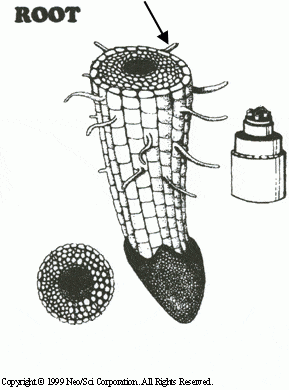
See a picture below. What is type of root?

a)

Primary root

b)

Secondary root

c)

Taproot

d)

Fibrous root

110.
Which is NOT a characteristic of plants?
a)
Autotroph
b)
Eukaryotic Cell
c)
Unicellular
d)
Cell walls
111.
Small openings called ______ are found on the underside of leaves and allow gases to enter or leave the plant cells.
a)
Phloem
b)
Chloroplasts
c)
Xylem
d)
Stomata
112.
The process of photosynthesis takes place in organelles (part of cell) called ______.
a)
Phloem
b)
Xylem
c)
Stomata
d)
Cholorplasts
113.
What is the outer most layer of root ? 
a)
epidermis
b)
cortex
c)
periyicle
d)
xylem
114.
Function of cortex
a)
store food
b)
support
c)
watertransport
d)
region of branch root
115.
what is this?
a)
Monocot Root  -X- Section 
b)
Dicot Root  -X- Section 
c)
Monocot stem  -X- Section 
d)
Dicot stem  -X- Section 
116.
What is the outer most layer of root ? 
a)
epidermis
b)
cortex
c)
periyicle
d)
xylem
117.
Function of cortex
a)
store food
b)
support
c)
watertransport
d)
region of branch root
118.
what is this?
a)
Monocot Root  -X- Section 
b)
Dicot Root  -X- Section 
c)
Monocot stem  -X- Section 
d)
Dicot stem  -X- Section 
119.

What is the term for the movement of food in the phloem called?

a)

translocation

b)

transpiration stream

c)

evaporation

d)

respiration

120.

Which of the following is the best description of phloem?

a)

A single, long hollow tube

b)

A series of individually moving systems, like blood vessels

c)

A series of tissue-filled cells connected by sieves

d)

Tissue that carries water and dissolved sugar

121.

How does water help move materials through the phloem?

a)

It enters and causes pressure to build, moving the materials.

b)

It dissolves the sugars, making them small enough to enter the phloem.

c)

When it rains, the force of the water moves the materials.

d)

Water is not a significant factor in material movement in plants.