
NEW
Font size
 Worksheets
Algebra 1: Topic 3 (Linear Functions)
Total questions: 32
Worksheet time: 32mins
1. Let 𝐹 be a set of ordered pairs such that {(−3,5),(3,0),(2,2)}. Which of the following statements about the relation is true?
The relation is a function because no value in the domain goes to multiple values in the range.
The relation is a function because all values in the range are different.
The relation is not a function because one value in the domain goes to multiple values in the range.
The relation is not a function because there is an ordered pair where the domain is equal to the range.

Which choice also represents the relation shown in the sets below as correct ordered pairs?
{(1,2),(2,4)}
{(2,1),(4,2),(6,2)}
{(1,2),(2,4),(2,6)}
{(2,2),(2,4),(2,6)}

Is the relation above a function?
Yes, because it doesn’t show any repeating 𝑥 values in the domain.
Yes, because every 𝑦 value in the range is different.
No, because one 𝑥 value in the domain goes to multiple different 𝑦 values in the range.
No, because there is an 𝑥 value in the domain that is equal to a 𝑦 value in the range.
If 𝑓(𝑥)=2𝑥+4, which of the following domain values would cause 𝑓(𝑥)=10?
x = 10
x = 3
x = 6
x =5
Let 𝑓(𝑥)=𝑥−7. Find the value of 𝑓(2).
5
-7
7
-5

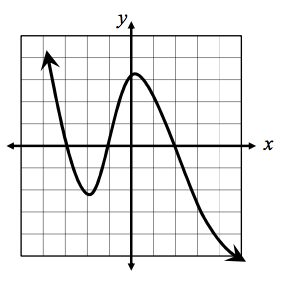


The relation in the graph is..
a function but not a one-to-one function.
a one-to-one function.
not a function
Which of the following relations is a one-to-one function?
{(1,2), (1,4), (1,5), (1,6)}
{(4,-5), (3,-5), (2,8), (1,8)}
{(-3,-2), (3,4), (-1,-2), (-1,5)}
{(10,9), (8,7), (6,5), (4,3)}

The domain of the relation is:
{0, 4, 7, 10, 11, 13, 17, 20}
{4, 7, 10, 11, 13, 17, 20}
{7, 10, 13}
{4, 11, 17, 20}
The range of the relation is:
{0, 4, 7, 10, 11, 13, 17, 20}
{4, 7, 10, 11, 13, 17, 20}
{7, 10, 13}
{4, 11, 17, 20}

f(x) = 2x – 4
f(x) = -3x – 4
f(x) = 3x – 4
f(x) = 4x +2

On Saturdays, Eve earns $14 per hour for yard work and an extra amount for dog walking. Look at the table. Choose the linear function f Eve can use to determine her pay.
f(x) = x + 14
f(x) = 12x + 16
f(x) = 12x + 14
f(x) = 14x + 12
On Saturdays, Eve earns $14 per hour for yard work and an extra amount for dog walking. Assume Eve does yard work from 8:30 A.M. to 2:00 P.M. and then walks the dog.
Using the function f(x) = 14x + 12, how much does she earn?
$66
$77
$89
$109

What does the y-intercept of the line represent?
total time spent running
average time to run one lap
average time spent running to the school track
average number of laps run

Name the parent function.
linear
quadratic
absolute value
constant
Describe the transformation
f(x) = x+3
3 Units Up
3 Units Down
3 Units Left
3 Units Right
Describe the transformation
f(x) = x−6
6 Units Up
6 Units Down
6 Units Left
6 Units Right
Describe the transformations
g(x) = (x+4)−6
4 Units Left
6 Units Up
4 Units Left
6 Units Down
4 Units Right
6 Units Up
4 Units Right
6 Units Down
Describe the transformation
3h(x)
Vertically Stretched by a factor of 3
Vertically Compressed by a factor of 3
Horizontally Stretched by a factor of 3
Horizontally Stretched by a factor of 3
Describe the transformation
h(31x)
Vertically Stretched by a factor of 31
Vertically Compressed by a factor of 31
Horizontally Stretched by a factor of 31
Horizontally Stretched by a factor of 31

The linear parent function, f(x) = x, is transformed to g(x) = f(x) - 6. Describe the transformation.
g(x) is shifted up 6 units
g(x) is shifted down 6 units
g(x) is shifted left 6 units
g(x) is shifted right 6 units

Describe the transformation from the parent function.
Flatter/Vertical compress
Steeper/Vertical stretch
Shift up 2 units
Shift down 2 units
The linear parent function, f(x) = x, is transformed to g(x) = f(x + 3). Describe the transformation.
g(x) is shifted up 3 units
g(x) is shifted down 3 units
g(x) is shifted left 3 units
g(x) is shifted right 3 units
The linear parent function, f(x) = x, is transformed to g(x) = f(x - 6). Describe the transformation.
g(x) is shifted up 6 units
g(x) is shifted down 6 units
g(x) is shifted left 6 units
g(x) is shifted right 6 units
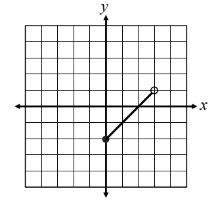
What is the RANGE?
0 ≤ x < 3
0 < y ≤ 3
-2 ≤ y < 1
-2 ≤ y ≤ 1


What is the DOMAIN of this graph?
-4 ≤ x ≤ 3
-1 ≤ x ≤ 4
4 < x < 3
-1 < x < 4

