
 Worksheets
Mixed Review 20221107
Total questions: 169
Worksheet time: 8hrs 27mins
Evaluate 2x−1 when x=−2
(a)
Evaluate −3n+11 when n=3
(a)
Evaluate 1+5m when m=−9
(a)
Evaluate 8−6c when c=−2
(a)
Evaluate 2(x−5)+9 when x=−1
(a)
Evaluate −4(−x−2)+7 when x=3
(a)
Evaluate 3x−5 when x=−2
(a)
Evaluate −2n+10 when n=3
(a)
Evaluate 10+7m when m=−9
(a)
Evaluate 9−4c when c=−2
(a)
Evaluate 3(x−9)+1 when x=−1
(a)
Evaluate −6(−x−1)+5 when x=3
(a)
Evaluate (−x−2)2+5 when x=3
(a)
Evaluate 6−(x+1)2 when x=−7
(a)
Evaluate x2+x−3 when x=3
(a)
Evaluate x2+x−3 when x=−3
(a)

The graph of a linear function is shown on the grid. Which function is best represented by this graph?
y=32x−3
y=23x−4
y=−3x+4
y=−3x+32
In math vocabulary, the word value means...
a number
an item that is on sale
a price
none of these
In math vocabulary, the word evaluate means...
Get a number as your final answer.
Get a variable as your final answer.
When a boss gives an employee their feedback for the past year.
None of these.
In math vocabulary, the word substitute means...
To replace a variable with its number value
When the teacher is absent.
Something you shouldn't accept.
Doing nothing.
In math class, the word variable refers to:
a term that contains a letter
a term that contains no letters
a negative integer
a positive integer
In math class, the word constant refers to:
a term that contains a letter
a term that contains no letters
a negative integer
a positive integer
In math class, the word distribute refers to:
multiplication and division
addition and subtraction
the lastest edition of a book
none of these
In math class, the word combining refers to:
multiplication and division
addition and subtraction
the lastest edition of a book
none of these
What is the coefficient of
x
an implied 1
0
x
none of these
What is another way to say, "Distribute and Combine Like Terms?"
simplify
solve
exemplify
illustrate
What is the difference between an expression and an equation?
(Answer with a complete sentence.)
Distribute and Combine Like Terms:
−2(5x−9)+7
(a)
Distribute and Combine Like Terms:
−8(7x−10)+1
(a)
Distribute and Combine Like Terms:
3+2(x−7)
(a)
Distribute and Combine Like Terms:
3−(5x+10)
(a)
Distribute and Combine Like Terms:
−5x+10(3x−4)
(a)
Distribute and Combine Like Terms:
x−(2x+8)
(a)
Distribute and Combine Like Terms:
3x+x(x−4)
(a)
Distribute and Combine Like Terms:
2x(−4+5x)−3x
(a)
Distribute and Combine:
−2(a−3)+3(a−9)
(a)
Distribute and Combine:
−5(n−1)+7(n+9)
(a)
Distribute and Combine:
5n(n−1)+4(n+3)
5n2−n+12
5n2+n−12
6n2+12
4n+12
Distribute and Combine Like Terms:
−4(3x−7)+12
(a)
Distribute and Combine Like Terms:
−2(9x−3)+1
(a)
Distribute and Combine Like Terms:
6+2(4x−5)
(a)
Distribute and Combine Like Terms:
5−6(7x−9)
(a)
Distribute and Combine Like Terms:
5x−2(3x−4)
(a)
Distribute and Combine Like Terms:
−x−(x+1)
(a)
Distribute and Combine Like Terms:
2+3(x−5)+2x
(a)
Distribute and Combine Like Terms:
6−2(b−4)+5b
(a)
Distribute and Combine Like Terms:
1−(n−2)+10n
(a)
Distribute and Combine Like Terms:
4c−(3c−8)+10
(a)
Distribute and Combine Like Terms:
−3(x−7)+4
(a)
Distribute and Combine Like Terms:
2+3(x−8)
(a)
Distribute and Combine Like Terms:
b−(4b+9)
(a)
Distribute and Combine Like Terms:
7+5(p−1)+8p
(a)
Distribute and Combine:
−4(n−3)+6(n+2)
(a)
Distribute and Combine:
−(m−1)+(m+2)
(a)
Distribute and Combine:
−2(2w−7)+6(w+1)
(a)
Explain how to Distribute and Combine Like Terms in the following expression:
−2(5x−9)+7
(For this expression, I would distribute and combine like terms. First, I would... Second, ... The outcome would be...)


Identify the x-intercept of the graph.
(-4, 0)
(0, -2)
(0, -4)
(-2, 0

Identify the y-intercept of the graph.
(0, 3)
(-1, 0)
(0, -1)
(3, 0)

Identify the graph with a x-intercept of 3 and a y-intercept of - 1


Identify the graph with a x-intercept of -2 and y-intercept of 2


(8,10), (3, -4), (0, 8), (4, -3), (9, 0)


Given the list of ordered pairs, what is the y-intercept?
(8,10), (3, -4), (0, 8), (4, -3), (9, 0)
(8,10)
10, -4, 8, -3, 0
(0,8)
(9,0)
Which of the following graphs has a negative slope?


Which of the following graphs has a positive slope?

A linear function is represented on the graph shown. What is the slope of the function?
m = 1
m = -1
m = 3
m = -3
A linear function is represented on the graph shown. What is the behavior of the function?
The function is increasing from left to right.
The function is decreasing from left to right.

A linear function is represented on the graph shown. What is the slope of the function?
m = 1
m = -1
m = 2
none of these

A linear function is represented on the graph shown. What is the behavior of the function?
The function is increasing from left to right.
The function is decreasing from left to right.
A linear function is represented on the graph shown. What type of slope does the function display?
The function has a positive slope.
The function has a negative slope.

A linear function is represented on the graph shown. What type of slope does the function display?
The function has a positive slope.
The function has a negative slope.

A linear function is represented on the graph shown. What is the slope of the function?
(a)

A linear function is represented on the graph shown. What is the behavior of the function?
The function is increasing from left to right.
The function is decreasing from left to right.

A linear function is represented on the graph shown. What type of slope does the function display?
The function has a positive slope.
The function has a negative slope.

A linear function is represented on the graph shown. What is the slope of the function?
(a)

A linear function is represented on the graph shown. What is the behavior of the function?
The function is increasing from left to right.
The function is decreasing from left to right.

A linear function is represented on the graph shown. What type of slope does the function display?
The function has a positive slope.
The function has a negative slope.

A linear function is represented on the graph shown. What is the slope of the function?
(a)

A linear function is represented on the graph shown. What is the behavior of the function?
The function is increasing from left to right.
The function is decreasing from left to right.

A linear function is represented on the graph shown. What type of slope does the function display?
The function has a positive slope.
The function has a negative slope.

A linear function is represented on the graph shown. What is the slope of the function?
(a)

A linear function is represented on the graph shown. What is the behavior of the function?
The function is increasing from left to right.
The function is decreasing from left to right.

A linear function is represented on the graph shown. What type of slope does the function display?
The function has a positive slope.
The function has a negative slope.

A linear function is represented on the graph shown. What is the slope of the function?
(a)

A linear function is represented on the graph shown. What is the behavior of the function?
The function is increasing from left to right.
The function is decreasing from left to right.

A linear function is represented on the graph shown. What type of slope does the function display?
The function has a positive slope.
The function has a negative slope.

A linear function is represented on the graph shown. What is the slope of the function?
(a)

A linear function is represented on the graph shown. What is the behavior of the function?
The function is increasing from left to right.
The function is decreasing from left to right.

A linear function is represented on the graph shown. What type of slope does the function display?
The function has a positive slope.
The function has a negative slope.
Which letter represents the slope?
m
b
y
x
Which letter represents the y-intercept?
m
b
y
x
Which letter represents the input?
m
b
y
x
Which letter represents the output?
m
b
y
x
What is the slope?
y=2x−5
(a)
What is the slope?
y=x+3
(a)
What is the slope?
y=53x−1
(a)
What is the slope?
y=−25x−31
(a)
What is the slope?
y=−2
(a)
What is the slope?
y=x
(a)
What is the y-intercept?
y=−x
(a)
What is the y-intercept?
y=2x−5
(a)
What is the y-intercept?
y=x+3
(a)
What is the y-intercept?
y=53x−1
(a)
What is the y-intercept?
y=−25x−31
−31
−25
25
31
What is the y-intercept?
y=−2
(a)
What is the y-intercept?
y=x
(a)
What is the slope?
y=−x
(a)

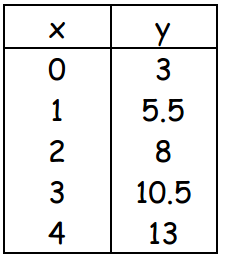
The table shown represents a linear function.
Which equation best represents the function?
y=x+4
y=x−4
y=−4x
y=4−x

The table shown represents a linear function.
Which equation best represents the function?
y=3x−3
y=−3−3x
y=3−3x
y=−3x+3

The table shown represents a linear function.
Which equation best represents the function?
y=32x−2
y=32x+2
y=−2x−1
y=2x+1

The table shown represents a linear function.
Which equation best represents the function?
y=2x+4
y=2x−4
y=2
y=4
Solve for x:
9+x=−3
(a)
Solve for x:
−7+x=11
(a)
Solve for x:
x−1=−10
(a)
Solve for x:
9−x=−3
(a)
Solve for x:
7−x=5
(a)
Solve for x:
−7−x=5
(a)
Solve for x:
−9=−1+x
(a)
Solve for x:
−1=x+5
(a)
Solve for x:
20=x−12
(a)
Solve for x:
−x=5
(a)
Solve for x:
x−9=−1
(a)
Explain how you would solve for x:
9+x=−3
(To solve this equation for x, first I would...... Second, I would...... Third, I would..... The solution will be.....)
Solve for x
2x=6
(a)
Solve for x
−2x=6
(a)
Solve for x
−2x+7=6
(a)
Solve for a
−6a+7=13
(a)
Solve for a
−7a−2=−10
(a)
Solve for b
−3+32b=6
(a)
Solve for b
−1−75b=1
(a)
Solve for b
−1−75b=0
(a)
Solve for c
19=17−53c
(a)
Solve for c
−5=5+21c
(a)
Solve for c
−5=5−21c
(a)

What is the slope?
(a)

What is the slope?
(a)

What is the slope?
(a)

What is the slope?
(a)
What is the slope?
(a)

What is the slope?
(a)

What is the slope?
(a)

What is the slope?
(a)
Find the slope of the line that passes through:
(-4, 7) and (-6, -4)
(a)
Find the slope of the line that passes through:
(-3, -4) and (7, 6)
(a)

What is the value of m?
(hint: m is the slope!)
(a)

Find the value of m.
(hint: m is the slope!)
(a)

What is the slope?
(a)

Find the slope.
(a)
Solve for x:
2x+3=x−1
(a)
Solve for b:
3−5b=6b+7
(a)
Solve for g:
2(g+1)+1=4g−3
(a)
Solve for x:
−3(x−5)−10=−7x+1
(a)
Solve for x:
2+4(x+5)=3(4−x)+5
(a)
Solve: 5x + 15 = 10x - 40
(a)
Solve: -2x + 18 = 2x + 40
(a)
Solve: 4x - 3 = 6x - 19
(a)
Solve: 12x + 1 = 6x - 47
(a)
Solve for x:
4(1-x) + 3x = -2(x+1)
(a)
Solve:
5y + 34 = -2(-7y+1)
(a)
Solve:
−(h−3)+50=16+7(h+9)
(a)
Solve:
−2(9+3x)−1=−4(6x+9)+5
(a)

