
NEW
Font size
 Worksheets
World History Interim 2 Review
Total questions: 38
Worksheet time: 20mins

What historical period is associated with these events?
The Renaissance
The French Revolution
The American Revoluton
The Protestant Reformation
Historians often praise Thomas Jefferson for incorporating the Enlightenment into the Declaration of Independence. Which of these BEST explains why this can be said?
There is evidence that it was written in France.
It was written in the middle of the 18th Century.
The philosophies of John Locke and Montesquieu are used.
It contains many references to "Nature's God" and religion.

These terms are describing what Russian ruler?
August II
Peter the Great
Ivan the Terrible
Catherine the Great
Which statement best describes a political theory of John Locke?
Men and women are born free and entitled to equality.
There should be a separation between church and state.
A government's power comes from the consent of the people.
The government should be divided into three separate branches.
Geography and harsh weather played a major role in Napoleon's defeat during his invasion of
Russia.
Hungary.
Germany.
Great Britain.
The Haitian Revolution was significant because
it was a rebellion led by European creoles.
it was the first and only successful slave rebellion in Latin America.
it demonstrated the power of Napoleon's military across the Atlantic Ocean.
the Spanish were forced to give Haiti their independence after the bloody conflict.
How does the French Revolution relate to the Latin American wars for independence, particularly in Haiti?
The French Revolution had no impact on the actions of slaves within Haiti.
The French Revolution forced white slave owners to abolish slavery in Haiti.
The French Revolution ignited thoughts of freedom and equality, especially among slaves.
The French Revolution scared Haitian citizens into believing all forms of protest are harmful.
How did the American Revolution influence the French Revolution?
The French rejected the ideas of the American Revolution as too liberal, but found success in a more conservative approach.
America provided battle strategies that were instrumental in helping the French overthrow the monarch.
The French received financial support from the Americans that allowed them to win the war.
America demonstrated that it was possible to overthrow old European government regimes.
Which of these was a key idea of the Renaissance?
the equality of all mankind
the supression of artistic innovation
an interest in classical civilizations of Greece and Rome
emphasis on the next world rather than man's place in this one
The "Middle Passage" referred to
the creation of the Panama Canal in Central America.
the transportation of slaves from Africa to the New World.
Lewis and Clark's expedition into the Louisiana Territory.
the best route over the Rocky Mountains to get to California.
Copernicus, Galileo, Kepler, and Newton all supported which idea from the Scientific Revolution?
law of gravity
geocentric theory
heliocentric theory
law of planetary motion
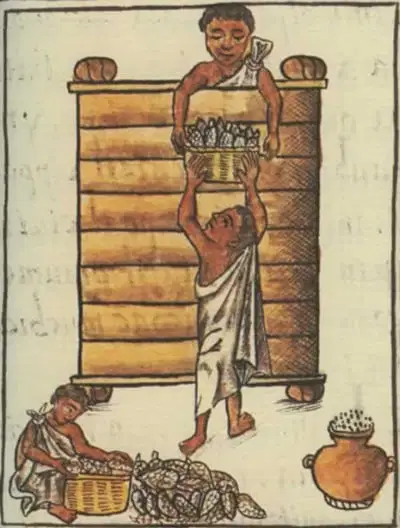
The GREATEST impact of the Columbian Exchange was
the annual storage of crops for native peoples.
the transport of slaves from the Americas to Africa.
the spread of new diseases, which led to vaccinations.
the transfer of plants, people, and ideas between the Americas, Europe, and Africa.
The Aztecs built a powerful and wealthy empire by
militarily conquering other tribes and making alliances.
using gold and silver to control Mesoamerican trade.
destroying their Toltec and Mayan rivals.
allying with the Spanish conquistadors.
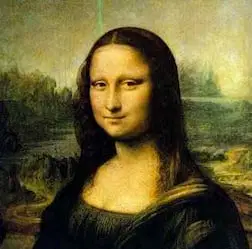
Unlike painting from the medieval period, Renaissance artists
worked exclusively with granite.
focused primarily on religious topics.
refused to accept payments from wealthy political or religious patrons.
used light, shadow, and perspective to carefully recreate the human form.
Which technological innovation had the MOST direct impact on European exploration in the 15th century?
steam engine
printing press
paper currency
navigational compas.
The voyage of Christopher Columbus in 1492
opened the way for Spain to colonize North and South America.
led the way for Portugal to build a vast trading empire in Asia.
led England to claim the the vast territory surrounding Hudson Bay.
showed Spain the way around South America and into the Pacific Ocean.
Though the Incas lacked wheeled tools and draft animals, their economy was based primarily on
engineering.
farming.
mining.
transportation.
Which of these ideas was stressed by humanists during the Renaissance?
the power of the Catholic Church should be unquestioned
religious officials needed to follow strict rules of behavior
music, art, literature, and grammar should be available to all
trade and wealth needed to be the goal of all levels of society
Why did the findings of Galileo frighten Catholic and Protestant leaders?
His findings supported the theories of Aristotle.
His findings did not support the Copernican theory.
His findings led him to rebel against the Cardinals.
His findings went against Church teaching and authority.

Who is this describing?
Isaac Newton
William Harvey
Galileo Galilei
Nicolaus Copernicus
The Council of Trent was a series of meetings held over an eighteen-year period beginning in 1545. Which statement BEST describes the work of the Council?
The Council divided the Church, creating a schism between its Eastern Orthodox and Roman Catholic branches.
Conservatives defeated reform efforts thus setting the Church on a course that would lead to the Inquisition.
The Council strengthened the Papacy, redefined church doctrine, and ended abuses such as the sale of indulgences.
Opponents of Protestantism purged the Church of Martin Luther’s influence and restored the power of local bishops.
The Jesuit Order played what important role in the Counter Reformation?
The Jesuits provided the Church with the first religious order for women.
Ignatius Loyola inspired the Pope to seek reforms among the clergy and to redefine Church doctrine.
The Jesuits practiced the spiritual beliefs necessary to reform the Church and restore the piety of the clergy.
Ignatius Loyola’s scholarship inspired the Pope to focus his efforts on organizational rather than spiritual reform.
What does vernacular languages mean?
Latin
English
native languages
Italian dialects
Increased warfare among neighboring Aztec tribes was caused by the
lack of food and resources.
need for human sacrifice victims.
advanced weaponry including guns.
lack of strong leadership within the Aztec empire.
What were indulgences?
criticisms of the Catholic Church written by Henry VIII
special privileges that were given to church leaders
certificates sold by the church that reduced or canceled a punishment for a sin
special taxes that the rich paid that allowed them to exempt certain punishments from the king
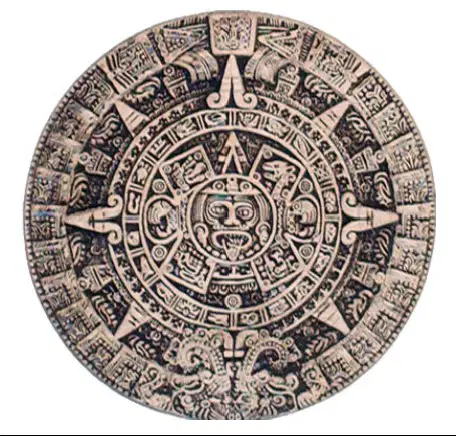
The image shown above was used by the Mayans as a _________
wheel.
calendar
compass.
religious ornament.
How did the Trans-Atlantic slave trade affect relations between the kingdoms of Africa?
The Trans-Atlantic slave trade contributed to the demise of these kingdoms.
The Trans-Atlantic slave trade strengthened the political stability of these kingdoms.
The Trans-Atlantic slave trade increased the positive relations between Europe and Africa.
The Trans-Atlantic slave trade unified the African kingdoms and allowed them to fight off the Europea
The mid-fourteenth century CE event that led to severe labor shortages in Northern Europe and the remainder of the European continent was
the Reformation.
the Bubonic Plague.
the invasion of the Mongols.
the Christian crusades to the Holy Land.
During the Columbian Exchange, what caused the largest number of indigenous deaths in the New World?
crop destruction and famine
smallpox and other diseases
wars between different tribes
fighting with the conquistadors
What three regions made up the Triangular Trade during the late 1500s?
Asia, Africa, and Europe
the Americas, Europe, and Asia
Europe, Africa, and the Americas
New England, the Caribbean, Asia
The Renaissance began in Italy MAINLY because
the wealthy merchants supported arts and
education
it had the largest collection of classical Greek
sculptures
the area's natural beauty attracted artists from
around the world
the Catholic Church paid artists and writers to
move there
The "humanism" of the Renaissance was inspired MAINLY by a new interest in
classical Greece and Rome.
the Christian Bible.
the art and writing of Asia.
ancient Egypt.
Which contributed to the English Reformation and the creation of the Church of England?
The pope denied Henry VIII's request for an
annulment of his marriage to Catherine of
Aragon.
Martin Luther claimed that the selling of
indulgences to the poor was a part of wider
corruption in the church.
Huldrych Zwingli contradicted the Catholic
Church by preaching that the Eucharist only a
symbol of the body of Jesus.
John Calvin challenged the pope's authority by
preaching that whether a person would go to
Heaven was predetermined.
) Enlightenment thought is best characterized by which of the following?
a complete rejection of religious faith
a conviction that logic and reason were capable of solving social and political problems
active advocacy of the rights of women to vote
support of the established political order
What weakened France's absolutist rulers, such as Louis XV?
draining the treasury to finance costly wars
sharing power with the nobility and clergy
allowing constitutional laws and liberties
ignoring military spending to finance palaces
Which of the following was NOT an accomplishment of Napoleon during his rule of France?
He established a peaceful alliance among European states.
He set up government-run public schools.
He was able to enact a comprehensive code of laws.
He established an equitable tax code for the people.
Which BEST describes the idea of nationalism that spread across Europe at the time of Napoleon?
The people, not the king, constitute the nation.
All of Europe should be united as one nation.
A nation should be ruled by law, not individuals.
No nation has the right to invade another.
In the seventeenth and eighteenth centuries, what was the theory of divine right most often used to justify?
democratic protests
communist revolutions
the power of the pope
absolute monarchies

