wayground logo

Free Printable Worksheets

NEW

Font size

S
M
L
XL
Worksheets

Topic 1/2 Review

Total questions: 60

Worksheet time: 3hrs 48mins

Name
Class
Date
1.
What is the first step in solving the equation 2a - 4(a - 5) = 10
a)
Add 4 to both sides
b)
Add the 2a and a 
c)
Distribute 4 to a and -5
d)
Distribute -4 to a and -5
2.
3a + 9 + 4a = 2
a)
-1
b)
1
c)
no solution
d)
-7
3.
What is the first step in solving this equation:
5x + 7 = 12
a)
Divide by 5
b)
Subtract 5
c)
Multiply by 7
d)
Subtract 7
4.

Solve:

2(2x + 3) = -6(x + 9)

a)
1.2
b)
6
c)
-6
d)
7.5
5.

Which is the correct order in which to solve multi-step equations?

10x - 36 = 2(x + 6) - 4x

a)

Distribute

Combine like terms

Move the variable

Add or Subtract

Divide or multiply

b)

Add or subtract

Distribute

Combine like terms

Divide or multiply

Move the variable

c)

Distribute

Add or subtracting

Move the variable

Divide or Multiply

Combine like terms

6.
Solve:
2x + 1 = 2x - 1
a)
No Solution
b)
x = 0
c)
Infinitely Many Solutions
7.

3(x-8)=3x-24

a)

No Solution

b)

x=3

c)

Infinite Solutions

8.

Maria has 25 dollars.  She has to buy a gallon of milk which costs $3.50.  She wants to spend the rest of her money on cereal that costs $4.50 per box. Which equation can be used to find out how many boxes she can purchase?

a)

3.50x + 4.50 = 25

b)

3.50x + 25 = 4.50

c)

4.50x + 3.50 = 25

d)

4.50x + 25 = 3.50

9.

     3x – 6 = 3(x – 1) – 3

a)

one solution

b)

no solution

c)

infinitely many solutions

10.

    2x + 7 =  –2x + 7

a)

one solution

b)

no solution

c)

infinitely many solutions

11.

Pentagon ABCDE is rotated  180°180\degree  clockwise about the origin to form pentagon A'B'C'D'E. Which statement is true?

a)

Pentagon ABCDE is congruent to pentagon A'B'C'D'E'.

b)

The sum of the angle measures of pentagon A'B'C'D'E' is  180°180\degree  more than the sum of the angle measures of pentagon ABCDE.

c)

Each side length of pentagon A'B'C'D'E' is 2 times the corresponding side length of pentagon ABCDE.

d)

Each side length of pentagon A'B'C'D'E' is  12\frac{1}{2}  the corresponding side lenth of pentagon ABCDE.

12.

Quadrilateral PRST is transformed according the the rule  (x, y)(x+9, y+4)\left(x,\ y\right)\rightarrow\left(x+9,\ y+4\right)  to create quadrilateral P'R'S'T'. Which statement is true.

a)

The side lengths of quadrilateral P'R'S'T' are twice the corresponding side lengths of quadrilateral PRST.

b)

The angle measures of quadrilateral P'R'S'T' are equal to the corresponding angle measures of quadrilateral PRST.

c)

The angle measures of quadrilateral P'R'S'T' are greater that the corresponding angle measures of quadrilateral PRST.

d)

The side lengths of quadrilateral P'R'S'T' are 9 units longer than the corresponding side lengths of quadrilateral PRST.

13.

Which representation of a transformation on a coordinate grid does not preserve congruence?

a)

(x, y)(17x,17y)\left(x,\ y\right)\rightarrow\left(\frac{1}{7}x,\frac{1}{7}y\right)

b)

(x,y)(x+7, y+7)\left(x,y\right)\rightarrow\left(x+7,\ y+7\right)

c)

(x,y)(x,y)\left(x,y\right)\rightarrow\left(x,-y\right)

d)

(x,y)(y,x)\left(x,y\right)\rightarrow\left(y,-x\right)

14.

A transformation is applied to a figure to create a new figure. Which transformation does not preserve congruence?

a)

A reflection across the x-axis

b)

A translation 7 units down

c)

A dilation by scale factor of 5

d)

A rotation of 90°90\degree clockwise

15.

Quadrilateral PQRS was translated 5 units to the right and 3 units up to create quadrilateral P'Q'R'S'. Which rule describes this transformation?

a)

(x,y)(x5,y3)\left(x,y\right)\rightarrow\left(x-5,y-3\right)

b)

(x,y)(x+5,y+3)\left(x,y\right)\rightarrow\left(x+5,y+3\right)

c)

(x,y)(x3,y5)\left(x,y\right)\rightarrow\left(x-3,y-5\right)

d)

(x,y)(x+3,y+5)\left(x,y\right)\rightarrow\left(x+3,y+5\right)

16.

Pentagon VWXYZ is shown on the coordinate grid. A student reflected pentagon VWXYZ across the x-axis to create pentagon V'W'X'Y'Z'. Which rule describes this transformation?

a)

(x,y)(x,y)\left(x,y\right)\rightarrow\left(x,-y\right)

b)

(x,y)(x,y+8)\left(x,y\right)\rightarrow\left(x,y+8\right)

c)

(x,y)(y,x)\left(x,y\right)\rightarrow\left(-y,x\right)

d)

(x,y)(x,y)\left(x,y\right)\rightarrow\left(-x,y\right)

17.

Triangle RST is translated 6 units to the left and 4 units up to create triangle R'S'T'. Which rule best describes this transformation?

a)

(x,y)(6x,4y)\left(x,y\right)\rightarrow\left(6x,-4y\right)

b)

(x,y)(6x,4y)\left(x,y\right)\rightarrow\left(-6x,4y\right)

c)

(x,y)(x+6,y4)\left(x,y\right)\rightarrow\left(x+6,y-4\right)

d)

(x,y)(x6,y+4)\left(x,y\right)\rightarrow\left(x-6,y+4\right)

18.

The coordinate grid shows the parallelogram PQRS. Parallelogram PQRS is rotated  90°90\degree  clockwise about the origin to create parallelogram P'Q'R'S'. Which rule describes this transformation?

a)

(x,y)(x,y)\left(x,y\right)\rightarrow\left(x,-y\right)  

b)

(x,y)(x,y)\left(x,y\right)\rightarrow\left(-x,y\right)  

c)

(x,y)(y,x)\left(x,y\right)\rightarrow\left(y,x\right)  

d)

(x,y)(y,x)\left(x,y\right)\rightarrow\left(y,-x\right)  

19.

The coordinates of the vertices of a quadrilateral are P(1, 2), R(1, 4), S(3, 4), and T(4, 2). Quadrilateral PRST is reflected across the y-axis to create quadrilateral P'R'S'T'. Which rule describes this transformation?

a)

(x,y)(x,y)\left(x,y\right)\rightarrow\left(x,-y\right)

b)

(x,y)(x,y)\left(x,y\right)\rightarrow\left(-x,y\right)

c)

(x,y)(y,x)\left(x,y\right)\rightarrow\left(y,-x\right)

d)

(x,y)(y,x)\left(x,y\right)\rightarrow\left(-y,x\right)

20.

A figure is graphed on a coordinate grid as shown. The figure is rotated  180°180\degree  clockwise withthe origin as the center of rotation to create a new figure. Which rule describes this transformation?

a)

(x,y)(x,y)\left(x,y\right)\rightarrow\left(-x,-y\right)  

b)

(x,y)(x,y)\left(x,y\right)\rightarrow\left(x,-y\right)  

c)

(x,y)(y,x)\left(x,y\right)\rightarrow\left(-y,-x\right)  

d)

(x,y)(x,y)\left(x,y\right)\rightarrow\left(-x,y\right)  

21.

This scale drawing shows a parking lot. What is the actual (real) length of the longer side of the lot? 

a)
63 m
b)
235 m
c)
315 m
d)
630 m
22.

On a map, the distance between two towns in 2.6 cm. The scale of the map is

1 cm : 50 km. What is the actual distance between the two towns?

a)

100 km

b)

130 km

c)

70 km

d)

150 km

23.

Kenny drew a scale drawing of a swimming pool.

The scale of the drawing was 2 cm : 1 m. If the pool is 26 cm in the drawing, how long is the actual pool?

a)

13 m

b)

2 m

c)

1 m

d)

52 m

24.
If the scale factor is less than one, the new figure will be
a)
an enlargement
b)
a reduction
c)
a scale factor
d)
bigger
25.
If the scale factor is greater than one, the new figure will be
a)
a reduction
b)
an enlargement
c)
a scale
d)
not proportional
26.
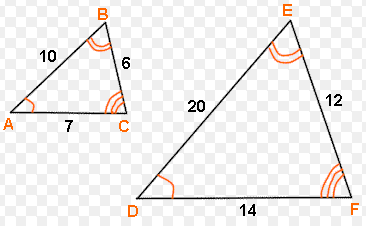
What is the scale factor from triangle ABC to triangle DEF?
a)
1/2
b)
7/3
c)
2/1
d)
10/3
27.
Find missing side
a)
5
b)
7
c)
9
d)
11
28.
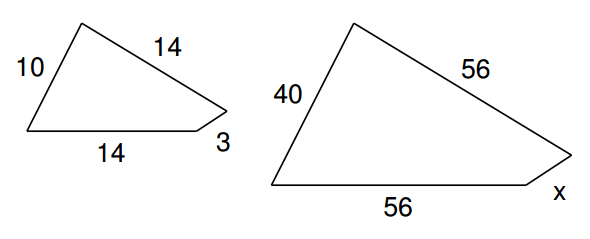
The pair of figures is similar. Find the missing side.
a)
x = 12
b)
x = 3
c)
x = 40
d)
x = 4
29.

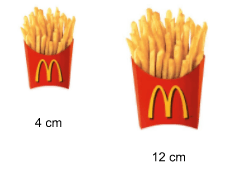
What is the scale factor from the small fry to the large fry?

a)

1/3

b)

48

c)

4

d)

3

30.
The two rectangles are scale drawings. What is the measurement of x?
a)
21
b)
1.25
c)
20
d)
4
31.
Solve the proportion.
a)
k=5
b)
k=3.3333333
c)
k=60
d)
k=90
32.
The distance between two cities on a map is 4.125 inches.  Find the actual distance if the scale on the map is 2 inches = 40 miles.
a)
165 miles
b)
50 miles
c)
82.5 miles
d)
41.25 miles
33.
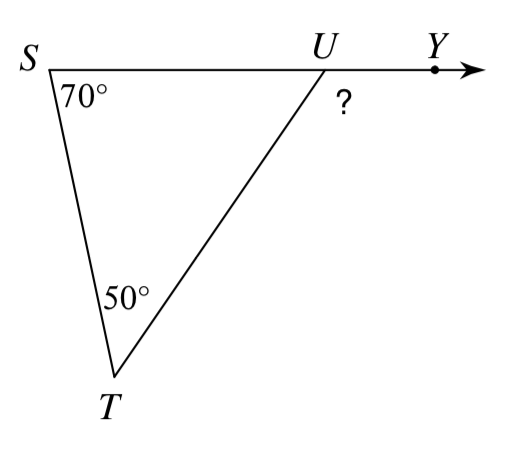
Solve for the missing angle with the question mark. 
a)
A
b)
B
c)
C
d)
D
34.
The Triangle Sum Theorem states that the sum of all angles in a triangle is ______. 
a)
45°
b)
90°
c)
180°
d)
360°
35.
Which of the following terms best describes Angle d?
a)
Remote interior angle
b)
Corresponding angle
c)
Exterior angle
d)
Interior angle
36.

Which of the following terms best describes Angles a and b?

a)

Remote interior angles

b)

Corresponding angles

c)

Exterior angles

d)

Interior angles

37.
Find the measure of the missing angle.
a)
90o
b)
100
c)
130o
d)
50o
38.

What is the value of the missing angle?

a)

90

b)

100

c)

20

d)

120

39.
Two angles added together to produce 90 degrees
a)
Supplementary
b)
Complementary
c)
Right
d)
Vertical
40.
Find the missing angle.
a)
60
b)
70
c)
50
d)
140
41.
These angles are...
a)
Complementary
b)
Supplementary
c)
Neither
42.
These angles are...
a)
Complementary
b)
Supplementary
c)
Neither
43.
Find the missing angle.
a)
47
b)
37
c)
57
d)
137
44.
What is the measure of the missing angle?
a)
76
b)
66
c)
156
d)
154
45.

What is an example of a pair of complementary angles?

a)

45° and 48°

b)

79° and 30°

c)

150° and 32°

d)

36° and 54°

46.

Find the missing angle.

a)

28°

b)

118°

c)

62°

d)

180°

47.

An angle measures 14°. What is the measure of the complementary angle?

a)

76°

b)

166°

c)

14°

d)

68°

48.
If ∠H and ∠J are complementary, and the measure of ∠H is 35°, what is the measure of ∠J?
a)
145
b)
55
c)
60
d)
65
49.
If ∠A and ∠B are supplementary, and the measure of ∠A is 120°, what is the measure of ∠B?
a)
180
b)
50
c)
60
d)
80
50.
1. Find X 
a)
28
b)
5
c)
55
d)
40
51.
2. Find X
a)
9
b)
27
c)
45
52.
If m∠1 = 30°, then m∠3 = 
a)
30°
b)
60°
c)
150°
d)
undetermined
53.
Which are pairs of vertical angles?
a)
∠COB & ∠COA
b)
∠AOD & ∠AOC
c)
∠COB & ∠AOD
d)
∠BOD & ∠AOD
54.
Vertical angles are always
a)
acute
b)
total 180 degrees
c)
congruent (equal measures)
d)
adjacent angles
55.
What is the value of x?
a)
37
b)
72
c)
108
d)
18
56.
The sum of the interior angles of a polygon is __________________ where n is the number of sides.
a)
(n - 2)180
b)
(n - 1)180
c)
360
d)
(n - 3)(180)
57.

In the Polygon Interior Angle Sum Theorem, what does nn  represent?

a)

The measure of the largest interior angle

b)

The number of sides of the polygon

c)

Nothing

d)

The number of triangles that compose the polygon

58.
What is the SUM of the angle measures in a 35-gon?
a)
180°
b)
5940°
c)
1080°
d)
169.71°
59.
-2x + 7 < 19
a)
x < 6
b)
x < -6
c)
x > 6
d)
x > -6
60.

Solve the inequality.

4d  9  3-4d\ -\ 9\ \le\ 3  

a)

d 3d\ \le3  

b)

d 3d\ \le-3  

c)

d  3d\ \ge\ 3  

d)

d  3d\ \ge\ -3