
 Worksheets
Japan Test Review
Total questions: 65
Worksheet time: 33mins
Japan being located on the Ring of Fire means that they face few environmental challenges.
True
False
Japan has the 4th highest GDP in the world.
True
False
Japan has some of the most respected schools in the world.
True
False
Japan fought hard to keep their traditional ways during the Meiji Restoration.
True
False
Japan is the only country in the world that had atomic bombs used against it.
True
False
Most Japanese citizens live in rural villages.
True
False

Which number is Japan?
38
37
36
33
Pearl Harbor was a surprise attack.
True
False
During WWI and WWII Japan was an enemy of the U.S., but today they are allies.
True
False
Edo was the ancient name of the modern Japanese city of Osaka.
True
False
Kamikazi plane tactics were mainly used after the US invasion of the Philippines.
True
False
What is the largest Japanese island?
Hokkaido
Honshu
Kyushu
Shikoku
Where is Pearl Harbor located?
The Pacific Ocean
The Atlantic Ocean
The Indian Ocean
The Arctic Ocean
What did the attack on Pearl Harbor accomplish?
It wiped out the U.S. military
It brought the U.S. into war
It put an end to WWII
It made Hawaii a tourist spot
During the Golden Age or Tokugawa Period in Japan, who had the most authority.
Emperor
Shogun
Daimyo
Priests
What made Manchuria attractive to the Japanese when they began their expansion into Asia?
It had a large Japanese population
It was rich in natural resources
It was the closest Japanese territory to China
It had a nationalist government
Who introduced Buddhism into Japan?
United States
Portugal
China
India
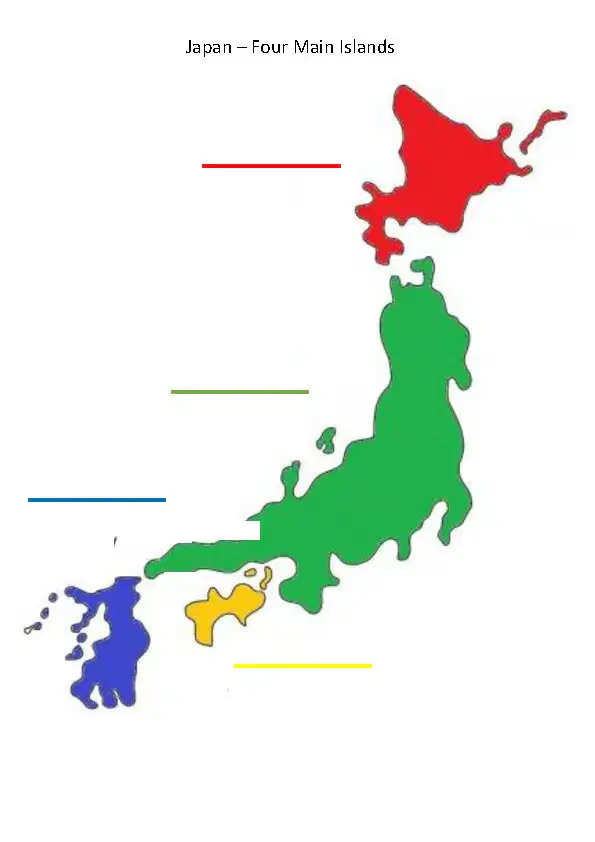
Which island is Hokkaido?
Red
Green
Blue
Yellow
Buddhism is often combined with which religion in Japan?
Shinto
Hinduism
Christianity
Islam
What did the Portuguese introduce to Japan?
Christianity
Guns
Ships
Christianity and Guns
Who is the current prime minister of Japan?
Shinzo Abe
Fumio Kishida
Shigeru Ishiba
Sanae Takaichi
Which social class was highest in Japan’s Golden Age?
Artisans
Peasants
Merchants
Warriors
What can best describe the “Enlightened Rule” in Japan from 1868 to 1912?
Modernization
Return to traditional values
Violence
Isolationism
From 1945 to 1951 who occupied and operated Japan after WWII?
Emperor Hirohito
Great Britain
Communist China
United States
Which number is Russia?
31
37
30
42
What action by the U.S. crippled the Japanese war machine after they invaded French Indochina?
Trade embargo on oil and steel
Declared war on Germany
Pearl Harbor Attack
Banned immigration
Who was the ruler during the Meiji or “Enlightened Rule”?
Emperor Kotuku
Emperor Hirohito
Emperor Mutsuhito
Empress Suiko
Which number is South Korea?
31
35
34
33
Which of the following is the artform of Japanese poetry?
Haiku
Origami
Bonsai
Bushido
What was the turning point of WWII when the tide of the war would turn against the Japanese?
Battle of Okinawa
Battle of Coral Sea
Battle of Tarawa
Battle of Midway
Which president of the U.S. made the decision to drop the atomic bomb on Japan?
Franklin Roosevelt
John Kennedy
Harry Truman
Dwight Eisenhower
Which of the following statements best describes the Meiji Restoration?
The Meiji reformers refused to adapt Western ways.
The Meiji Restoration worked to restore a rigid feudal order.
The Meiji reformers adapted the German model of government.
The Meiji constitution did not give the emperor absolute power.
Which island is Honshu?
Red
Green
Blue
Yellow
What is the name of the popular Japanese drama that explains Japanese history and only males play the roles?
Bushido
Haiku
Kabuki
Origami
How did the United States approach Japan to begin trade?
It sent well-armed ships with a letter from President Fillmore demanding trade.
It sent gifts and greetings to the shogun with an invitation to visit the United States.
It fired upon Japan’s coast, invading its shoreline and overtaking its government.
It consulted European nations and carved Japan into spheres of influence.
Who was the U.S. Commodore credited with the 1853 opening of Japan for trade.
Millard Fillmore
Dwight Eisenhower
Douglas MacArthur
Matthew Perry
Who was the leader that began Japan’s Golden Age?
Shinzo Abe
Tokugawa Ieyasu
Emperor Hirohito
Emperor Mutsuhito
Which island is Shikoku?
Red
Green
Blue
Yellow
Who was the emperor of Japan during WWII?
Emperor Hirohito
Emperor Mutsuhito
Tokugawa Ieyasu
Shinzo Abe
What world event led Japan to seek expanding its territory to provide an expansion for its population.
WWI
WWII
Great Depression
Russo Japanese War
Besides the atomic bomb, what other new bomb was developed during WWII and was used heavily in the firebombing of Japan?
Agent Orange
Mustard Gas
White Phosphorus
Napalm
What countries signed the Tripartite Pact with Japan?
Great Britain and France
United States and Russia
Greece and China
Germany and Italy
How did the new technology of splitting the atom end WWII?
Allied scientists used the technology to destroy Axis forces in Europe.
The Allies developed a new energy supply to power aircraft.
U.S. scientists created a new bomb that was used against Japan.
The threat of nuclear warfare forced Germany to surrender.
Who primarily ran Japan by the time of WWII?
Emperor
Shogun
Military
Diet
Militarism
country extending its powers by conquering other territories
strength of the military is equal to strength of the nation
legislative branch in Japan
leader of warlords appointed by emperor
Diet
country extending its powers by conquering other territories
strength of the military is equal to strength of the nation
legislative branch in Japan
leader of warlords appointed by emperor
Imperialism
country extending its powers by conquering other territories
strength of the military is equal to strength of the nation
legislative branch in Japan
leader of warlords appointed by emperor
Shogun
country extending its powers by conquering other territories
strength of the military is equal to strength of the nation
legislative branch in Japan
leader of warlords appointed by emperor
Which number is China?
31
37
34
33
Kublai Khan
”divine wind”
leader of the Mongol invasion
warriors
chain of islands
Samurai
”divine wind”
leader of the Mongol invasion
warriors
chain of islands
Kamikaze
”divine wind”
leader of the Mongol invasion
warriors
chain of islands
Archipelago
”divine wind”
leader of the Mongol invasion
warriors
chain of islands
Extraterritorial
tidal wave created by an earthquake
Ancient religion native to Japan
legislative branch in Japan
foreigners are exempted from local law
Tsunami
tidal wave created by an earthquake
Ancient religion native to Japan
noble warlords
foreigners are exempted from local law
Shintoism
tidal wave created by an earthquake
Ancient religion native to Japan
noble warlords
foreigners are exempted from local law
Which number is North Korea?
31
35
34
33
Daimyo
tidal wave created by an earthquake
Ancient religion native to Japan
noble warlords
foreigners are exempted from local law
What is the name of Japan’s tallest mountain which is also a dormant volcano?
Mount Fuji
Mt. Kilimanjaro
Mount Everest
K2
What is the capital of Japan?
Kyoto
Beijing
Tokyo
Hiroshima
What is the name of the first novel in the world written by, Murasaki Shikibu, a Japanese noblewoman?
Tale of Shikibu
Arabian Nights
The Good Earth
Tale of Genji
Name the location of the first atomic bomb dropped on Japan.
Tokyo
Kyoto
Hiroshima
Nagasaki
Name the location of the second atomic bomb dropped on Japan.
Tokyo
Kyoto
Hiroshima
Nagasaki
What is the name for the active set of tectonic plates that Japan lays on top of?
Ring of Fire
Ring of Volcanos
Ring of Death
Ring around the rosy
Which island is Kyushu?
Red
Green
Blue
Yellow

