
 Worksheets
6.P.3.1 Heat Transfer Test Review
Total questions: 30
Worksheet time: 32mins

What is the main kind of energy transfer within the hot air balloon?
absorption
conduction
convection
radiation

Which best describes the transfer of energy in the picture?
Heat is being transferred from the person’s hand to the ice by convection
Heat is being transferred from the person’s hand to the ice by conduction
Coolness is being transferred from the ice to the person's hand by convection.
Coolness is being transferred from the ice to the person's hand by conduction.

The diagram shows energy being transmitted from the sun to Earth.
How is the energy being transferred?
The energy is transferred as thermal radiation and light because no direct contact is needed between the sun and Earth for the energy to transfer.
The energy is transferred by conduction because no direct contact is needed between the sun and Earth for the energy to transfer.
The energy is not being transferred because the Earth is the same temperature as the sun and they are both in equilibrium.
The energy is transferred by conduction because the sun and Earth are always in direct contact.
A scoop of ice cream is placed on top of a hot brownie. How will the temperatures of the ice cream and the brownie change?
The ice cream will become warmer than the brownie.
The brownie will become warmer than the ice cream.
The ice cream will become warmer, and the brownie will become colder until they become the same temperature.
The brownie will become warmer, and the ice cream will become colder.
Which is the movement of thermal energy from a warmer substance to a cooler substance?
activity
heat
absorption
temperature
Which is the best indicator that thermal energy is moving between two objects?
The temperature of both objects changes until they have reached equilibrium.
The temperature of both objects remains the same.
The temperature of both objects decreases.
The temperature of both objects increases
Which condition is needed for heat to be transferred by conduction?
The heat must be circulated in a fluid, either a liquid or a gas for heat to be transferred through conduction.
Two objects must be in direct contact for heat to be transferred through conduction.
Two objects must be located in a vacuum for heat to be transferred through conduction.
Two objects must be the same temperature for heat to be transferred through conduction.

Which type of heat transfer is represented by hot water rising in a boiling pot as cooler water moves below to replace it?
conduction
convection
evaporation
radiation
Heat transfer is also called...
Thermal Energy
Conduction
Convection
Radiation
What does it mean when there is thermal equilibrium?
No heat is being transferred.
Heat is being transferred through conduction.
Heat is being transferred through convection.
Heat is being transferred through radiation.

Which type of heat transfer is illustrated by the fire?
conduction
convection
radiation

Which type of heat transfer is illustrated with the pan sitting on the stovetop burner?
conduction
convection
radiation

Which type of heat transfer is illustrated inside the pot?
conduction
convection
radiation
Which is an example of the transfer of heat energy by conduction?
soup moving up and down in a pot as it is heated
wind blowing from cooler parts of Earth to warmer parts
a person's hands warming up as they are held above a campfire
the bottoms of a person's feet feeling warm as they walk along the beach
Which condition is needed for heat to be transferred by convection?
Two objects must be made of solids for heat to be transferred through convection
Two objects must be in direct contact for heat to be transferred through convection
The heat must be circulated in a fluid, either a liquid or a gas, for heat to be transferred through convection
Two objects must be at equilibrium for heat to be transferred through convection
Which is an example of the transfer of heat energy by radiation?
warm air rising and cool air sinking in a house
water boiling in a pot
a person's hand warming up above a campfire
a person's hand being burnt when they touched a hot pan
Which condition is needed for heat to be transferred by radiation?
No conditions are needed for heat to be transferred through radiation. Radiation can occur in a vacuum.
Two objects must be in direct contact for heat to be transferred through radiation.
The heat must be circulated in a fluid, either in a liquid or a gas, for heat to be transferred through radiation.
Two objects must be at equilibrium for heat to be transferred through radiation.

Cup A contains hot water and Cup B contains cold water. A student bends a copper wire and places each end into the cups.
How will heat transfer between the hot water (Cup A) and the cold water (Cup B) and the copper wire?
Heat will transfer from the hot water and the cold water to the copper wire.
Heat will transfer from the copper wire to the hot water and the cold water.
Heat will transfer from the hot water to the copper wire and from the copper wire to the cold water.
Heat will transfer from the cold water to the copper wire and from the copper wire to the hot water.
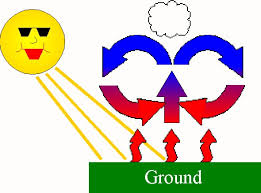
Which statement is true?
The quicker a molecule moves, the colder it is.
The slower a molecule moves, the warmer it is.
The quicker a molecule moves, the warmer it is
The movement of molecules don't affect temperature

