
 Worksheets
Waves Unit Review Bank
Total questions: 254
Worksheet time: 3hrs 6mins

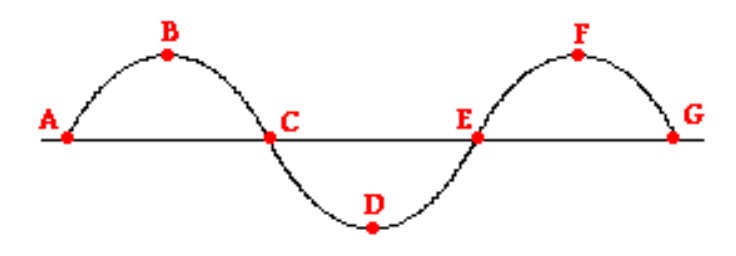
Which letter represents wavelength?
A
B
C
D

Which letter represents the wave crest?
A
B
C
D

Which letter represents the wave trough?
A
B
C
D

Which letter represents amplitude?
A
B
C
E

Which wave has a greater frequency?
A
B
What is another name for wave height?
Amplitude
Origin
Wavelength
Frequency
If a wave has a greater frequency, what happens to number of waves per second?
decreases
increases
stays the same

A disturbance that transfers energy from place to place through matter or space
wave
protien
position
time

Which wave has the largest wavelength?
B
None (same wavelength)
A
C
What is transferred by a wave?
Particles
Mass
Matter
Energy

Which image represents a longitudinal wave?
A
B

What part of the wave is a compression?
A
B

What part of the wave is a rarefaction?
A
B

How do these waves compare?
wave 2 has a higher frequency than wave 4
all have the same frequency
all have the same wavelength
wave 3 has a longer wavelength than wave 4

What type of wave is pictured here?
sound wave
transverse wave
seismic wave
longitudinal wave
Transverse waves carry energy _______ to the direction the medium is moving.
perpendicular
opposite
parallel
at a 45 degree angle
A longitudinal wave carries energy __________ to the direction the medium is moving.
at a 90 degree angle
perpendicular
parallel
at a 45 degree angle
Shaking a rope up and down produces which type of wave?
transverse
amplitude
longititudinal
period
Sound waves are which type of waves?
frequency
seismic
transverse
longitudinal
What type of waves are usually found in space?
Mechanical
Electromagnetic
happens when a wave bounces back after hitting a barrier
reflection
refraction
diffraction
interference
a reflected sound wave
refraction
diffraction
echo
resonance
when a wave passes through a substance
transmitted
dispersed
echo
interference
the bending of a wave as the wave passes from one medium to another at an angle
refraction
transmitted
reflection
echo
spread out in different directions
resonance
transmitted
dispersed
interference
the bending of waves around a barrier or through an opening
echo
diffraction
refraction
reflection
the combination of two or more waves that results in a single wave
diffraction
echo
resonance
interference
when the crests and troughs of one wave overlap the crests of another wave or waves
resonance
constructive interference
destructive interference
reflection
when the crests of one wave and the troughs of another wave overlap
destructive interference
diffraction
resonance
constructive interference
when two objects naturally vibrate at the same frequency (ex. the sound produced by one object causes the other object to vibrate)
diffraction
interference
resonance
rarefaction

A wave travels through a material. (Example: light passes through a window.)
Reflection
Refraction
Absorption
Transmission

The bending of a wave as the wave passes from one medium to another at an angle.
Reflection
Refraction
Absorption
Transmission

The "bouncing of a wave when it hits a barrier. (Example a sound wave, echoing off a canyon wall.)
Reflection
Refraction
Absorption
Transmission

Transfer of energy carried by electromagnetic waves to particles of matter.
Reflection
Refraction
Absorption
Transmission
Describe how light interacts with a translucent object.
No light passes through the object.
All light passes through the object.
Some light passes through the object.
Which of the following objects is translucent?
cat
door
wax paper
desk
How does light interact with a transparent object?
All of the light will pass through the object.
No light passes through the object.
Some light passes through the object, but the light is scattered.
Which of the following objects is transparent?
Wax Paper
Frosted Glass
Phone
Window
How does light interact with an opaque object?
All light is able to pass through the object.
No light passes through the object.
Some light passes through but is scattered.
Identify the opaque object.
Popsicle Stick
Wax Paper
Eyeglass Lenses
Fog

Which wave has the most energy?
Red because it has the longest wavelength.
Red because it has the greatest amplitude.
Violet because it has the highest frequency.
Violet because it has the lowest amplitude.

How are these waves different?
The top wave has more energy because it has a higher amplitude.
The top wave has more energy because it has a higher frequency.
The bottom wave has more energy because it has a higher amplitude.
The bottom wave has more energy because it has a higher frequency.
The waves are the same.

How are these waves the similar? (Select both correct answers.)
They all have the same frequency.
They all have the same amplitude.
They all are electromagnetic waves.
They all have the same wavelength.

Why does this block appear red?
The object gives off red light.
White light is shining on the object, but it only reflects red.
White light is shining on the object, but it only absorbs the red.
Only red light is hitting the object.

When white light is shining through a blue filter onto a red object, what color with the object appear?
Blue because the blue light is the only light hitting the object.
Purple because the red light will mix with the red object.
Black because the red object will absorb the blue light and no light will be reflected.
Black because the red object will reflect the blue light.
Three different objects are shown in the pictures below. Which of the following reflects all colors of light?


Light from the Sun transfers solar energy to the Earth system. Sunlight travels to Earth as _______ waves.
electromagnetic
seismic
sound
water
Which of the following situations would cause light to refract?
traveling through a vacuum
moving from air to water
moving through the air
passing from one glass block to another
Which of the images best describes the reflection of light?


Scientists use electromagnetic waves to detect supernovas in space. Why are electromagnetic waves used instead of sound waves?
Electromagnetic waves can travel in vacuums.
Electromagnetic waves cannot be absorbed.
Electromagnetic waves travel slower than sound waves.
Electromagnetic waves are created by physical vibrations.
How does light travel through a uniform medium?
in an unpredictable course
in a straight line
in an angled path
in a wave-like pattern
Which of the following is a true statement about waves?
All waves require a medium through which they can travel.
Waves can transfer energy when they interact with matter.
All waves travel longitudinally and compressionally at the same time.
Waves are never affected when they interact with matter.

If a student were to measure the distance labeled as "Z," she would know the value of the _______ of the wave.
wavelength
radius
amplitude
frequency
If Garrett counts the number of waves that reach the shore over a 10‑second period, what property of the waves is he measuring?
wavelength
speed
frequency
amplitude

Comparing the two, it appears that wave X has a greater _______ than wave Y.
period
wavelength
frequency
amplitude


Light waves and sound waves are similar in that...
They are both longitudinal waves
They are both transverse waves
They both transmit energy
They both can travel through space.





Sound waves travel as ________ waves.
transverse
electromagnetic
longitudinal
surface
Sound is made when a source of energy forces the matter to:
shake
vibrate
move
stay still
A back-and-forth motion causing particles to move close together generates a ______________.
rarefaction
surface
transverse
compression
A rarefaction is generated when particles move ___________.
together
closer
under
apart
Sound waves cannot travel through which of these?
paper
milk
outer space
hydrogen
In which of these types of media will sound travel fastest?
solid
liquid
gas
vacuum
The elasticity of a substance describes how fast or slow its particle bounce back-and-forth as ___________ move through the object.
vibrations
chemicals
electrons
surface waves
Which physical property of a medium is defined by how close the particles of the substance are to each other?
elasticity
temperature
density
amplitude
Which temperature causes sound to travel more slowly?
hot
cold
Which of these is not a property of a sound wave?
intensity
pitch
elasticity
loudness
The amount of energy a sound wave carries per second through a unit of area is its ______________.
pitch
intensity
loudness
frequency
The ________ of a wave increases with increased energy.
wave length
amplitude
Loudness of waves is measured in ____________.
Hertz
Decibels
Watts
meters/second
The maximum safe level for loudness is _________.
0 dB
60 dB
85 dB
130 dB
Frequency of waves is measured in ___________.
Hertz
Decibels
Watts
meters/second
High frequency sounds have __________ pitch.
high
low
Which is true of a moving sound (doppler effect)?
Sounds moving toward a person are a higher frequency and heard louder.
Sounds moving toward a person are lower frequency and are heard softer.
Which medium is the best medium to hear a sound through?
solid
liquid
gas
Which statement is true of amplitude?
the lower the amplitude the louder the sound
the lower the amplitude the quieter the sound
the lower the amplitude the lower pitch the sound
the lower the amplitude the higher pitch the sound
Which is true of pitch?
the lower the pitch the lower the frequency
the lower the pitch the higher the frequency
the lower the pitch the greater the amplitude
the lower the pitch the lower the amplitude
Electromagnetic waves vary in
the speed they travel in a vacuum
wavelength and frequency
the way they reflect
the orientation of their electric and magnetic fields
The full range of frequencies of electromagnetic radiation is called
visible light
the electromagnetic spectrum
radio waves
invisible radiation

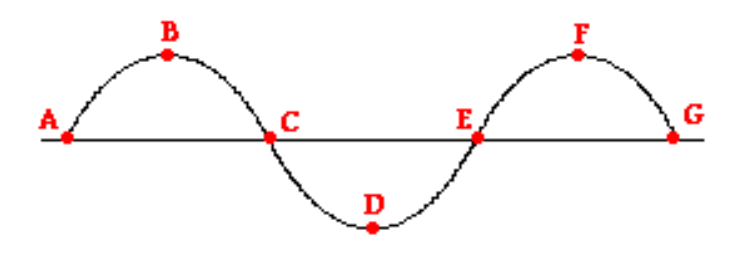
What part of the wave is shown at letter A?
crest
wavelength
trough
frequency

Which part of the wave is shown at letter B?
crest
wavelength resting point
trough
What does a wave carry?
boats
energy
matter
water

Which wave has a greater frequency?
wave B
wave C
Which section of the spectrum is the ONLY one we can see?
X-rays
Gamma Rays
Visible Light
Ultraviolet Rays

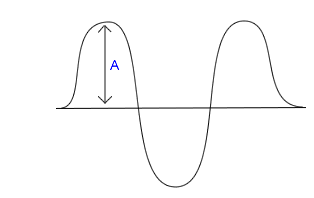

Between waves B and D, which is louder?
Wave B
Wave D

Between waves F and G, which is lower in pitch?
Wave F
Wave G

What does sound waves travel the fastest through?
Liquids
Gases
Solids
Which of the following is not an example of a mechanical wave?
Light wave
Sound wave
Water wave
Seismic wave
What type of wave is a light wave?
A sound wave
A seismic wave
A electromagnetic wave
A mechanical wave

What is the amplitude of this model wave?
0mm
5cm
15cm
10mm
Why is a light wave not considered a mechanical wave?
A light wave is visible to humans.
A light wave moves faster than most waves.
A light wave does not have a wavelength.
A light wave travels through the vacuum of space.

What is the frequency of this model wave?
10 waves per second
3 waves per second
6 waves per second
2 waves per second
How is an electromagnetic wave different from a mechanical wave?
An electromagnetic wave travels slower than a mechanical wave.
An electromagnetic wave has a larger amplitude than a mechanical wave.
An electromagnetic wave can travel through a vacuum, but a mechanical wave cannot.
An electromagnetic wave has no wavelength, but a mechanical wave has a wavelength.
Which of the following are not a part of the Electromagnetic Spectrum?
Gamma Rays
Radio waves
Magnetic waves
x-rays
Gamma Rays are
High energy
Low energy
Medium energy
Just right

Based on your observations of the prism, select the true statements.
When light travels through a prism, the light is separated by wavelength.
Humans see the different wavelengths of visible light as different colors.
The prism is being used to combine different colors of light.
The light bends when it enters the prism and again when it leaves the prism.
A light wave is considered to be an electromagnetic wave. But what other kind of wave is it?
Surface wave
Longitudinal wave
Transverse wave

Why does this car appears red under a white light?
The car is absorbing the red light and reflecting the blue and green.
The car is reflecting only the red light while absorbing the blue and green.
The car is absorbing the red and green light while reflecting the blue.
The car is absorbing the red, blue and green, but our eyes can only see the red.
What is ultraviolet light
Light that has more energy than regular light so we can't see it.
Light that has less energy than regular light so we can't see it.
Light that is only given off at night.
Light that only All Might can see.
Materials that allow light to pass through but not all of it are ___________.
Translucent
Transparent
Opaque
Materials that do not allow light to pass through are __________.
Translucent
Transparent
Opaque
Light waves bounce off a surface
Reflection
Refraction
Absorption
Materials that allow light to pass through easily are ___________.
Translucent
Transparent
Opaque
Light energy transferred to matter
Reflection
Refraction
Absorption
Light waves changing direction or bending as they pass from one medium to another
Reflection
Refraction
Absorption
A banana appears yellow. The color yellow is ________.
Reflected
Absorbed
A ________ object absorbs all colors.
Black
White
A _______ object reflects all colors.
Black
White
Which answer correctly orders the colors of the rainbow from the largest wavelength to the shortest wavelength?
Red, Orange, Yellow, Green, Blue, Indigo, Violet
Orange, Red, Yellow, Green, Blue, Indigo, Violet
Violet, Indigo, Blue, Green, Yellow, Orange, Red
Red, Orange, Yellow, Blue, Green, Indigo, Violet
Which of the following is the best example of a translucent object?
Empty fish tank
Sunglasses
Cardboard box
Aluminum foil
Which of these materials will absorb the most light?
Clear plastic
Apple
Mirror
Magnifying glass
Why does a pencil appear broken when it is placed in a glass of water?
Reflection
Absorption
Refraction
Transmission
When looking in a mirror, light...
Bends as it passes through
Is absorbed by the mirror
Bounces off the surface of the mirror
Is partially absorbed by the mirror and partially transmitted
Which is an example of a translucent object?
Ice cube
Rock
Eraser
Glass beaker
Which lens represents the path light takes through a diverging lens?


When light waves move from passing through air to passing through a glass lens when happens to them?
They slow down and change direction
They speed up and change direction
They maintain the same speed and change direction
They maintain their same speed and direction


A __________ is a piece of glass that
separates white light wider into seven different colors.
Prism
White light appears white or transparent, but it is actually
made up of several different colors.
True
False

What is "F" stand for?
Focal point
Crest point
Wavelength point
What lens is in the picture?
Divergent lens
Prism
Convergent lens

What lens is in the picture?
Divergent lens
Prism
Convergent lens

Which EM waves have the longest wavelength?
radio
x-rays
ultraviolet
gamma rays
Which EM waves have the shortest wavelength?
radio
x-rays
ultraviolet
gamma rays
Which EM waves are invisible? (more than one correct answer)
radio
visible
ultraviolet
gamma rays
Which EM waves are have a SHORTER wavelength than visible?
radio
none
infrared
x-rays
Which EM waves are have the lowest frequency?
radio
none
infrared
x-rays
Which EM waves are have the highest energy & are the most dangerous?
radio
gamma rays
infrared
x-rays
Which color waves have the lowest frequency?
red
yellow
green
violet
Which color waves have the shortest wavelength?
red
yellow
green
violet
What happens to frequency when wavelength decreases?
stays the same
decreases
increases
There is no relationship between wavelength & frequency.
Which type of electromagnetic wave travels fastest through a vacuum?
radio
gamma rays
visible light
They all travel at the same speed.

The diagram shows a person observing a thunderstorm located several kilometers away. The person hears the thunder several seconds after seeing the lightning. Which statement accurately explains the difference in observations of sound and light by the observer?
Human eyes see light faster than their ears can hear sound.
The medium the waves are traveling through is different for each type of wave.
Light waves travel faster than sound waves.
Sound waves travel faster than light waves.

The picture below shows a ringing bell inside a vacuum jar. As air is pumped from the vacuum jar, the sound level of the ringing bell will decrease until it can no longer be heard.
This happens because air must be present in the jar in order for
sound to be transferred
electricity to flow through the wires
the rubber to seal the jar
the bell clanger to vibrate

The diagram below shows a light ray. In this diagram, the light ray is being
transmitted
absorbed
reflected
refracted

The diagram below shows a pencil in a glass of water. When viewed from the side, the pencil appears to be broken. What process causes this to happen?
absorption
evaporation
reflection
refraction
What do electromagnetic waves NOT need to transfer energy?
matter
speed
wavelength
frequency


Which of the following has the lowest energy?
The color yellow
The color blue
The color indigo
The color orange

Which of the following has the shortest wavelength?
microwaves
UV rays
Infrared
the color blue

Which of the following has the most energy?
Red
Blue
Green
Violet
Which of the following is true for sound waves?
They require a medium.
They are unrelated to vibrations.
They cannot travel through liquids
They can travel in a vacuum
A student asks a series of questions about a wave. The answer to which question will allow the student to determine whether the wave is electromagnetic or mechanical?
Does it require a medium in order to travel?
Can it pass through air and water?
Does it have a measurable speed?
Does it have a measurable frequency?
How do electromagnetic and mechanical waves compare?
Mechanical waves can only travel through a vacuum, but electromagnetic waves can travel through a solid, liquid, or gas.
Mechanical waves can travel through a solid, liquid, or gas, but electromagnetic waves can only travel through a gas.
Mechanical waves can only travel through a solid, liquid, or gas, but electromagnetic waves can travel through a vacuum.
Mechanical waves can travel through a solid, liquid, or gas, but electromagnetic waves can only travel through a solid.
This sound has high pitch, which means it has a higher frequency. This means when you hear the sound...
More waves hit your ears per second
Bigger waves hit your ears
Less waves hit your ears per second
Longer waves hit your ears
How are Electromagnetic waves different from Mechanical waves?
EM waves have very short wavelengths
EM waves transmit energy instead of matter
EM waves can travel through the vacuum of space (without particles)
EM waves can change direction by reflection
Select the correct order of waves on the EMS from low to high energy
Radio, Micro, Infra, Visible, Ultra, X-ray, Gamma
Gamma, X-ray, Ultra, Vis, Infra, Micro, Radio
Vis, Micro, Infra, Ultra, X-ray, Gamma, Radio
Micro, Radio, Vis, Infra, Ultra, X-ray, Gamma
A wave has a frequency of 10 hz and a wavelength of 4 m. What is the velocity of the wave?
24 m/s
40 m/s
2.5 m/s
A wave has a velocity of 10 m/s and a frequency of 20 hz. What is the wave length of the wave?
2 m
0.5 m
10 m
A wave has a frequency of 2.5 hz and a wavelength of 20 m. What is the velocity of the wave?
50 m/s
8 m/s
40 m/s
A wave has a velocity of 4 m/s and a wavelength of 2 m. What is the frequency of the wave?
2 hz
8 hz
18 hz
A wave has a frequency of 6 Hz. What is the period of the wave?
0.167 s
6 m
0.167
6 Hz
A radio wave has a wave length of 4 m and a frequency of 4 Hz. What is the speed of the wave?
16 m/s
16 m
4 Hz
8 m/s
What is a rapid back-and-forth motion that can occur in solids, liquids or gasses?
vibration
sound
light
rarefaction
Sound waves can travel through:
solids
liquids
gasses
all of these
Sound waves cannot travel through:
solids
liquids
gasses
empty space
Sound waves require a __________ to travel through.
medium
person
transverse
Slinky
You usually hear sound through the medium of:
air
water
fire
earth
Sound waves travel fastest in:
gasses
liquids
solids
empty space
A wave with a greater intensity will produce:
a louder sound
a softer sound
a lower pitch sound
a higher pitch sound
The pitch of a sound depends on its:
frequency
amplitude
intensity
loudness
The higher the frequency, the ____________ the wavelength.
longer
shorter
taller
bolder
The human ear can detect frequencies between:
20 and 20000 Hz
100 and 200 Hz
1 and 100 Hz
20 and 30 Hz
Frequency is measured in:
decibels
Hertz
meters
seconds
Which of the following best describes a sound wave with high amplitude?
The sound wave is loud
The sound wave is high pitched
The sound wave is above the cloud

What does the area pointed by the arrow in the diagram represent?
compression
rarefaction
equilibrium
What is the name for an area of low pressure in a longitudinal wave?
compression
rarefaction
equilibrium
Sound is made when a source of energy forces the matter to:
shake
vibrate
move
stay still
Which temperature causes sound to travel more slowly?
hot
cold
Loudness of waves is measured in ____________.
Hertz
Decibels
Watts
meters/second
The maximum safe level for loudness is _________.
0 dB
60 dB
85 dB
130 dB
Frequency of waves is measured in ___________.
Hertz
Decibels
Watts
meters/second
High frequency sounds have __________ pitch.
high
low
As wavelength goes up, frequency goes
up
down
As amplitude goes up, energy goes
down
up
As wavelength goes up, energy goes
down
up
As frequency goes up, energy goes
up
down
What is pitch?
How loud or soft a sound is.
How high or low sound is.
When you throw a baseball.
The sound that you hear.
What is volume?
How loud or soft a sound is.
How high or low sound is.
When you throw a baseball.
The sound that you hear.
Volume measures how low or high a sound is while pitch measures how loud or soft a sound is.
True
False
If a sound has a loud volume, it must have a high pitch.
True
False
If we describe a sound as loud, we are describing the ________.
pitch
volume
noise
vibrations
If we are describing how low or high a sound is, we are describing the ______.
noise
pitch
volume
waves
A sound with a high pitch can have a ________ volume.
low or high
loud or soft
loud
soft
A sound with a soft volume can have a ________ pitch.
low
low or high
loud or soft
high
What is the unit of sound?
decibel
sound level meter
meter
liter
What instrument is used to measure sound?
decibel
sound level meter
measuring tape
meter tape
What are the 3 States of Matter
ice, sun, river
solids, liquids and gases
evaporation, sleet and melting
which variables will affect the pitch of sound that your panpipe produces?
The colour of the pipes
how hard or soft you blow across the pipes
The length of the pipes
The size of your panpipe
It is the highness or lowness of a sound.
Pitch
Intensity
Timbre
Doppler effect
It is the change in wave frequency caused by a moving wave source.
Pitch
Intensity
Timbre
Doppler effect
It is the inducing of vibrations of a natural rate by a vibrating source having the same frequency.
Refraction of sound
Diffraction of sound
Interference
Resonance

What kind of wave is in the image?
transverse waves
longitudinal waves
It is the reflected sound.
Echo
Interference
Diffraction
Refraction
It is the highness or lowness of a sound.
Pitch
Intensity
Timbre
Doppler effect
It is the change in wave frequency caused by a moving wave source.
Pitch
Intensity
Timbre
Doppler effect
It is the inducing of vibrations of a natural rate by a vibrating source having the same frequency.
Refraction of sound
Diffraction of sound
Interference
Resonance
What kind of wave is in the image?
transverse waves
longitudinal waves

What kind of wave is in the image?
transverse waves
longitudinal waves
What is a general definition of wave interference?
When a wave bounces off an object
When more than on wave meet and interact in the same medium
When a wave bends around a corner
When a wave creates static

What type of interference is being shown in the picture?
Constructive
Destructive

What type of interference is occurring in the picture?
Constructive
Destructive
How can resonance break an object?
forcing an object to vibrate at its natural frequency for a short time
forcing an object to vibrate at different frequencies for a short time
forcing an object to vibrate at different frequencies for a longtime
forcing an object to vibrate at its natural frequency for a long time
What type of energy does a sound wave have?
Mechanical
Radiant
Electrical
Sound
True or False: Sound needs a medium.
True
False
Sound waves are also known as ----- waves.
Compression
Longitudinal
Neither
Both longitudinal and compression

The measure of the amount of energy in a wave is ----
Wavelength
Hertz
Frequency
Amplitude
The speed of sound depends on these two things:
The type of medium and the temperature of the medium
Speed of the medium and temperature of the medium
Temperature of the medium and sound of the medium
None of the above

Sonar and echolocation use ----- to detect objects under water.
Refraction
Reflection
happens when a wave bounces back after hitting a barrier
reflection
refraction
diffraction
interference
when a wave passes through a substance
transmitted
dispersed
echo
interference
the bending of a wave as the wave passes from one medium to another at an angle
refraction
transmitted
reflection
echo
the bending of waves around a barrier or through an opening
echo
diffraction
refraction
reflection