
 Worksheets
FOSSILS
Total questions: 24
Worksheet time: 33mins

A student wants to create a model to represent how a turtle fossil formed once it dies. They designed the following plan for the model.
Which of the following would be the BEST for the student to do to continue their model for Step 3?
Squish the clay to show that overtime fossils will disappear.
Fill in the gaps with glue to represent minerals filling the space.
Reveal the fossil since it is time for scientists to discover the fossil.
Smooth the imprint over with your fingers to show that sediment will fill in the spaces.

Erik and Carol are each creating a model to represent how an imprint of a leaf fossil is formed. Below are their descriptions of the model they created.
Who has a more accurate model?
Erik, because he used play dough and it will decompose in the soil.
Erik, because he buried it in soil which happens to all dead things.
Carol, because the glue represents the minerals filling in the spaces to form a fossil.
Carol, because she used clay and it could be molded over and over into something new.
A student is observing two fossils found in a warm wooded region. One fossil is of an animal and one of a plant. Both of these fossils appear to have the same characteristic that they retain water. What can you infer about the environment in which these organisms lived?
The fossils are of organisms that once lived in an ocean because they need water in order to survive.
The fossils are of organisms that once lived in a desert since these organisms are able to live where there is limited water.
The fossils are of organisms that once lived on the coast next to the ocean because they lived on land, but need access to the ocean.
The fossils are of organisms that once lived in a wooded area because there are a lot of types of plants and animals found in this region.
Two fossils are found in a cold mountain region. One is a fish fossil and the other is a palm tree fossil. What can you infer about the environment in which these organisms lived?
A cold mountain region because an environment cannot change its type of environment over time.
A warm mountain region because since there are palm trees, the area needs to be warm.
A hot desert because palm trees are found in hot areas.
A warm ocean environment because fish are found in areas with water and palm trees are found in warm ocean environments.
A group of third graders share the task of creating a model to represent how fossils are formed. One of the students is in charge of representing the step that organisms are buried under sediment. They are using a clay dinosaur to show the steps. Which of the following would BEST demonstrate this step?
Use glue to fill in empty spaces on the clay dinosaur.
Use a book to push down dirt over the clay dinosaur.
Use a pencil to pick at the dirt around the clay dinosaur.
Use a piece of paper to squeeze the clay dinosaur from all directions.
A boy was hiking through a desert with his family. He found a fossilized insect that has pinchers for eating grass while he was digging in the sand. What can the boy conclude about the habitat of the once living insect?
The area was always a desert and someone put the fossil there.
The area was once covered in water and must have had sea animals.
The area must have once had lots of grass because of the characteristics of the fossil.
The area has always been a desert because of the location where the fossil was found

A student creates a model to show the process of how the following fossil formed.
Which of the following should the students include in their illustration?
The student should show people digging out the fossil to show an animal becomes a fossil the moment it is discovered.
The student should draw a time lapse of images for each step with arrows and descriptions.
The student should label the soil types in each layer of the illustration.
The student should label the type of dinosaur in their image.

Which table is the correct sequence and why?
Table 1 because the fossil is discovered last.
Table 1 because the organism must be buried quickly after dying.
Table 2 because the parts decay before it is buried.
Table 2 because the fossil is discovered last.
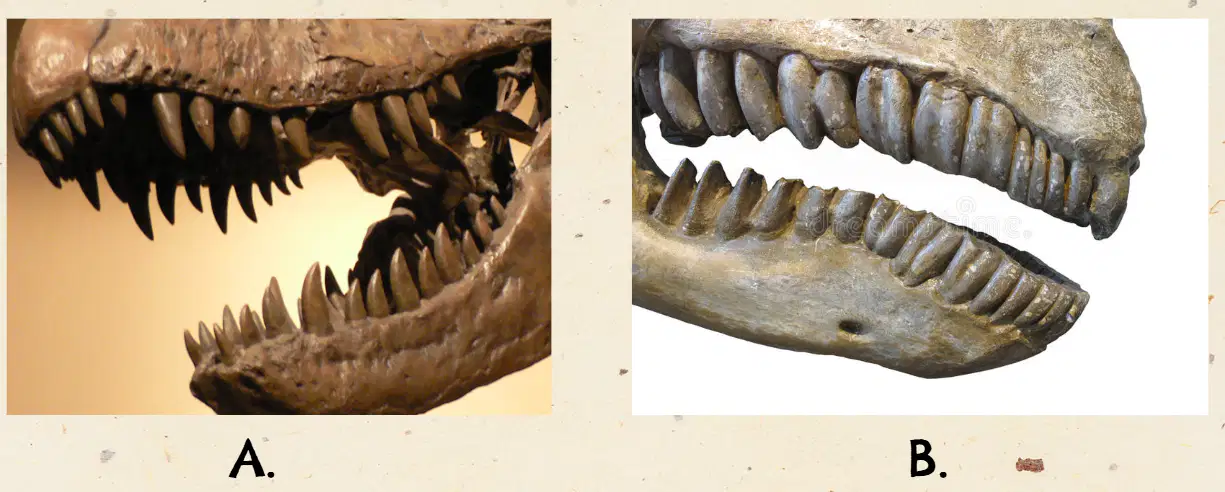
Which fossil shows evidence that the organism ate meat when it was alive?
A
B

What clues does the fossil give you about how the animal moved and what type of habitat it lived in?
This animal lived at the bottom of the mountain since it was discovered at the mountain, but the mountain rose in height over time.
This animal lived at the top of a mountain since that is the location it was discovered.
This animal lived in a water environment such as a lake or ocean since it has bones.
This animal lived in a water environment since it has dorsal fins.
A student was observing a full fossilized skeleton of an animal at a museum. He wants to know more about the animal and is curious about the type of habitat it lived in when it was alive. What clues below would BEST help him to find out what he wants to know?
The animal has large tusks with very short front legs and long legs in back.
The animal has a very large body and flipper-like front feet.
The animal has large flat teeth and really large rib bones.
The animal has very sharp teeth and a really large skull.

From the fossil, which of the following observations is NOT an observation that a scientist could make about the dinosaur?
That the dinosaur moved on four feet.
The color the dinosaur was.
What the dinosaur ate.
The size the dinosaur was.

Which fossil shows evidence that the organism moved around by flying when it was alive?
A
B
What can scientists learn by studying fossils?
what types of organisms lived a long time ago
how every organism died a long time ago
how minerals are formed
what rocks are made of
Where are most fossils formed?
Near earthquakes, because the shaking ground traps organisms to create fossils.
In glaciers, because fossils are created when an organism is frozen quickly.
Near volcanoes, because the high heat of the lava helps to form fossils.
In sedimentary rock, because being buried in sediment helps to form fossils.
Which fossil shows evidence that the organism ate plants when it was alive?
A
B
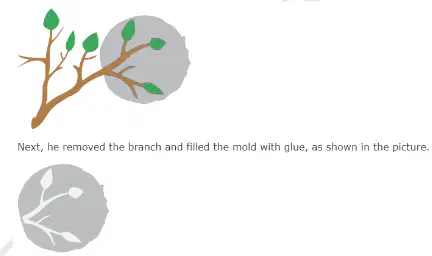
Titus created a model of a plant becoming a fossil. First, he pressed a branch into clay, as shown in the picture. What does the glue represent in this model?
soil
bone
water
minerals
Plants and animals with weak structures create poor fossils. They may break apart before fossilization can occur. When they do become fossils, the shape of the organism may not be well preserved.
Why might not all organisms become fossils?
They create poor fossils because they have the wrong shape
They have weak structures that break apart.
They were the wrong plants and animals.
They may break apart because they don’t want to become fossils.
If an animal gets trapped in mud, which part of the animal is most likely to turn into a fossil?
organs
bone
hair
skin

Which fossil shows evidence that the organism moved around by swimming when it was alive?
A
B

A third grader is tasked to create a model to show how a fossil is formed. Which of the following steps comes first and why?
The first step is that the animal is buried by sediment because if it is buried by sediment, it will then die to become a fossil.
The first step is that bone is slowly replaced with minerals because if they are replaced by minerals, then once it dies, it starts to fossilize.
The first step is that an animal dies because once any living thing dies, it will always start the fossilization process.
The first step is that an animal dies because once a living thing dies, it has the possibility of becoming a fossil.

The first step is that bone is slowly replaced with minerals because if they are replaced by minerals, then once it dies, it starts to fossilize.
What clues does the fossil give you about how the animal moved and what type of habitat it lived in?
This animal lived at the top of a mountain since that is the location it was discovered.
This animal lived in a water environment since it has fins.
This animal lived in a water environment such as a lake or ocean since it has bones.
This animal lived at the bottom of the mountain since it was discovered at the mountain, but the mountain rose in height over time.

Two fossils are found in a cold mountain region. One is a fish fossil and the other is a palm tree fossil. What can you infer about the environment in which these organisms lived?
A hot desert because palm trees are found in hot areas.
A warm ocean environment because fish are found in areas with water and palm trees are found in warm ocean environments.
A warm mountain region because since there are palm trees, the area needs to be warm.
A cold mountain region because an environment cannot change its type of environment over time.
Which fossil shows evidence that the organism moved around by walking on 4 legs when it was alive?
A
B

