
 Worksheets
Science Moy Study Guide
Total questions: 202
Worksheet time: 3hrs 52mins
Match the following types of energy to their definitions:
light energy
Radiant energy that travels in electromagnetic waves
sound energy
Energy caused by wave vibrations through matter
chemical energy
Energy stored in chemical bonds of molecules
thermal energy
Energy a substances has related to its temperature
mechanical energy
Energy a system has because of its motion
A toaster converts ___ energy to ___ energy.
light; electrical
heat; electrical
electrical; heat
heat; light

Alice is watching her mother make some tea. Her mother fills the tea kettle with water and plugs it into the outlet. She turns the switch on, causing it to glow red. Soon, Alice can see steam rising from the spout of the kettle. The steam builds until the kettle lets out a loud whistle. The diagram shows the kettle. Alice claims that energy is being transformed when her mother makes tea. What transformations occur? Choose the BEST answer.
electrical -> light and heat -> sound
sound- > electrical -> heat
heat -> electrical -> sound
electrical -> sound -> heat -> light

A skier increases speed while skiing down a hill during a race. Which statements accurately describe the potential and kinetic energy of the skier?
Kinetic energy increases. Potential energy decreases.
Kinetic energy increases. Potential energy stays the same.
Kinetic energy stays the same. Potential energy decreases.
Kinetic energy stays the same. Potential energy increases.

Which answer choice correctly describes the roller coaster's kinetic and potential energy?
The coaster has more potential energy at point 3 than at point 4.
The coaster has more kinetic energy at point 3 than point 2.
The potential and kinetic energy of the coaster are equal at point 4.
The potential and kinetic energy of the coaster are the greatest at point 1.

A pendulum is given potential energy by being pulled up to location W. At which location does the pendulum have maximum kinetic energy?
Location W
Location X
Location Y
Location Z

What type of energy is created using this?
chemical
electrical
mechanical

Batteries have _________ energy.
mechanical
thermal
chemical

The sun gives off __________ energy.
mechanical
electrical
radiant

A lamp that plugs into a wall socket draws energy, which flows through a thin wire in the bulb, causing it to heat up until it glows. What energy transformations are taking place?
Chemical → light → electrical
Mechanical → sound → light
Thermal → solar → electrical
Electrical → thermal → light
An electric pencil sharpener uses electricity to make its motor spin. The pencil sharpener also makes noise and heats up. Which observation of the pencil sharpener demonstrates the law of conservation of energy?
The amount of electrical energy used equals the total amount of mechanical, sound, and thermal energy produced.
The amount of energy used by the electric pencil sharpener is greater than an electric lamp.
The electric pencil sharpener only uses energy when it is being used to sharpen a pencil.
The electric pencil sharpener is easier to use than the older version that was cranked by hand.
During energy transformations, energy is never ___.
released as heat
used to increase an object's potential energy
created or destroyed
completely transformed

What type of energy is generated in a wind turbine?
Mechanical to Light
Mechanical to Electrical
Mechanical to Solar (Radiant)
Problem
A student walks 3 km in 20 minutes. What is the student’s average speed in km/h
12
9
7
6
Problem
A car travels 10 km in 15 minutes. What is the average speed of the car?
25 km/h
20 km/h
40 km/h
45 km/h


Problem
A dog runs 6 km in 30 minutes. What is the dog’s average speed in km/h?
25
180
12
5

Carleton walked for a while, stopped to sit on a bench in the park, and then ran the rest of the way home.
Carleton ran all the way from school to home going the same constant speed and never stopping.
Carleton waited around after school for his friend, and then they ran home together.
Carleton ran for a long time, then slowed down to walk the rest of his trip. Once he got home, he sat down on the couch.

Jessica ran all the way from school to home going the same constant speed and never stopping.
Jessica waited around after school for her friend, and then they ran home together.
Jessica ran for a long time, then slowed down to walk the rest of her trip. Once she got home, she sat down on the couch.
Jessica walked for a while, stopped to sit on a bench in the park, and then ran the rest of the way home.
Problem
Which of the following best describes the speed of an object?
14 m/s2
14 m/s south
14 m/s
14 m south

0.8 m/s
0.08 m/s
1.25 m/s
0.125 m/s

Sam ran for a long time, then slowed down to walk the rest of his trip. Once he got home, he sat down on the couch.
Sam waited around after school for his friend, and then they ran home together.
Sam walked for a while, stopped to sit on a bench in the park, and then ran the rest of the way home.
Sam ran all the way from school to home going the same constant speed and never stopping.


7. How fast are you going if you walk 24 km in 3 hours?
72 km/h
36 km/h
27 km/h
8 km/h

#4 Show all your work on your answer document.
4.5 m/s
0.22 m/s
175 m/s
11250 m/s

#10 Show all your work on your answer document. (Average speed = total distance / total time)
6.25 km/min
21 m/s
0.16 km/min
100 m/s

#9 Show all your work on your answer document. (Average speed = total distance / total time)
1.6 km/min
1.6 m/s
0.625 km/min
0.625 m/s

#2 Show all your work on your answer document.
400 m/min
0.0025 m/min
3600 mi/hr
40 m/s

Ms. H rides her unicorn to the mall. The mall is 2400 meters from her home and it takes her 12 minutes to get to the mall. What is Ms. H's average speed in meters per minute?
200 m/m
150 m/m
220 m/m
250 m/m

How fast is uncle Billy running if it takes him 30 minutes to travel 240 meters?
10 m/m
6 m/m
8 m/m
5 m/m
What is the speed of a rocket that travels 9000 meters in 12.12 seconds?
725 m/s
7,425 m/s
742.5 m/s
680 m/s

Which elements are to the right of the zig zag?
metals
nonmetals
metalloids

What is an example of a physical change?
having less ash than the paper that was burned to form it
ice forming and then melting back into water
rust having a different identity than the iron it forms on
the irreversible reaction of vinegar and baking soda
The Statue of Liberty is made of copper that has turned green because it has undergone a change. What can be said about this change?
The change is a physical change because the copper in the statue is still there.
The change is a physical change because a new chemical is formed on the outside of the statue.
The change is not a physical change because the color of the statue has changed.
The change is not a physical change because a new chemical is formed on the outside of the statue.
A rock breaks into smaller pieces when it is struck with a hammer.
Rust forms on a bike that has been left outside too long.
A cup of water turns pink when a few drops of red food coloring are added.
A solid is formed when heat is removed from a sample of water.

What is the volume of this liquid?
60 mL
70 mL
67 ML
69 mL


a metric unit of measurement used to measure small volumes of liquid
matter
cubic centimeter
mass
milliliter mL
has mass and takes up space.
gram
volume
displacement
matter
a metric unit of measurement used to measure small volumes of solid substances
cubic centimeter
displacement
milliliter
What is the formula for density?
D=V/M
D=MxV
D=M/V
D=M+V
The physical property relating the amount of matter in a substance to the volume of the substance.
classify
density
volume
mass
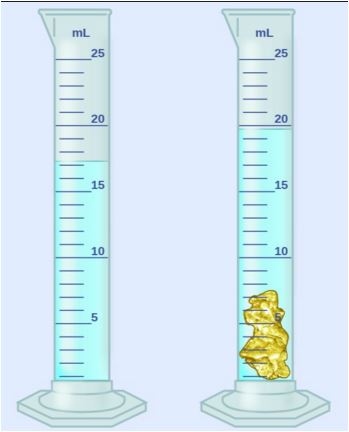

An irregularly shaped rock was lowered into a graduated cylinder holding a volume of water equal to 50 ml. The height of the water rose to 75 ml. If the mass of the stone was 250 g, what was its density?
15 g/mL
5 g/mL
10 g/mL
20 g/mL


If these are all moving at the same speed, the vehicle with the greatest KE would be
(Think about their sizes)




Which letter shows where kinetic energy is at is highest point?
X
Y
W
Z
Which of the following statements about a skier skiing down a steep slope is true?
His kinetic energy decreases and his potential energy increases
His potential energy decreases and his kinetic energy increases
His chemical energy increases
Both his potential and kinetic energy increases
Which of the following statements about a skier skiing down a steep slope is true?
His kinetic energy decreases and his potential energy increases
His potential energy decreases and his kinetic energy increases
His chemical energy increases
Both his potential and kinetic energy increases

Which number shows kinetic energy at its maximum?
three
two
four
five
The ability to do work by applying force is called
work
energy
force
net force
True or False: elements AND compounds are pure substances.
True
False
True or False: elements AND compounds are pure substances.
True
False
Which of the following is the best description of an element?
A substance that cannot be broken down into simpler substances.
A naturally occurring mineral made of more than one substance.
A small particle made with a specific chemical composition.
A collection of atoms that have different abilities when joined together.
Which of the following is the best description of an element?
A substance that cannot be broken down into simpler substances.
A naturally occurring mineral made of more than one substance.
A small particle made with a specific chemical composition.
A collection of atoms that have different abilities when joined together.
Provided is a list of five different substances.
NaOH Cu H2O N2 H2
How many of these substances are elements?
2
3
4
5
Which element is one of the most abundant in both solid parts of Earth and in living matter?
Carbon
Oxygen
Nitrogen
Phosphorus
Which element makes up most of Earth's atmosphere?
Hydrogen
Carbon
Oxygen
Nitrogen
Below is a list of some substances and their symbols.
Oxygen O
Sodium Chloride NaCl
Gold Au
Neon Ne
How many of these substances are an example of an element?
1
2
3
4
How are elements and compounds different?
A compound is represented by a chemical formula, and elements are represented by a chemical symbol.
Compounds are represented by chemical symbols of one letter, and elements are represented by symbols of two letters.
Elements are pure substances, and compounds are not.
Elements are always larger units of matter, and compounds are smaller.
How many elements are in the compound Fe2O3?
0
1
2
3
Which "sphere" includes all water?
Hydrosphere
Lithosphere
Atmosphere
Biosphere
Which 'sphere' has oxygen and nitrogen as its two main elements?
Lithosphere
Biosphere
Atmosphere
Hydrosphere
Which 'sphere' has oxygen and carbon as its two main elements?
Atmosphere
Lithosphere
Hydrosphere
Biosphere
Oxygen and ____ are the main elements found in the Lithosphere!
Silicon
Carbon
Nitrogen
Aluminum
Which 'sphere' has oxygen and hydrogen as its two main elements?
Atmosphere
Biosphere
Lithosphere
Hydrosphere
Hydrogen is considered an element, while hydrogen peroxide is considered a compound. This is because hydrogen peroxide is...
is used for cleaning wounds.
made of two different elements.
is a liquid.
useful to human beings.
The smallest particle of matter
Element
Compound
Atom
Chemical
Rocks are primarily composed of which two elements?
Hydrogen and Oxygen
Oxygen and Silicon
Calcium and Hydrogen
Carbon and Nitrogen
All of the following elements are major components of soil on Earth except:
Oxygen
Iron
Hydrogen
Calcium
The hydrosphere is mostly comprised of Hydrogen and ...
Oxygen
Silicon
Carbon
Hydrogen
Which of the following three elements are most abundant in the lithosphere?
Aluminum, oxygen, and silicon
Oxygen, carbon, and hydrogen
Silicon, nitrogen, and calcium
Nitrogen, oxygen, and silicon
Which two elements are most common in both the hydrosphere and biosphere?
Hydrogen and oxygen
Nitrogen and oxygen
Calcium and nitrogen
Oxygen and carbon
All of the following elements are major components of plants on Earth except...
Carbon
Oxygen
Nitrogen
Iron

This tea kettle whistles when the water boils. What energy transformations are taking place?
electrical --> thermal --> sound
chemical --> sound --> thermal
mechanical --> thermal --> sound

Identify the correct sequence of energy transformations in the campfire.
Chemical --> thermal + radiant
Chemical --> solar + radiant
Nuclear --> sound + thermal
Chemical --> electric + sound
What is a "pro" for coal use as an energy resource?
It produces more energy per kilogram
It is relatively cheap and plentiful
It burns without producing greenhouse gases
It is renewable
What is a "pro" for using solar power as an energy resource?
Solar panels do not produce pollution
Solar panels can only generate electricity during daylight hours
Weather conditions and air pollution can reduce the effectiveness of solar cells
The initial cost of installing solar panels is high
What is a "pro" for using solar power as an energy resource?
Solar panels do not produce pollution
Solar panels can only generate electricity during daylight hours
Weather conditions and air pollution can reduce the effectiveness of solar cells
The initial cost of installing solar panels is high


Match the graph to the description:
"The car is stopped."
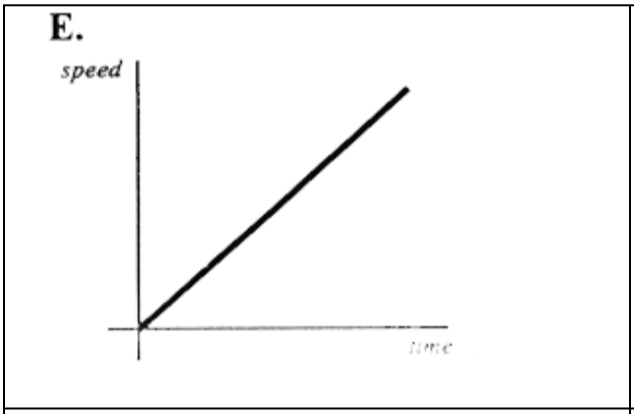
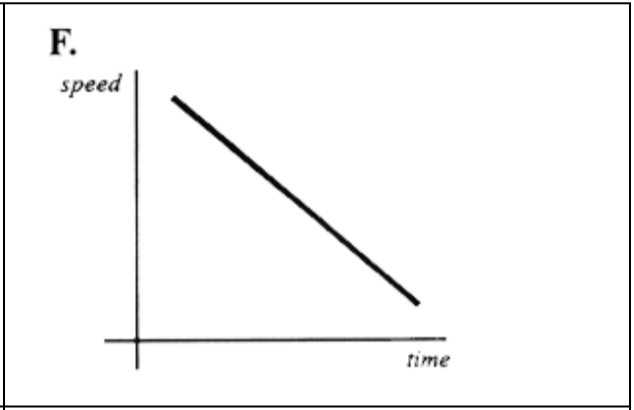
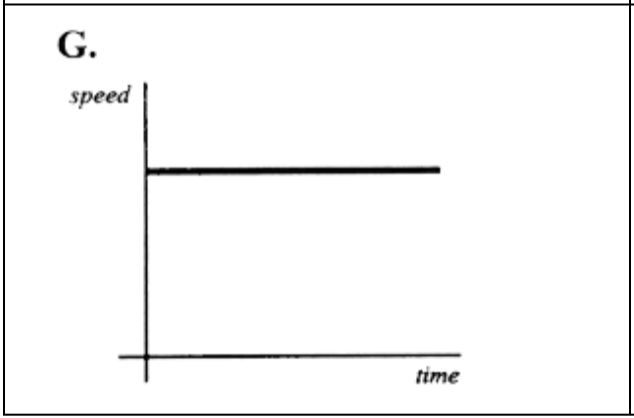
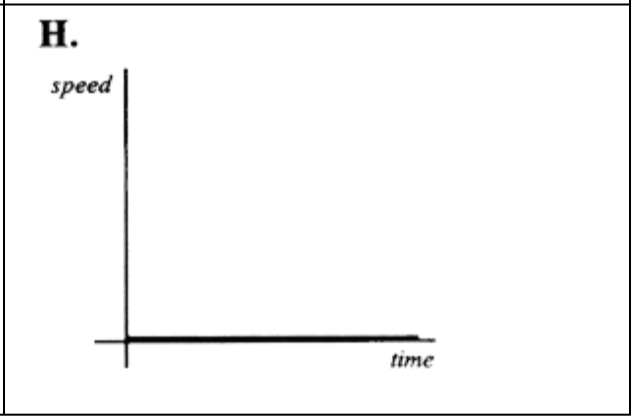
Match the graph to the description:
"The car is traveling at a constant speed."


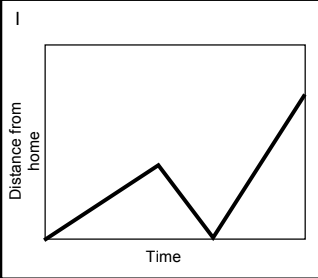
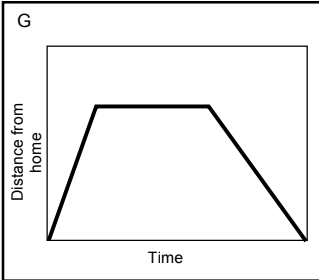
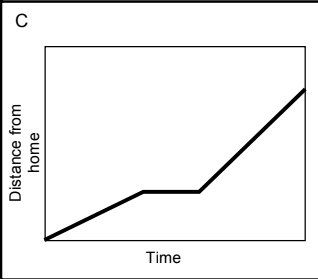
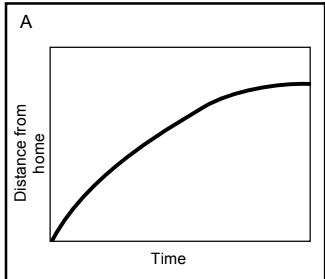

What is happening between 9am and 11am?
(Hint: total number of miles is the same as distance)
The cyclist is traveling up a hill
The cyclists is speeding up
The cyclists is traveling at a constant speed
The cyclist is slowing down

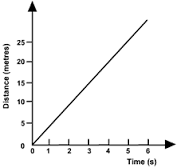
What is the line on this graph showing?
moving away from starting point at a constant speed
moving back towards the starting point at a constant speed
acceleration (getting faster)
deceleration (getting slower)


A runner races in the 100 meter dash. It takes her 10 seconds to finish. What is her average speed?
10 m/s
1000 m/s
100 seconds
10 seconds

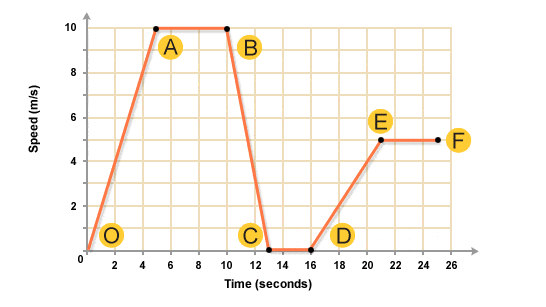
Between which section did the bus stop?
A - B
O - A
C-D
D - E

What is the distance the object moved in 3 min. time ?
50
100
150
200


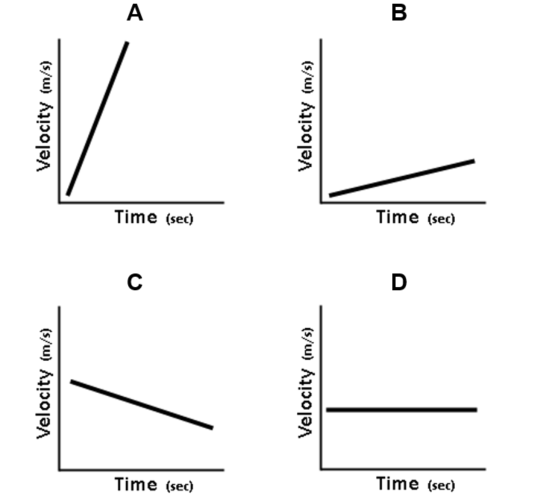
Consider the 4 line graphs representing speed in meters/second, where each X-axis is labelled in seconds and each Y-axis labeled in meters.
What do the four graphs have in common?
They all indicate a constant speed.
They all indicate an increase in speed.
All 4 graphs have nothing in common.
They all represent the same speed in m/s.

The x axis is distance, the y axis is time. What is happening in the graph?
the object keeps getting faster
the object starts out fast, but starts to slow down
the object starts out slow, but gradually speeds up and moves fastest at the end
the object moves, stops, then moves again
Choose the graph that matches the following scenario:
A student walked to his locker, stopped for a few seconds and then continued on the same path to class.


Choose the graph that matches the following scenario:
A student walked at a steady, constant pace as she went from one class to the other.
Choose the graph that matches the following scenario:
A student ran to the cafeteria, then stopped and looked around for his lunch kit, and then ran back to the class to get it.
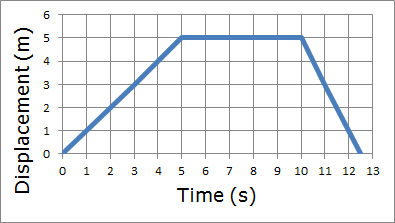
According to the graph how far does the person travel in the first 5 seconds?
2 m
10 m
0 m
5 m


Speed is different from velocity because
Velocity has a direction
Speed uses Distance /Time
Velocity doesn't include time
Velocity doesn't include distance
Carleton walked for a while, stopped to sit on a bench in the park, and then ran the rest of the way home.
Carleton ran all the way from school to home going the same constant speed and never stopping.
Carleton waited around after school for his friend, and then they ran home together.
Carleton ran for a long time, then slowed down to walk the rest of his trip. Once he got home, he sat down on the couch.
Jessica ran all the way from school to home going the same constant speed and never stopping.
Jessica waited around after school for her friend, and then they ran home together.
Jessica ran for a long time, then slowed down to walk the rest of her trip. Once she got home, she sat down on the couch.
Jessica walked for a while, stopped to sit on a bench in the park, and then ran the rest of the way home.
Problem
A student walks 3 km in 20 minutes. What is the student’s average speed in km/h
12
9
7
6
Problem
A student walks 3 km in 20 minutes. What is the student’s average speed in km/h
12
9
7
6
Problem
A car travels 10 km in 15 minutes. What is the average speed of the car?
25 km/h
20 km/h
40 km/h
45 km/h
Problem
A dog runs 6 km in 30 minutes. What is the dog’s average speed in km/h?
25
180
12
5
Carleton walked for a while, stopped to sit on a bench in the park, and then ran the rest of the way home.
Carleton ran all the way from school to home going the same constant speed and never stopping.
Carleton waited around after school for his friend, and then they ran home together.
Carleton ran for a long time, then slowed down to walk the rest of his trip. Once he got home, he sat down on the couch.
Jessica ran all the way from school to home going the same constant speed and never stopping.
Jessica waited around after school for her friend, and then they ran home together.
Jessica ran for a long time, then slowed down to walk the rest of her trip. Once she got home, she sat down on the couch.
Jessica walked for a while, stopped to sit on a bench in the park, and then ran the rest of the way home.
Problem
Which of the following best describes the speed of an object?
14 m/s2
14 m/s south
14 m/s
14 m south
0.8 m/s
0.08 m/s
1.25 m/s
0.125 m/s
Sam ran for a long time, then slowed down to walk the rest of his trip. Once he got home, he sat down on the couch.
Sam waited around after school for his friend, and then they ran home together.
Sam walked for a while, stopped to sit on a bench in the park, and then ran the rest of the way home.
Sam ran all the way from school to home going the same constant speed and never stopping.
7. How fast are you going if you walk 24 km in 3 hours?
72 km/h
36 km/h
27 km/h
8 km/h
#4 Show all your work on your answer document.
4.5 m/s
0.22 m/s
175 m/s
11250 m/s
#10 Show all your work on your answer document. (Average speed = total distance / total time)
6.25 km/min
21 m/s
0.16 km/min
100 m/s
#9 Show all your work on your answer document. (Average speed = total distance / total time)
1.6 km/min
1.6 m/s
0.625 km/min
0.625 m/s
#2 Show all your work on your answer document.
400 m/min
0.0025 m/min
3600 mi/hr
40 m/s
Ms. H rides her unicorn to the mall. The mall is 2400 meters from her home and it takes her 12 minutes to get to the mall. What is Ms. H's average speed in meters per minute?
200 m/m
150 m/m
220 m/m
250 m/m
How fast is uncle Billy running if it takes him 30 minutes to travel 240 meters?
10 m/m
6 m/m
8 m/m
5 m/m
What is the speed of a rocket that travels 9000 meters in 12.12 seconds?
725 m/s
7,425 m/s
742.5 m/s
680 m/s
What is happening between 9am and 11am?
(Hint: total number of miles is the same as distance)
The cyclist is traveling up a hill
The cyclists is speeding up
The cyclists is traveling at a constant speed
The cyclist is slowing down
What is the line on this graph showing?
moving away from starting point at a constant speed
moving back towards the starting point at a constant speed
acceleration (getting faster)
deceleration (getting slower)
A runner races in the 100 meter dash. It takes her 10 seconds to finish. What is her average speed?
10 m/s
1000 m/s
100 seconds
10 seconds
Between which section did the bus stop?
A - B
O - A
C-D
D - E
What is the distance the object moved in 3 min. time ?
50
100
150
200
Consider the 4 line graphs representing speed in meters/second, where each X-axis is labelled in seconds and each Y-axis labeled in meters.
What do the four graphs have in common?
They all indicate a constant speed.
They all indicate an increase in speed.
All 4 graphs have nothing in common.
They all represent the same speed in m/s.
The x axis is distance, the y axis is time. What is happening in the graph?
the object keeps getting faster
the object starts out fast, but starts to slow down
the object starts out slow, but gradually speeds up and moves fastest at the end
the object moves, stops, then moves again
Choose the graph that matches the following scenario:
A student walked to his locker, stopped for a few seconds and then continued on the same path to class.
Choose the graph that matches the following scenario:
A student walked at a steady, constant pace as she went from one class to the other.
Choose the graph that matches the following scenario:
A student ran to the cafeteria, then stopped and looked around for his lunch kit, and then ran back to the class to get it.
According to the graph how far does the person travel in the first 5 seconds?
2 m
10 m
0 m
5 m
Speed is different from velocity because
Velocity has a direction
Speed uses Distance /Time
Velocity doesn't include time
Velocity doesn't include distance
Problem
A student walks 3 km in 20 minutes. What is the student’s average speed in km/h
12
9
7
6
Problem
A car travels 10 km in 15 minutes. What is the average speed of the car?
25 km/h
20 km/h
40 km/h
45 km/h
Problem
A dog runs 6 km in 30 minutes. What is the dog’s average speed in km/h?
25
180
12
5
Carleton walked for a while, stopped to sit on a bench in the park, and then ran the rest of the way home.
Carleton ran all the way from school to home going the same constant speed and never stopping.
Carleton waited around after school for his friend, and then they ran home together.
Carleton ran for a long time, then slowed down to walk the rest of his trip. Once he got home, he sat down on the couch.
Jessica ran all the way from school to home going the same constant speed and never stopping.
Jessica waited around after school for her friend, and then they ran home together.
Jessica ran for a long time, then slowed down to walk the rest of her trip. Once she got home, she sat down on the couch.
Jessica walked for a while, stopped to sit on a bench in the park, and then ran the rest of the way home.
Problem
Which of the following best describes the speed of an object?
14 m/s2
14 m/s south
14 m/s
14 m south
0.8 m/s
0.08 m/s
1.25 m/s
0.125 m/s
Sam ran for a long time, then slowed down to walk the rest of his trip. Once he got home, he sat down on the couch.
Sam waited around after school for his friend, and then they ran home together.
Sam walked for a while, stopped to sit on a bench in the park, and then ran the rest of the way home.
Sam ran all the way from school to home going the same constant speed and never stopping.
7. How fast are you going if you walk 24 km in 3 hours?
72 km/h
36 km/h
27 km/h
8 km/h
#4 Show all your work on your answer document.
4.5 m/s
0.22 m/s
175 m/s
11250 m/s
#10 Show all your work on your answer document. (Average speed = total distance / total time)
6.25 km/min
21 m/s
0.16 km/min
100 m/s
#9 Show all your work on your answer document. (Average speed = total distance / total time)
1.6 km/min
1.6 m/s
0.625 km/min
0.625 m/s
#2 Show all your work on your answer document.
400 m/min
0.0025 m/min
3600 mi/hr
40 m/s
Ms. H rides her unicorn to the mall. The mall is 2400 meters from her home and it takes her 12 minutes to get to the mall. What is Ms. H's average speed in meters per minute?
200 m/m
150 m/m
220 m/m
250 m/m
How fast is uncle Billy running if it takes him 30 minutes to travel 240 meters?
10 m/m
6 m/m
8 m/m
5 m/m
What is the speed of a rocket that travels 9000 meters in 12.12 seconds?
725 m/s
7,425 m/s
742.5 m/s
680 m/s

