
 Worksheets
Protein Synthesis Review
Total questions: 25
Worksheet time: 13mins
All of your cells have the same exact DNA. How can different cells do different things?
Genes fit better on some cells
Regulators… mount up
Gene expression is the same in all cells
Gene regulation allows the cell to choose what genes are expressed

What are the letters pointing to?
A: Base
B: Sugar
C: Phosphate Body
A: Phosphate
B: Sugar
C: Nitrogen Base
A: Phosphorous
B: Carbon
C: Nitrogen
A: Nitrogenous Base
B: Phosphate
C: Sugar Belly
5’ TAG ATC GGC TGC 3’
3’ ATC ATC CCG ACG 5’
Describe this model of DNA
It is perfect
It is wrong because the base pairs are wrong
It is wrong because the proteins are wrong
It is right because the base pairs are correct
What is the significance of the order of nitrogenous bases?
DNA
The order of nitrogenous bases determines the order of amino acids in a protein
The order of nitrogenous bases determines the order of proteins
mRNA
TAC ATG CCC CAT —> TAC AAG CCC CAT
How many amino acids will change because of the above mutation?
1
2
3
All of the amino acids will change because I didn’t pay attention to my teacher
TAC TAG TTC AGC
TAC TAA GTT CAG C
What type of mutation happened here?
(Count the bases)
Insertion
Substitution
Chromosomal Mutation
Deletion

What’s happening here?
Cytoplasm
DNA
Translation
Transcription
Are mutations always a bad thing?
No, mutations allow for diversity in a species
No, mutations produce Super Heroes
Yes, mutations always cause illnesses
Teenage Mutant Ninja Turtles
After DNA replication…
The new DNA molecules will be identical to each other
mRNA will create codons
The new DNA molecules will be different from the parent DNA
The parent DNA will die

What process produces mRNA?
Train Tracks
Transmutation
Translation
Transcription
What is the main function of mRNA?
Transcribing tRNA
Coding for protein synthesis
Coding for amino bases
Giving offspring their traits
What type of mutation has occurred?
(Original DNA) - CTT —> CAT (Mutated DNA)
Base Substitution
Deletion
Inversion
Translocation

Pay no attention to the predator under the hat… It looks like it’s about to get you! But, pay no attention to it. Instead…
Transcribe the following DNA sequence into mRNA.
TAC AGG CCG TGA
ABC DEF GHI JKL
ATG TCC GGC ACT
TAC AGG CCG TGA
AUG UCC GGC ACU
Arginine
AAG
AGG
ACU
CUG
UAG
lysine
AAG
AGG
ACU
CUG
UAG
Threonine
AAG
AGG
ACU
CUG
UAG
Methionine
AUG
AGG
ACU
CUG
UAG
Glutamine
AUG
CAA
ACU
CUG
UAG
Proline
AUG
CAA
ACU
CCC
UAG
Stop
CUG
UAG
ACU
CCC

Which RNA carries the message?
mRNA
rRNA
tRNA
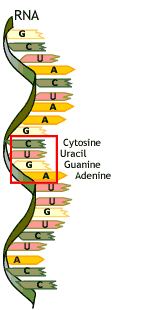
Which of these is FALSE when it comes to the differences between DNA and RNA?
RNA has ribose sugar
RNA is not a nucleic acid
RNA is single stranded
RNA contains a nitrogen base called uracil

