wayground logo

Free Printable Worksheets

Font size

S
M
L
XL
Worksheets

Alg 2 Sem 1 Final Review

Total questions: 140

Worksheet time: 8hrs 1mins

Name
Class
Date
1.


Describe the transformation that occurred

p(x) = f(x + 3)

a)

Right 3 units

b)

Vertical Stretch

c)

Up 3 units

d)

Left 3 units

2.


Describe the transformation that occurred.

h(x) = f(x) + 2

a)

up 2 units

b)

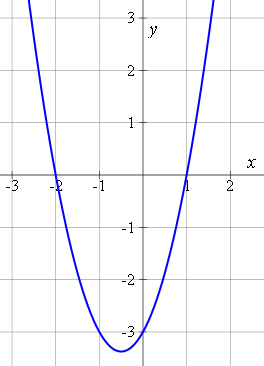
left 2 units

c)

Vertical Stretch

d)

right 2 units

3.

 Given f(x) = (x-3)2 + 5.  What transformations took place from the original function f(x)?

a)

Left 3 up 5

b)

Right 3 down 5

c)

Left 3 down 5

d)

Right 3 up 5

4.

Describe the transformations of f(x) when compared to the parent function. f(x)=(x+7)2

a)

horizontal shift left 7 units

b)

horizontal shift right 7 units

c)

vertical shift up 7 units

d)

vertical shift down 7 units

5.

Match the equation to its description.

a)

Right 2 and up 2

b)

Left 2 and up 2

c)

Right 2 and down 2

d)

Left 2 and down 2

6.

Which quadratic would be the narrowest?

a)

f(x)=12x2f\left(x\right)=\frac{1}{2}x^2

b)

f(x)=x2f\left(x\right)=x^2

c)

f(x)=3x2f\left(x\right)=3x^2

d)

f(x)=5x2f\left(x\right)=5x^2

7.
What is the domain of the graph?
a)
All real numbers
b)

No Solution

c)

y ≥ -1

or

[1,)\left[-1,\infty\right)  

d)

x ≥ 0

or

(,0)\left(-\infty,0\right)  

8.
What is the range of the graph?
a)
All real numbers
b)
To infinity and beyond
c)

y ≥ -1

or

[1,)\left[-1,\infty\right)  

d)

x ≥ 0

or

(,0]\left(-\infty,0\right]  

9.

A quadratic function is graphed on the grid.

Which answer choice best represents the domain and range of the function?

a)

Domain: x3x\ge-3  

Range: y5y\ge5  

b)

Domain: All real numbers

Range: y5y\ge5  

c)

Domain: x3x\ge-3  Range: All real numbers

d)

Domain: y5y\ge5  

Range: x3x\ge-3  

10.

What is the vertex of the following function? y=2x3+1y=2|x-3|+1  

a)

(2,3)(2,3)  

b)

(3,1)(-3,1)  

c)

(2,3)(2,-3)  

d)

(3,1)(3,1)  

11.

Write an absolute value function given the following transformations from the parent function:

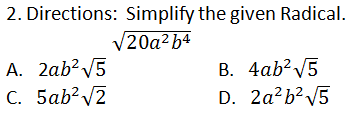
Reflection across the x-axis

Vertical shift right 2 units

Horizontal shift down 7 units

a)

y=x+27y=-|x+2|-7  

b)

y=x27y=|x-2|-7  

c)

y=x27y=-|x-2|-7  

d)

y=x2+7y=-|x-2|+7  

12.

What is the vertex of the graph of this equation?
y=x+6y=-\left|x+6\right|  

a)

(-1, 6)

b)

(-6, 1)

c)

(-6, 0)

d)

(6, 0)

13.
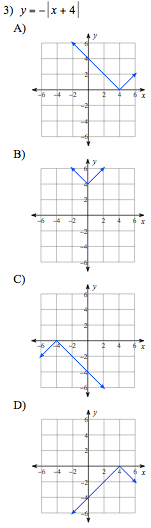
f(x) = −|x+4|
a)
A
b)
B
c)
C
d)
D
14.
Describe the transformations of the absolute value equation.
a)
Reflects over x-axis, compresses wider, shifts right 1 unit
b)
Reflects over x-axis, compresses wider, shifts up 1 unit
c)
Reflects over x-axis, stretches more narrow, shifts right 1 unit
d)
Reflects over x-axis, stretches more narrow, shifts up 1 unit
15.

Find the solution to the system.

a)

(-2, -3, 3)

b)

(-2, 3, 3)

c)

(2, -3, 3)

16.

Find the solution to the system.

a)

(4, 0, 2)

b)

(-4, 0, -2)

c)

(4, 0, -2)

17.

x+y+z=12

3x+y=19

5x=25

What would you solve for First?

a)

Solve for x

b)

Solve for y

c)

Solve for z

d)

(5,3,4)

18.

Solve using Substitution:

x + y – z = 4                

    3x + 2y + 4z = 17

    z = x - 5y + 8

Answer format: (x,y,z)

(a)  

19.
Which of the following equations matches standard form of a quadratic?
a)
ax + by = c
b)
y = a(x - h)2 + k
c)
y = ax2 + bx + c
d)
y = mx + b
20.
What is the equation for axis of symmetry?
a)
y=3
b)
x=3
c)
x=5
d)
x=1
21.
What is the vertex?
f(x) = -x- 4x + 12.
a)
(-2, 16)
b)
(2, 0)
c)
(2, 4)
d)
(-2, 4)
22.
Graph the quadratic.
a)
A
b)
B
c)
C
d)
D
23.
A parabola has a vertex at (-3,2).
Where is the axis of symmetry?
a)
y = -2
b)
x = 3
c)
x = -3
d)
y = 2
24.
Does this parabola have a maximum or minimum?
a)
Maximum
b)
Minimum
25.

Graph the following equation:

y=x2-2x-3

a)
b)
c)
d)
26.

A parabola has a vertex at (1,6) and passes through (3,-18). Write the equation in vertex form.

Formula: f(x) = a(x - h)2 + k

a)

f(x) = 3(x - 1)2 - 18

b)

f(x) = -6(x - 1)2 + 6

c)

f(x) = 6(x - 3)2 - 18

d)

f(x) = -3(x + 1)2 - 6

27.

Find the vertex:

g(x)=2(x4)2+8g\left(x\right)=2\left(x-4\right)^2+8  

a)

( 4 , 8 ) 

b)

( -4 , -8 ) 

c)

( 4 , -8 )

d)

( -4 , 8 )

28.
Identify the vertex and whether the graph opens up or down.
a)
(5, 2); opens up
b)
(5, 2); opens down
c)
(-5, 2); opens up
d)
(-5, 2); opens down
29.

What is the equation for the axis of symmetry for the function: g(x)=2(x3)2+1g\left(x\right)=2\left(x-3\right)^2+1  

a)

x = 1

b)

y = 1

c)

y = 3

d)

x = 3

30.

What is the vertex for the function: h(x) = 2x2+3h\left(x\right)\ =\ -2x^2+3  

a)

(-2,3)

b)

(0,3)

c)

(3,0)

d)

(0,-3)

31.
What are the x- intercepts?
a)
x= 0 and x= -4
b)
x= 0 and x= 4
c)
y= 0
d)
x= 2
32.
How many solutions does this graph have?
a)
one
b)
two
c)
no solutions
d)
cannot be determined
33.
Solve:
x2 - 49 = 0
a)
x = -7, x = 7
b)
x = -7
c)
x = 7
d)
x = -7, x = 1
34.

Solve using the Zero-Product Property.

(x + 4)(x − 3) = 0

a)

x = 4 and x = −3

b)

x = 2 and x = 1

c)

x = −4 and x = 3

d)

x = −2 and x = 1

35.

Factor and solve:

z2 − 14z + 45 = 0

a)

z = 1, 45

b)

z = −1, 45

c)

z = −5, 9

d)

z = 5, 9

36.

Use the quadratic formula to find the solutions for

y = -x2 - 5x + 12

a)

No Real Solution

b)
c)
d)
37.

Solve using the quadratic formula...

9x2 = 4 + 7x

a)
b)
c)
d)

No solution

38.

Find all the solutions for x when

x2 + 9x - 36 = 0

a)

A.

(x + 12)(x - 3)

b)

B.

x = 12 and x = -3

c)

C.

x = -12 and x = 3

d)

D.

(x - 9)(x - 4)

39.
To solve by completing the square, what needs to be moved in this equation?
x2 = 9 - 4x
a)
the -4x
b)
the 9
c)
the x2
40.
Complete the Square
x2 + 6x = 5
a)
(x + 3)2 = 5
b)
(x + 6)2 = 9
c)
(x + 3)2 = 14
d)
(x + 6)2 = 14
41.
Solve the following equation by completing the square:
n2 - 2n - 3 = 0
a)
{3, -1}
b)
{4, -4}
c)
{5, -3}
d)
{8, -7}
42.
Solve the following equation by completing the square:
n2 = 18n + 40
a)
{11, -11}
b)
{16, 2}
c)
{20, -2}
d)
{10, -4}
43.

12. Solve using any method.

(x - 2 )2 -49 = 0

a)

5, 9

b)

-9, -5

c)

9, -5

d)

9, -9

44.

Solve using any method:

n2 - 5 = -4

a)

n = ±√9

b)

n = ±3

c)

n = ±1

d)

No real solution

45.

k² - 2k = 0

a)

k = 2 and 0

b)

k = -2 and 0

c)

k = 2

d)

k = 0

46.

a)

a

b)

b

c)

c

d)

d

47.

a)

a

b)

b

c)

c

d)

d

48.

Simplify (7 - 4i) + (2 - 3i)

a)

3 - i

b)

7 - 9i

c)

9 - 7i

d)

5 - i

49.

(5 + 7i) - (-5 - i)

a)

0 + 8i

b)

10 + 6i

c)

6i

d)

10 + 8i

50.
Simplify:
√-81
a)
9i
b)
81i
c)
-9
d)
-9i
51.
Simplify:
√-24
a)
4i√6
b)
-2i√6
c)
24i
d)
2i√6
52.

Identify the solution to the system graphed here.

a)

(1, 5) and (-4, 0)

b)

(1, 5) and (-2, 0)

c)

(1, 5) and (0, -4)

d)

No solution

53.

Identify the solution to the system graphed here.

a)

(0, 4) and (0, -2)

b)

(2, -2)

c)

(0 4)

d)

No solution

54.

Find the solution(s) to the system by graphing, elimination, or substitution

a)

(0,-3)(1,-2)

b)

(0,-3)

c)

(-2,0)(2,0)

d)

No solution

55.

Which of the following graphs correctly represents:
y=x2y=x^2  
y=2x+1y=-2x+1  

a)
b)
c)
d)
56.

Is the point (5, 3) a solution to this nonlinear system?

a)

Yes a solution

b)

No Not a solution

57.

Solve the System using ANY method:

y = x26x+9y\ =\ x^2-6x+9  
y = 2x+5y\ =\ -2x+5  

a)

(1, 2)

b)

(2, 1)

c)

(1, 2) and (2, 1)

d)

No solution! It is an Inconsistent System.

58.

What is the solution set to the inequality x2 - 4x - 5 > 0

a)

x < -1 or x > 5

b)

x < -5 or x > 1

c)

-1 < x < 5

d)

-5 < x < 1

59.
8x + 140 > 4x2
hint: put squared term on the LEFT!
a)
-5 < x < 7
b)
-3 ≤ x ≤ 12
c)
4 < x < 15
d)
-2 < x < 10
60.
x2 - 9x - 112 ≥ 0
a)
-7 < x < 16
b)
-7 ≤ x ≤ 16
c)
x < -7 or x > 16
d)
x ≤ -7 or x ≥ 16
61.
a)
y > x² + 3
b)
y < -x² - c
c)
y > x² - 3
d)
y > -x² - 3
62.
Consider the function y < 2x+3. Which is true?
a)
The line would be solid with shading above.
b)
The line would be dashed with shading above.
c)
The line would be solid with shading below.
d)
The line would be dashed with shading below.
63.

What is the standard form of the polynomial?

 9x2 + 5x + 27 + 2x3

a)
27 + 5x + 9x2 + 2x3
b)
9x2 + 5x + 2x3 + 27
c)
9x2 + 5x + 27 + 2x3
d)
2x3 + 9x2 + 5x + 27
64.

Add the polynomials. (3x3 + 3x2 – 4x + 5) + (x3 – 2x2 + x – 4)

(combine like terms)

a)
4x3 + 1x2 – 3x + 1
b)
2x3 + 1x2 - 5x + 9
c)
6x3 + 1x - 1x2 - 3
d)
3x5 +1x - 1x5 - 3x
65.
Find the difference. 
(3- 2x + 2x2) - (4x -5 +3x2)
a)
x2 + 6x + 8
b)
2x+ 5x - 7
c)
-x2 -6x + 8
d)
-2x2 + 11x - 4
66.
(5x- 4x- 2x2 + x - 19) - (x+ 5x3 + 8x2 + x + 5)
a)
4x- 9x- 10x- 24
b)
4x- 9x3 - 10x- 2x - 24
c)
4x4 - 9x3 - 10x2 + 2x - 24
d)
-4x4 - 9x3 - 10x2 - 24
67.
Find the product:
(2x+3)2
a)
2x+3+2x+3
b)
4x2+12x+9
c)
4x2+9
d)
16x2+9
68.

(2x3 - 5x2 + 3x + 7) ÷ (x - 2) using long division

a)

2x3 - x2 + x + 9

b)

2x2 - x + 1

c)

2x2 - x + 1 + 9/x-2

d)

2x2 - 9x - 15 - 23/x-2

69.
Multiply.
(b+3)(b2+2b+1)
a)
b3+6b2+6b+3
b)
b3+5b2+7b+3
c)
4b3+8b2+3b
d)
3b3+6b2+3b
70.

(2x3 - 5x - 7) ÷ (x - 2) using synthetic division (remember zeros)

a)

2x3 - 4x2 + 3x - 13

b)

2x3 + 4x2 +3x - 1

c)

2x2 - 4x + 3 - 13/x-2

d)

2x2 + 4x + 3 - 1/x-2

71.

Find the product:
(8x7)(26x+9x2)\left(8x-7\right)\left(2-6x+9x^2\right)  

a)

9x3+14x27x+149x^3+14x^2-7x+14  

b)

72x3111x2+58x1472x^3-111x^2+58x-14  

c)

x3+2x25x+2x^3+2x^2-5x+2  

d)

3x32x2+7x93x^3-2x^2+7x-9  

72.
Which row of Pascal's Triangle would you use to expand (x+y)3?
a)
1
b)
1  1
c)
1  2  1
d)
1  3  3  1
73.

Expand using Pascal's triangle:

(d-5)5

a)

d5 - 25 d4 + 250 d3 - 1250 d2 + 3125 d - 3125

b)

d5 + 25 d4 + 250 d3 + 1250 d2 + 3125 d + 3125

c)

d4 - 20d3 + 150d2 - 750d + 3125

d)

d4 + 20d3 + 150d2 + 750d + 3125

74.

Use Pascal's Triangle to expand the expression.

(2x+5)4

a)

2x4 + 40x3 + 300x2 + 1000x +625

b)

16x4 + 160x3 +600x2 +1000x + 625

c)

16x4 + 1000x3 + 600x2 + 160x +625

75.

What is the proper way to write the answer for the following problem?

a)

2x3-x2-25x+12

b)

2x4-x3-25x2-12x+0

c)

2x3-x2-25x-12

d)

2x4-x3-25x2-12x-0

76.
Divide using synthetic division 
(2x³ + 4x² - 5) by (x + 3).
a)
2x² + 2x - 4  R(-12)
b)
2x² - 2x + 6  R(-23)
c)
2x² - 2x + 8  R(-20)
d)
2x² - 4x + 1  R0
77.
If you are missing an exponent in your polynomial you must put a zero as a coefficient place holder for that exponent
a)
True
b)
False
78.
Factor by grouping:
4p³+8p²+3p+6
a)
(2p²+3)(p+2)
b)
(2p²+6)(p+4)
c)
(4p²+3)(p+2)
d)
(4p²+8p)(3p+6)
79.
Factor by grouping:
5n³-10n²+3n-6
a)
(5n²+3)(n-2)
b)
(5n²-3)(n-2)
c)
(5n³+3)(n-2)
d)
10n(n²-6)
80.

Factor:

80x5-70x2-60x7

a)

2x2(40x3- 35 - 30x5)

b)

10x2(8x4 - 7x -6x6)

c)

10x2(8x3 - 7 - 6x5)

d)

10x7(8x2- 7 - 6)

81.

Find the values of the zeros of the function y=(x+2)(x-3)(3x-5)

a)

x=-2, x=3, x=5/3

b)

x=2, x=-3, x= -5/3

c)

x=-2, x=3, x=3/5

d)

x=2, x=-3, x=-3/5

82.

What are the zeros of the function?

a)

4, 1

b)

-3, -1, 2, 5

c)

-3, -1, 30, 2, 5

d)

3, 1, -2, -5

83.

State the zeros of the polynomial function f(x)=x(x+3)2(x2)f\left(x\right)=x\left(x+3\right)^2\left(x-2\right)  

a)

0, 2, -3

b)

0, 2, -3 multiplicity 2

c)

2, -3 mulitiplicity 2

d)

0, -2, 3 multiplicity 2

84.

How many zeros does the polynomial function f(x)=3x4+4x2 +8f\left(x\right)=3x^4+4x^{2\ }+8  have?

a)

2

b)

3

c)

4

d)

6

85.

Write the polynomial in standard form given the zeros, x=0, -2, 1

a)

y=x2 +x2y=x^{2\ }+x-2  

b)

y=x4+x32x2y=x^4+x^3-2x^2  

c)

y=x3 +x22xy=x^{3\ }+x^2-2x  

d)

y=x3 x22xy=x^{3\ }-x^2-2x  

86.

Which of the following is the correct equation for the function graphed?

a)

f(x)=(x1)2 (x+2)2 f\left(x\right)=\left(x-1\right)^{2\ }\left(x+2\right)^{2\ }  

b)

f(x)=(x+1)2(x2)2 f\left(x\right)=\left(x+1\right)^2\left(x-2\right)^{2\ }  

c)

f(x)=(x1)(x+2)f\left(x\right)=\left(x-1\right)\left(x+2\right)  

d)

f(x)=(x+1)(x2)f\left(x\right)=\left(x+1\right)\left(x-2\right)  

87.

Which is a possible equation in factored form of the function in the graph?

a)

y=(x+2)(x1)2y=\left(x+2\right)\left(x-1\right)^2  

b)

y=(x2)(x+4)(x+1)2y=\left(x-2\right)\left(x+4\right)\left(x+1\right)^2  

c)

y=(x+2)(x1)2y=-\left(x+2\right)\left(x-1\right)^2  

d)

y=(x+1)2(x2)y=-\left(x+1\right)^2\left(x-2\right)  

88.

What is the degree of the function graphed?

a)

5

b)

1

c)

3

d)

2

89.
Find all real solutions of the polynomial equation x3 - 3x2 - 2x + 4 = 0
a)
x = -1, 1 ± √5
b)
x = 1, 1 + √5
c)
x = 2, 1 ± √5
d)
x = 1, 1 ± √5
90.

Q. Is (x-2) a factor of f(x) = x3 - 8x2 + 14x - 4?

a)

Yes, (x-2) is a factor. There is a remainder.

b)

Yes, (x-2) is a factor. The remainder is zero.

c)

No, (x-2) is  not a factor. The remainder is zero.

d)

No, (x-2) is  not a factor. There is a remainder. 

91.

Write the simplest polynomial in standard form given the following zeros. x = -2, 1, 4

a)

f(x)=(x+2)(x1)(x4)f(x)=(x+2)(x-1)(x-4)  

b)

f(x)=x3+8f\left(x\right)=x^3+8  

c)

f(x)=x33x26x+8f(x)=x^3-3x^2-6x+8  

d)

f(x)=x33x2+8f(x)=x^3−3x^2+8  

92.

Write a polynomial function of least degree for the given zeros:

a)

A

b)

B

c)

C

d)

D

93.

Describe the end behavior of the polynomial function?

a)

as x +, f(x)  as\ x\rightarrow\ +\infty,\ f\left(x\right)\ \rightarrow-\infty\   as x  , f(x)  +as\ x\ \rightarrow\ -\infty,\ f\left(x\right)\ \rightarrow\ +\infty  

b)

as x +, f(x) +as\ x\ \rightarrow+\infty,\ f\left(x\right)\ \rightarrow+\infty  

  as x  , f(x) +as\ x\ \rightarrow\ -\infty,\ f\left(x\right)\ \rightarrow+\infty  

c)

as x +, f(x)  +as\ x\ \rightarrow+\infty,\ f\left(x\right)\ \rightarrow\ +\infty  

as x  , f(x)  as\ x\ \rightarrow\ -\infty,\ f\left(x\right)\ \rightarrow\ -\infty  

d)

The answer is not here.

94.

Describe the end behavior of the polynomial function?

a)

as x +, f(x)  as\ x\rightarrow\ +\infty,\ f\left(x\right)\ \rightarrow-\infty\   as x  , f(x)  +as\ x\ \rightarrow\ -\infty,\ f\left(x\right)\ \rightarrow\ +\infty  

b)

as x +, f(x) +as\ x\ \rightarrow+\infty,\ f\left(x\right)\ \rightarrow+\infty  

  as x  , f(x) +as\ x\ \rightarrow\ -\infty,\ f\left(x\right)\ \rightarrow+\infty  

c)

as x +, f(x)  +as\ x\ \rightarrow+\infty,\ f\left(x\right)\ \rightarrow\ +\infty  

as x  , f(x)  as\ x\ \rightarrow\ -\infty,\ f\left(x\right)\ \rightarrow\ -\infty  

d)

The answer is not here.

95.
Solve x^2 – 3x = 28 by factoring.
a)
{–4, 7}
b)
{–14, 2}
c)
{–7, 4}
d)
{–2, 14}
96.
Simplify (15 – 13i) – (–1 + 17i).
a)
16 – 30i
b)
16 + 4i
c)
16 + 30i
d)
46
97.

If the zeros of f(x) = 5, 10, -13, then the factors of f(x) are:

a)

(x + 5)(x + 10)(x - 13)

b)

(x - 5)(x - 10)(x + 13)

c)

(x + 5)(x - 10)(+ 13)

d)

(x - 5)(x - 10)(x - 13)

98.

Factor:

a)

(x5)(x2+5x+25)\left(x-5\right)\left(x^2+5x+25\right)  

b)

(x+5)(x25x+25)\left(x+5\right)\left(x^2-5x+25\right)  

c)

x5x-5  

d)

(x25x)(x5x+25)\left(x^2-5x\right)\left(x-5x+25\right)  

99.
Factor: 8x3 - 1
a)
(2x - 1)(4x2 + 2x + 1)
b)
(2x + 1)(4x2 - 2x + 1)
c)
(2x - 1)(4x2 - 2x - 1)
d)
(2x + 1)(4x2 +2x + 1)
100.
What does the discriminant tell us?
a)
The maximum or minimum
b)
The y-intercept
c)
The number and type of solutions
d)
The axis of symmetry
101.
If the discriminant is positive, how many solutions and of what type?
a)
1 real solution
b)
2 real solutions
c)
2 imaginary solutions
102.
If the discriminant is negative, how many solutions and of what type?
a)
1 real solution
b)
2 real solutions
c)
2 imaginary solutions
103.
Find the discriminant of the quadratic equation:
2x2 + 10x - 15 = 0
a)
25
b)
-20
c)
220
d)
92
104.
(2i)(3i)
a)
5i
b)
-5
c)
6i
d)
-6
105.
What is the complex conjugate of 3i + 1
a)
-3i + 1
b)
3i - 1
c)
-3i - 1
d)
3i - (-1)
106.

The graph of

y=(x+3)2+2y=-\left(x+3\right)^2+2  is

a)
b)
c)
d)
107.

Which correctly shows the inequality y<(x+4)2+1y<\left(x+4\right)^2+1  ?

a)
b)
c)
d)
108.

Which correctly shows the inequality yx2+2x+1y\ge-x^2+2x+1  ?

a)
b)
c)
d)
109.

Which transformations are involved in the equation y=12x+11y=\frac{1}{2}\sqrt{x+1}-1  ?

a)

Horizontal translation left

b)

Vertical shrink

c)

Vertical translation down

d)

Horizontal translation right

e)

Vertical stretch

110.

Given the function f(x)=xf\left(x\right)=\sqrt[]{x}  , write the equation after the following transformations: vertical compression by the factor of 12\frac{1}{2}   , reflection in the x-axis, translation 3 units left and 5 units up

a)

f(x)=12x+3+5f\left(x\right)=-\frac{1}{2}\sqrt[]{x+3}+5  

b)

f(x)=12x+3+5f\left(x\right)=\frac{1}{2}\sqrt[]{x+3}+5  

c)

f(x)=12x3+5f\left(x\right)=-\frac{1}{2}\sqrt[]{x-3}+5  

d)

f(x)=2x+3+5f\left(x\right)=-2\sqrt[]{x+3}+5  

111.

Solve by factoring: 3x2 + 2x  1 = 03x^2\ +\ 2x\ -\ 1\ =\ 0  

a)

A. x = 1 and x = 1/3

b)

B. x = 1 and x = 3

c)

C. x = -1 and 1/3

d)

D. x = 1 and -1

112.

What is the equation of the line of best fit?

a)

y= 12x + 6-\frac{1}{2}x\ +\ 6

b)

y= 12x +6\frac{1}{2}x\ +6

c)

y= 6x + 2

d)

y = -2x +6

113.

What is the equation of the line of best fit?

a)

y= 2x

b)

y=3x+7

c)

y= 12x +3\frac{1}{2}x\ +3

d)

y= 12x 3-\frac{1}{2}x\ -3

114.
What kind of function is represented by the graph?
a)
Cube Root Function
b)
Cubic Function
c)
Polynomial Function
d)
Square Root Function
115.
What is the range of the function in this graph?
a)
y ≤ 3
b)
y ≥ 3
c)
y ≤ 0
d)
y ≥ 0
116.
What is the domain of this graph?
a)
x ≥ -1
b)
x ≤ -1
c)
x ≥ 0
d)
x ≤ 0
117.
Match the correct equation with the given graph.
a)
y = √(x) + 2
b)
y = √(x) - 2
c)
y = √(x + 2)
d)
y = √(x - 2)
118.
What function best describes this graph?
a)
f(x)= -√(x+4) -2
b)
f(x)= √(x-4) -2
c)
f(x)= -√(x-4) -2
d)
f(x)= √(x+4) +2
119.

f(x)=5x+1f\left(x\right)=5x+1  
Find  f1(x)f^{-1}\left(x\right)  

a)

x51\frac{x-5}{1}  

b)

x51\frac{x}{5}-1  

c)

x15x-\frac{1}{5}  

d)

x15\frac{x-1}{5}  

120.

Based on the table of f(x), which point will appear in the table of f-1(x)?

a)

(-1,-6)

b)

(0,6)

c)

(1,-6)

d)

(6,1)

121.

This is f(x).

Which graph appears to be the inverse of f(x)?

a)
b)
c)
d)
122.

f(x)=13x+2f\left(x\right)=\frac{1}{3}x+2  

What is the inverse of the equation above?

a)

h(x)=13x2h\left(x\right)=\frac{1}{3}x-2  

b)

h(x)=13x+2h\left(x\right)=\frac{1}{3}x+2  

c)

h(x)=3x2h\left(x\right)=3x-2  

d)

h(x)=3x6h\left(x\right)=3x-6  

123.
Find the inverse of f(x) = -4x - 12
a)
f-1(x) = 4x - 3
b)
f-1(x) = -1/4x - 3
c)
f-1(x) = 1/4x + 3
d)
f-1(x) = -4x - 3
124.
Simplify:
a)
2
b)
8
c)
16
d)
32
125.
a)
W
b)
O
c)
R
d)
K
126.
Evaluate 45/2
a)
32
b)
16
c)
8
d)
2
127.
Read the question carefully and choose the correct answer.
a)
A
b)
B
c)
C
d)
D
128.

Simplify:

98\sqrt{98}  

a)

727\sqrt{2}  

b)

272\sqrt{7}  

c)

49249\sqrt{2}  

d)

2492\sqrt{49}  

129.

Simplify:

109610\sqrt{96}  

a)

40640\sqrt{6}  

b)

1606160\sqrt{6}  

c)

961096\sqrt{10}  

d)

601660\sqrt{16}  

130.

Simplify:

80x2y4\sqrt{80x^2y^4}  

a)

2xy2202xy^2\sqrt{20}  

b)

4xy254xy^2\sqrt{5}  

131.
 Solve the equation.
a)

36

b)

18

c)

-18

d)

27

132.
Solve.  Remember to check for extraneous solutions. 
a)

{-3}

b)

{6}

c)

{-5,6}

d)

{-5}

133.
a)

x = -6

b)

x = 3

c)

x = -3

d)

x = 5±

134.

Solve for x. 4x+9+11=74\sqrt{x+9}+11=7  

a)

x = -8

b)

x = -10

c)

x = -1

d)

No Solution

135.

Solve the radical equation. Don't forget to check your answers!

a)

x = -6

b)

x = 3

c)

x = 7/3

d)

No Solution

136.

Solve. (2x-8)2/3 = 4

a)

x = 8

b)

x = 0

c)

x = 7

d)

no solution

137.

Solve. (3x-5)1/4+3=4

a)

4/3

b)

2

c)

-2

d)

-4/3

138.

2+95x6-2+\sqrt{9-5x}\ge6  Solve the inequality.

a)

x11x\le-11  

b)

No solution

c)

x95x\le\frac{9}{5}  

d)

11x95-11\le x\le\frac{9}{5}  

139.

Solve √(x + 2) > 3

a)

x > 7

b)

x ≥ 7

c)

x > -2

d)

x ≥ -2

140.
3 + √(3x+12) ≤ 9
a)
[-4,8]
b)
(- ∞, 8]
c)
[-4,-2]
d)
[4,6]