wayground logo

Free Printable Worksheets

Font size

S
M
L
XL
Worksheets

Smeed V Begley

Total questions: 38

Worksheet time: 19mins
Name
Class
Date
1.
Formed by heat and pressure
a)
Sedimentary
b)
Metamorphic
c)
Extrusive Igneous
d)
Intrusive Igneous
2.
Formed by cooling & solidification of lava
a)
Sedimentary
b)
Metamorphic
c)
Extrusive Igneous
d)
Intrusive Igneous
3.
Formed by cooling & solidification of magma
a)
Sedimentary
b)
Metamorphic
c)
Extrusive Igneous
d)
Intrusive Igneous
4.
Formed by compacting & cementing of sediments
a)
Sedimentary
b)
Metamorphic
c)
Extrusive Igneous
d)
Intrusive Igneous
5.
Formed by weathering & erosion
a)
magma
b)
sediments
c)
sedimentary rock
d)
intrusive igneous
6.
Formed by melting
a)
magma
b)
sediments
c)
sedimentary rock
d)
intrusive igneous
7.
Has large crystals because of slow cooling
a)
sedimentary rock
b)
metamorphic rock
c)
intrusive igneous rock
d)
extrusive igneous rock
8.
Has small or no crystals because of rapid cooling
a)
sedimentary
b)
metamorphic
c)
extrusive igneous
d)
intrusive igneous
9.
Has wavy bands.
a)
sedimentary rock
b)
metamorphic rock
c)
extrusive igneous rock
d)
intrusive igneous rock
10.

Which rocks contains fossils. 

a)
sedimentary rocks
b)
metamorphic rocks
c)
extrusive igneous rocks
d)
intrusive igneous rocks
11.
An igneous rock containing large crystals is most likely a(n)
a)
Chemical Rock
b)
Foliated Rock
c)
Extrusive Rock
d)
Intrusive Rock
12.
If heat and pressure inside the Earth cause a rock to melt, the material that formed would be
a)
Metamorphic
b)
Magma
c)
Sedimentary
d)
Igneous
13.
You find a rock in which the grains are arranged in parallel bands of white and black crystals.  The rock is probably a(n)
a)
Igneous rock
b)
Sedimentary rock
c)
Metamorphic rock
d)
Extrusive rock
14.
As lava cools and crystallizes, what type of rock will form?
a)
Sedimentary
b)
Metamorphic
c)
Extrusive Igneous
d)
Intrusive Igneous
15.
When minerals line up in bands within a metamorphic rock, this rock is...
a)
Nonfoliated
b)
Foliated
c)
Igneous
d)
Sedimentary
16.
Which of the following is not a rock
a)
Pumice
b)
Lava
c)
Halite
d)
Sandstone
17.
Fossils are only found in
a)
Sedimentary rocks
b)
Foliated Metamorphic rocks
c)
Igneous Rocks
d)
Nonfoliated Metamorphic rocks
18.
Scientists divide rocks into groups based on how they form.
a)
True
b)
false
19.
Major groups of rocks
a)
sedimentary and igneous
b)
sedimentary, igneous and metamorphic
c)
metamorphic and sedimentary
20.

This rock was another type of rock that was heated and compressed over time. What type of rock is this?

a)

Sedimentary

b)

Igneous

c)

Metamorphic

21.

This rock started as molten magma but transformed after a volcano erupted. What type of rock is this?

a)

Sedimentary

b)

Igneous

c)

Metamorphic

22.

This rock was formed by smaller pieces of rock that settled at the bottom of a lake millions of years ago. What type of rock is this?

a)

Sedimentary

b)

Igneous

c)

Metamorphic

23.

The process when rocks break into smaller pieces due to exposure to natural elements is called

a)

erosion

b)

weathering

c)

sediments

24.

What causes igneous rocks to form

a)

compaction of sediment

b)

animal and plant remains aka fossils

c)

cementation or hardening of minerals

d)

cooling magma, lava, and pressure

e)

sediment

25.

Geologists are scientists that study _______.

a)

rocks

b)

lakes

c)

rivers

d)

animals

26.

A model that describes the formation, breakdown, and reformation of a rock.

a)

Fall Zone

b)

Weathering/ Erosion/ Deposition

c)

Rock Cycle

d)

Soil Profile

27.

Rock formed from sediments, such as sand, pebbles, shells and remains of dead plants / animals; often deposited in layers

a)

Regolith

b)

Sedimentary Rock

c)

Igneous Rock

d)

Metamorphic Rock

28.

The process necessary to form a metamorphic rock:

a)

uplift, weathering, erosion

b)

heat and or pressure

c)

burial and cementation

d)

compaction

29.

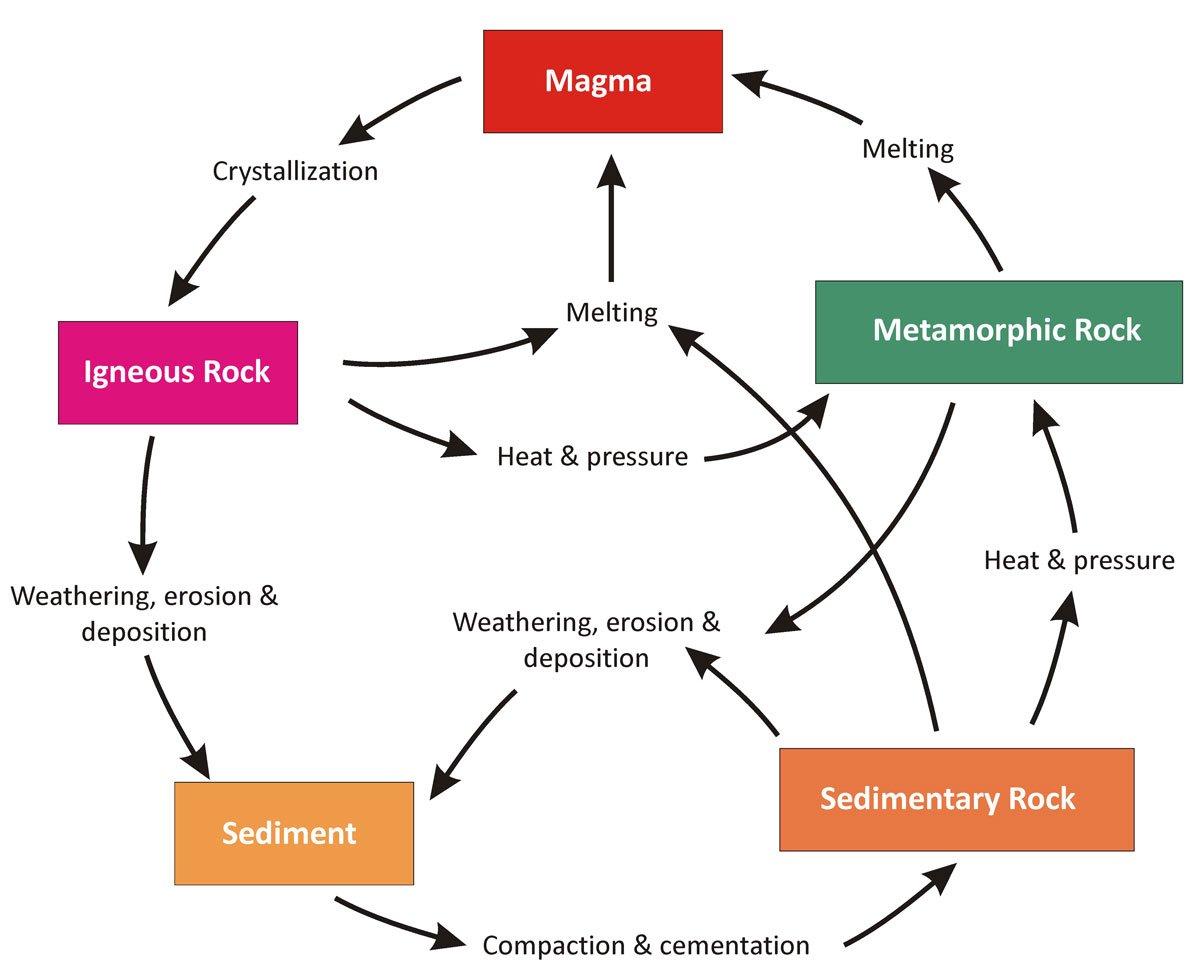
According to this diagram, igneous rock can form into sedimentary rock by ______ way(s).

a)

one

b)

two

c)

three

d)

no

30.

According to the diagram, Igneous rock becomes Metamorphic by melting and cooling.

a)

true

b)

false

31.

What type of igneous rock is obsidian?

a)

Extrusive Igneous Rock

b)

Intrusive Igneous Rock

32.

Limestone is formed from layers of sand, shells and animal remains that have been compacted together. Limestone is a ____.

a)

Igneous Rock

b)

Sedimentary Rock

c)

Metamorphic Rock

33.

Which of the following represents the correct order of the processes responsible for the formation of sedimentary rocks?

a)

Erosion, weathering, compaction, cementation, deposition.

b)

Compaction, cementation, deposition, weathering, erosion, lithification

c)

Deposition, lithification, cementation, compaction, erosion, weathering.

d)

Weathering, erosion, deposition, compaction, cementation, lithification

34.

Which of the following is an example of an extrusive igneous rock?

a)

basalt

b)

granite

c)

diorite

d)

pegmatite

35.

It is the laying down of sediment carried by wind, water, or ice.

a)

erosion

b)

deposition

c)

lithification

d)

weathering

36.

The movement of sediments from broken rocks is called___________.

a)

erosion

b)

weathering

c)

deposition

d)

cementation

37.

What type metamorphic rock is gneiss?

a)

Foliated

b)

Non-foliated

38.

Which of the following is NOT a variable of metamorphism?

a)

stress

b)

once living organism

c)

heat

d)

pressure