
 Worksheets
Weather Review
Total questions: 20
Worksheet time: 10mins
What is the source of energy for all weather on Earth?
Plate Tectonics
The Sun
The Moon
Electricity
What is an explanation for consistent temperatures of the Earth?
Wind and ocean currents help distribute the sun's energy.
Rotation causes even distribution.
The different season's distribute the temperatures evenly.
Winds moving from West to East distribute temperatures evenly.
Which of the following factors contributes most to the formation of hurricanes?
Glaciers melting in the polar regions of the earth
Solar radiation being absorbed by oceans on the Equator
Toxic chemicals added to the atmosphere by industry
The gravitational pull of the moon and the Sun
The Sun warms the atmosphere and drives convection currents because -
the cooler land pushes away warm air.
warm air is less dense, so it rises.
the warmed air cools and makes rain.
warm air, in contact with cool air, rotates.

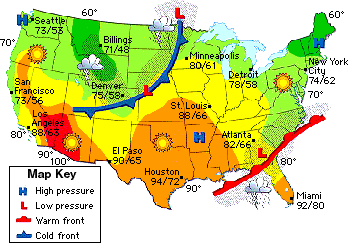
Which city will experience warmer temperatures in the near future?
Houston because it is in a high pressure area
St. Louis because a cold front and low pressure are approaching
Atlanta because a warm front is approaching
Minneapolis because it is raining
What happens to hurricanes as ocean water gets warmer?
They get stronger.
They weaken.
Nothing.
How does the air feel in high pressure?
warm and humid
cool and dry
What are weather conditions like in low pressure?
Sunny, clear, dry
Widespread, steady rain
Heavy rain and thunderstorms
Cloudy, stormy skies, humid

What weather tool measures air pressure?
hygrometer
barometer
wind vane
anemometer
What instrument (weather tool) is used to measure wind speed?
thermometer
wind vane
anemometer
barometer
What will happen to our weather if we get dry winds from the north?
cooler with low humidity
cooler with high humidity
warmer with low humidity
warmer with high humidity
Which of the following is important to do in an experimental investigation?
make your results match your predictions
make your explanation match your opinion
make sure your explaination of results is based on evidence
publish your results
Which layer of the atmosphere contains the ozone layer?
the stratosphere
the troposphere
the thermosphere
the mesosphere
What characteristics do thunderstorms, hurricanes, and tornadoes ALL share?
They all form over dry and hot desert regions.
They are all easily predicted by weather forecasters.
They are all formed when warm and moist air rapidly rises.
They ALWAYS cause SEVERE damage to land, property, injury, and death.

Leanne created the following diagram to show the process that warms the air above a lake. She decided to label each step with the energy transfer that is happening. Which step should Leanne label conduction?
Step 1
Step 2
Step 3
Step 4
A lampshade is heated by a lightbulb even though they are not in direct contact with each other. Which heating process is responsible for this?
conduction
convection
radiation
absorption
Dominic has a block made of wood. Jesse has a block of the same volume made of stone. If they are both left in the sun for the same length of time, which one will feel hotter when touched?
Jesse, because stone absorbs heat energy better than wood
Dominic, because wood absorbs heat energy better than stone.
They will feel the same, because they are equally good conductors.
They will feel the same, because they are equally good insulators.

The diagram shows a simple model of an Earth Process.
the condensation of water vapor driven by clouds in the atmosphere.
the radiation of ocean currents driven by energy from Earth's core.
the convection of ocean currents driven by energy from the Sun.
the transpiration of water vapor driven by underwater plants.

Which statement best describes what is happening in the image?
Cold Front: Cool weather, thunderstorms, tornadoes, and wind
Warm Front: light rain or snow, gentle winds
Occluded front: quick heavy stroms
Stationary front: many days of rainy weather and wind

