Wayground logo

Free Printable Worksheets

Font size

S
M
L
XL
Worksheets

EL 5 Chemical Reactions Review (Honors)

Total questions: 49

Worksheet time: 2hrs 38mins

Name
Class
Date
1.

What reaction has the following general formula:

A + CD --> C + AD

a)

Combination

b)

Decomposition

c)

Single Replacement

d)

Double Replacement

e)

Combustion

2.

What reaction has the following general formula:
CxHy + O2 −>CO2 + H2OC_xH_y\ +\ O_2\ ->CO_{2\ }+\ H_2O  

a)

Combination

b)

Decomposition

c)

Single Replacement

d)

Double Replacement

e)

Combustion

3.

What is the general reaction scheme for a decomposition reaction?

a)

A + B --> AB

b)

AB --> A + B

c)

A + CD --> C + AD

d)

AB + CD --> CB + AD

e)

CxHy+O2 −> CO2+H2OC_xH_y+O_2\ ->\ CO_2+H_2O

4.

Which of the following is a compound?

a)

zinc (Zn)

b)

magnesium (Mg)

c)

sodium chloride (NaCl)

d)

potassium (K)

5.

Which of the following is an element?

a)

potassium chloride (KCl)

b)

water (H2O)

c)

carbon (C)

d)

calcium carbonate (CaCO3)

6.
What law governs the balancing of chemical equations? 
a)
Law of Energy
b)
Law of Conservation of Matter/Mass
c)
Law of Gravity
d)
Law of Matter Movement 
7.
What is the Law of Conservation of Mass?
a)
It states that no matter can be created or destroyed.
b)
It states that no energy can be created or destroyed.
c)
It states that matter can be created or destroyed.
d)
It states that no sound can be created or destroyed.
8.
How many elements are in C6H12O6?
a)
1
b)
2
c)
3
d)
4
9.
How many HCl molecules do you need to balance this equation? 
Mg +  __HCl --->  MgCl2 + H2
a)
1
b)
2
c)
3
d)
4
10.
Which number should go in the blank?
Al(NO3)3 + _  NaOH -> Al(OH)3 + 3 NaNO3
a)
1
b)
2
c)
3
d)
0
11.
How many HCl molecules do you need to balance this equation? 
Mg +  __HCl --->  MgCl2 + H2
a)
1
b)
2
c)
3
d)
4
12.

This is when heat is absorbed, it is an

a)

Exothermic reaction

b)

endothermic reaction

c)

both

d)

none

13.

When heat is released it is an

a)

exothermic reaction

b)

endothermic reaction

c)

both

d)

none

14.

The temperature decreases outside of this reaction

a)

exothermic

b)

endothermic

c)

both

d)

none

15.

The temperature increases outside of this reaction

a)

exothermic

b)

endothermic

c)

both

d)

none

16.
More collisions correspond to a: 
a)
Faster reaction rate  
b)
Slower reaction rate
c)
Constant reaction rate 
d)
None of the above
17.
Which of the following is/are the fundamental idea(s) of collision theory?
a)
Molecules react by colliding together
b)
The effective collisions must occur with certain minimum amounts of energy 
c)
In a large sample, the greater the number of effective collisions, and the faster the rate of reaction
d)
All of the above
18.
Which factors increase the rate of a reaction.
a)
increasing temperature
b)
increasing concentration
c)
increasing surface area
d)
all of these
19.
What is the activation energy?
a)
The energy of the products
b)
The energy of the reactants
c)
The minimum energy needed by the reactants to form the products.
d)
The energy lost in the reaction
20.
Which factors increase the rate of a reaction.
a)
increasing temperature
b)
increasing concentration
c)
increasing surface area
d)
all of these
21.
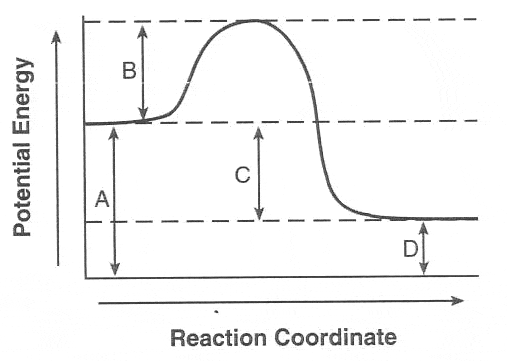
What kind of reaction is this?
a)
Endothermic
b)
Exothermic
c)
Cannot be determined
22.

How does a catalyst work in speeding up a reaction?

a)

By lowering the activation energy or reaction

b)

by giving them more energy

c)

by making them more available

23.
What type of reaction is this?
a)
Endothermic
b)
Exothermic
24.
When forming an ionic bond, a metal atom
a)
Gains electrons to form a cation
b)
Loses electrons to form a cation
c)
Gains electrons to form an anion
d)
Loses electrons to form an anion
25.
The polarity of a bond between two elements can be best determined by
a)
The difference in electronegativity between the elements
b)
The difference in first ionization energy between the elements
c)
The number of electrons shared in the bond
d)
The difference in atomic radius between the elements
26.
Which formula represents a polar molecule?
a)
H2
b)
H2O
c)
CO2
d)
CCl4
27.
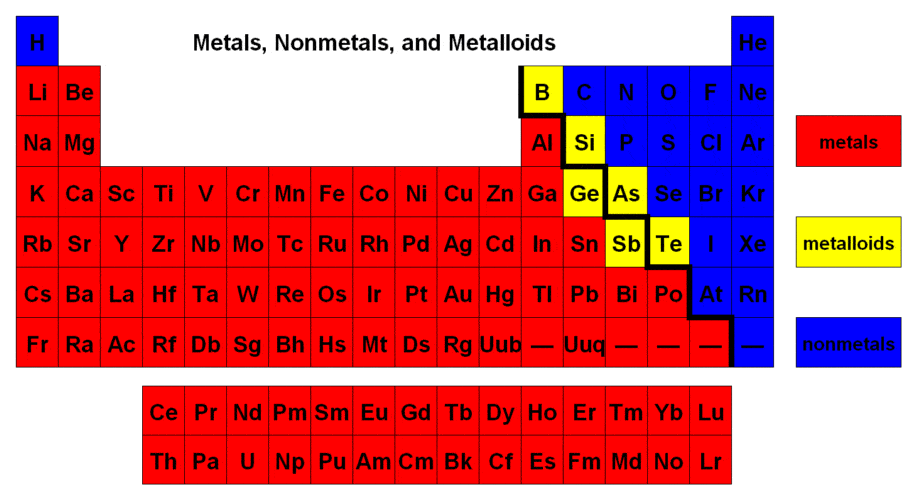
What elements generally make an ionic bond?
a)
metal and nonmetal
b)
2 or more nonmetals
c)
metal
d)
none of the above
28.
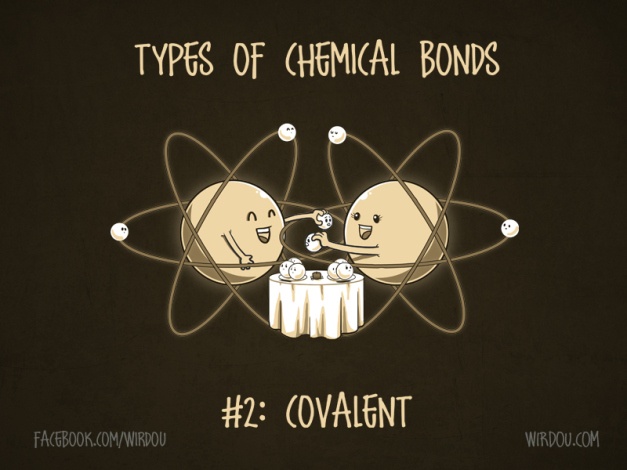
What elements generally make a covalent bond?
a)
metal and nonmetal
b)
2 or more nonmetals
c)
metal
d)
none of the above
29.
In chemical compounds, covalent bonds form when
a)
the electronegativity difference between two atoms is very large.
b)
electrons are completely transferred between two metals.
c)
pairs of electrons are shared between two nonmetal atoms.
d)
two nonmetal atoms are attracted to each other by opposite charges.
30.
An ionic bond forms when 
a)
Valence electrons are shared
b)
a sea of mobile electrons surround the cations
c)
valence electrons are transferred between atoms
d)
none of the above
31.
What is a valence electron?
a)
an electron that is found in the outermost shell of an atom. 
b)
an electron found in the innermost shell of an atom.
c)
an electron found in the middle shell.
32.
How many valence electrons in this structure?
a)
6
b)
5
c)
4
d)
7
33.

When an atom gains a valence electron, it becomes a(n) _____________ ion.

a)

positive

b)

negative

c)

neutral

34.

When an atom loses a valence electron, it becomes a(n) _____________ ion.

a)

positive

b)

negative

c)

neutral

35.
What charge will an Oxygen ion have? 
a)
+1
b)
-1
c)
+2
d)
-2
36.
If an element has 3 valence electrons, what charge will likely form on its ion ?
a)
+3
b)
+5
c)
-3
d)
-5
37.

What is the charge of a sodium ion?

a)

+2

b)

+1

c)

-1

d)

-2

38.
Which of the following has a -3 charge?
a)
Boron
b)
Fluorine
c)
Nitrogen
d)
Neon
39.
Ionic bonds form between two ions that have...
a)
ionic compounds
b)
negative charges
c)
positive charges
d)
opposite charges
40.
A(n) _____________ is an atom or group of atoms that has an electric charge. 
a)
ion
b)
electron
41.

Why do ionic bonds form?

a)

so the number of protons equals the number of electrons

b)

to fill the outermost energy level to make the atom stable

c)

so an atom can become unstable

42.

An electron located in the outermost shell (valence shell) of the atom, that can be transferred to or shared with another atom.

a)

Ionic bond

b)

Valence electrons

c)

Ion

d)

Anion

43.

What is the correct Lewis Dot Structure for ammonia NH3

a)
b)
c)
d)
44.

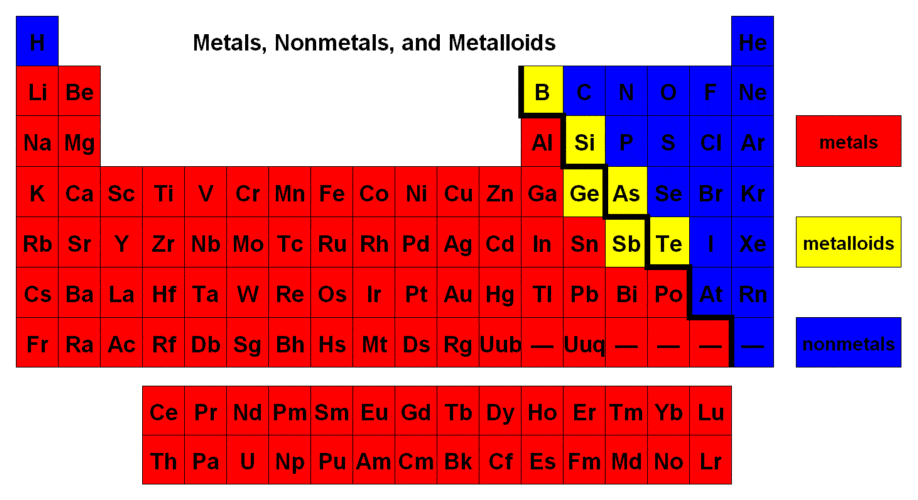
Which of the following is NOT one of the key physical properties for metals?

a)

Shiny

b)

Good Conductor

c)

Dull

d)

Malleable

45.

Which of the following is a main physical properties of nonmetals?

a)

Dull

b)

Malleable

c)

Good Conductor

d)

All of them

46.

Which of the following is a key characteristic of metalloids?

a)

Used as semiconductors

b)

Ductile

c)

Insulator

d)

Malleable

47.

What is cohesion?

a)

The ability of a molecule to "stick" to itself

b)

The ability of a molecule to "stick" to other molecules

c)

Large amounts of energy are required to change the temperature of a substance

d)

A well-organized and efficient team

48.

What characteristic is shown in the image?

a)

Polarity

b)

Hydrogen Bonds

c)

Cohesion

d)

Adhesion

49.

This individual is ice fishing. They cut through the top layers of ice to reach the water and fish below. What property of water allows for this to happen?

a)

Expansion Upon Freezing

b)

Universal Solvent

c)

Ability to Moderate Temperature

d)

Cohesive Behavior