
 Worksheets
PHYSICS 8
Total questions: 23
Worksheet time: 21mins

Which best explains why the pith balls are not touching at step 3?
they have LIKE charges
they have OPPOSITE charges
They were magnetized by the rod
They exchanged electrons with each other

The force between charges q1 and q2 is (a)

When the distance between those two charges doubles, the force between the charges (a)

Hydrogen fuel cells combine oxygen gas and hydrogen gas to produce electricity. The oxygen atoms react with the hydrogen atoms across an electrochemical cell, similar to a battery. This process produces electricity, water, and small amounts of heat. Hydrogen fuel cells are a promising energy source for many reasons. Hydrogen is the most abundant element on Earth. Hydrogen fuel cells don't produce pollutants, and they are more efficient than traditional combustion technology (such as that of combustion engines used in most vehicles).
Hydrogen fuel cells convert (a) energy stored in molecules into electrical energy.
Electrical energy is a form of (a) energy

The light ray image shown is an example of_____
diffracted
reflected
absorbed

the image shows what kind of light ray?
diffracted
reflected
absorbed

Most light shown on the image is
diffracted
reflected
absorbed

This picture of the mountain shows _____.
Reflection
Refraction

The bouncing of light off an object
basketball
refraction
reflection
echo

What happens to light passing through a hand lens that makes the image of the penny appear larger? The light is-
The arrows in the diagrams below represent light. Which diagram best shows how a
glass mirror would reflect light?


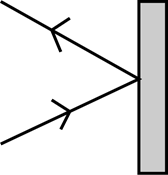
In the illustration, the light ray striking the object is-

This is an example of
Reflection
Refraction
Absorption
None of the above

Students wanted to observe how gravity affects the speed of falling objects. Because they struggled to measure the distance traveled by a falling object at different time intervals, they decided to observe gravity's effect on the speed of an object rolling down a ramp. They made a 1-meter ramp by cutting a PVC pipe in half lengthwise. They made 1-centimeter tick marks along the ramp to help them identify the distance traveled. They rolled a 45.9-gram golf ball down the ramp and videoed its progress along the ramp. They played the video back in slow motion so they could record the distance the ball traveled at different time intervals. They conducted three trials. Their data in the table.
COMPARED TO A FALLING BALL, THE RAMP (a) the ball so that gravity's effect on its motion is easier to observe

The RAMP slows down the ball so that gravity's effect on its motion is (a)

The golf's speed (a) as it traveled down a ramp because of gravity

Gravity causes objects to (a) as objects travels down
Which wave carries the most energy?


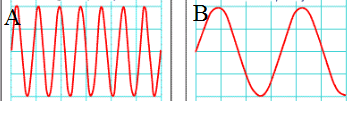
Which wave has a greater Energy?
Which wave has a lower energy?
which has the least energy?


Why does this wave carries the most energy?
The wave has the sharpest peaks.
The wave has the greatest curvature
The wave has the longest wavelength.
The wave has the greatest amplitude.

