
 Worksheets
Evidence of Evolution
Total questions: 18
Worksheet time: 13mins

The pelvic bone of whales is not needed for movement within the water. This is an example of a(n) ______________ structure.
vestigial
analogous
homologous

The forelimbs of mammals have similar anatomy because these groups descended from a recent common ancestor. Their bone structure is an example of a(n) ______________ structure.
vestigial
analogous
homologous

Many different groups of organisms have wings, even though they do not share a recent common ancestor. This is because they evolved in environments with similar selective pressures. Wings are an example of a(n) ______________ structure.
vestigial
analogous
homologous
Below are the % similarities of DNA between whales and other species. Based on this, which are whales most closely related to?
Pig, 68.4%
Hippo, 83.4%
Mouse, 38.4%
How does embryology support the Theory of Evolution?
It shows that embryos who develop similarly share a common ancestor
It shows that embryos who develop similarly are not related to one another
It shows that organisms have the ability to evolve, or change, over time
What did Darwin notice about the Finches in the Galapagos?
the size and shape of beak was different depending on the food source of each island
the size of finch was different depending on the habitat of each island
the shape and size of beak was the same
the size of finch was the same but the color was different


Which of the following can be determined by observing the embryos shown in the diagram

Vestigial structures
structures that perform a similar function but are not similar in origin
remnants of once-important structures that have slowly lost all or most of their function
features found in different organisms that share structural similarities but may have very different functions
preserved remains of an organism

What best describes the hind leg bones seen in the whale?
The bones are analogous structures to the fins of living fish.
The bones are vestigial structures that had a function in an ancestor.
The bones are homologous structures to the wings of butterflies.
The bones are fossil structures from an extinct ancestor.
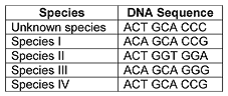

Two organisms that are closely related would have
Very similar DNA sequences
Very different DNA sequences
The same exact DNA sequences
No similarity in DNA
this evidence provides proof of what life existed in the past. These show animals that were once alive and now completely excitinct, and animals that still have living relatives today. The higher up the animal is in the rock, the more similar it is to todays species.
Genetics
fossil records
anatomy
patterns of distribution
What is the best way to determine the evolutionary relationships between species?
by comparing their bone structures
by comparing their physical appearance
by comparing the amino acid sequences of their proteins or DNA
by comparing fossils that resemble the organisms to identify common ancestors

The table shows the number of differences between the amino acid sequence in the hemoglobin molecules of several different species compared with the amino acid sequence in human hemoglobin. Using this data, which organism is most related to humans?
Responses
frog
gorilla
horse
pig

What
type
of structure?
Homologous
Analogous
Embryological
Vestigial

What
type
of structure?
Homologous
Analogous
Embryological
Vestigial

