
NEW
Font size
 Worksheets
Formal Email Writing
Total questions: 10
Worksheet time: 6mins
What does email stands for?
Engineered Mail
Electronic Mail
Easy Mail
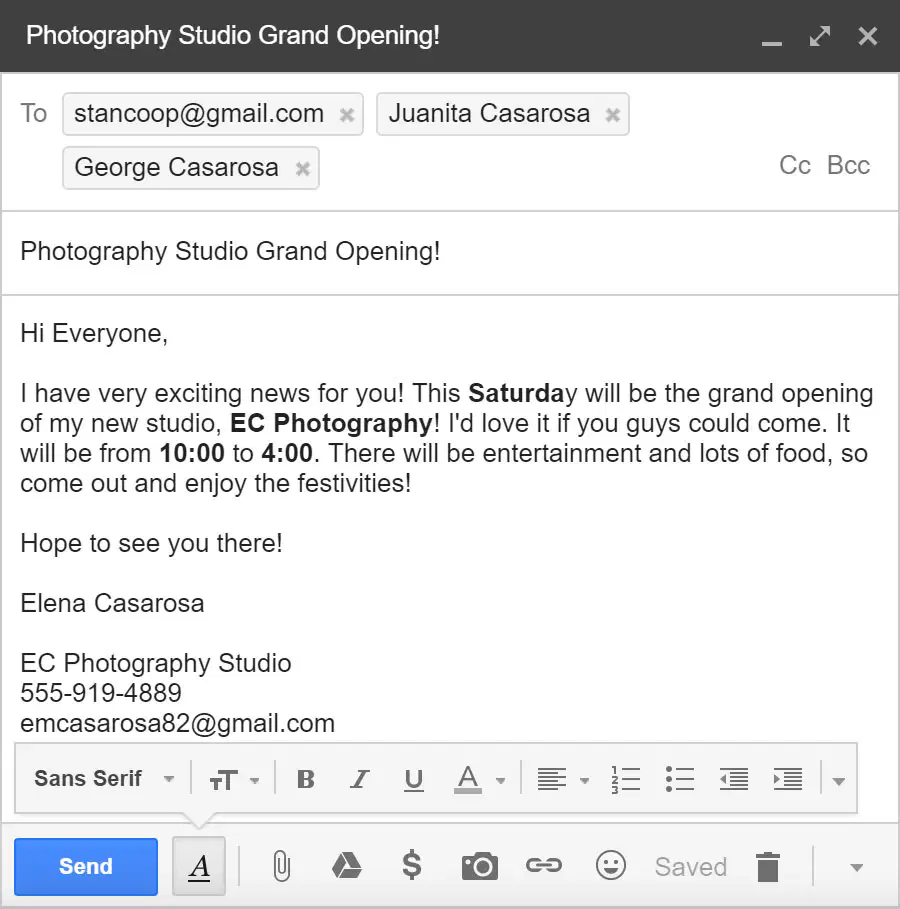
Which of the following displays the format/structure of an email in the correct order?
Subject Line; Body, Salutation; Closing; Signature
Subject Line; Body; Closing; Signature
Subject Line; Salutation; Body; Closing; Signature
Addresses; Subject Line; Body; Closing; Signature

Arrange the sentences from an email in the correct order.
F> E> B > G> D> C> A
A> F> E> B> D> G> C
F> E> G> B> D> C> A
F> G> E> B> D> C> A
The first paragraph of a formal email should set the tone and reason for your email. Which of the following paragraph DOES NOT considered appropriate for formal email?
I hope this email finds you well. I am Alicia, a member of the Product Research and Development Team. I would like to make an innovation proposal for our well-known product, X.
Thank you for taking the time to meet with me last week. I would like to follow up on our conversation and ask a few questions.
I'm really happy that we'll see each other next week. Would you like to review my proposal first? I've made it simple and short.
The second and following paragraphs should provide the main information based on the purpose stated in the introductory paragraph. To present your ideas clearly in the email, you can add transitional words.
The following are transitional words you can use to bolster your ideas with additional support/ information EXCEPT *(except = kecuali)
In addition,
Moreover,
However,
Besides,
The following are transitional words you can use to show sequence EXCEPT
Firstly,
Subsequently,
Next,
Accordingly,
You can use the following transitions to give example EXCEPT
As an illustration,
Likewise
For instance,
In this case,
When proposing an idea, you can emphasize a thought or idea you previously stated. To do so, you can consider using the following transitions EXCEPT
In fact
Certainly
More importantly
In brief
Which among the following will be the LEAST appropriate way to write your final paragraph in a formal email?
Thank you in advance. Looking forward to meeting you soon.
Thank you for your consideration of my suggestions. I look forward to an opportunity to discuss this matter further.
Thanks for your attention. That is all from me.
Tone reveals your attitude and professionalism. Expressing yourself clearly, efficiently, and politely is key to successful professional communication. Which tone is NOT appropriate in a formal email?
Dear Members of the Committee,
I believe that this is the best plan of action.
I need to conduct the event next week. Please review this proposal immediately.
Please find attached the proposal paper. I am looking forward to your feedback.

