wayground logo

Free Printable Worksheets

NEW

Font size

S
M
L
XL
Worksheets

Conduction, Convection & Radiation Review

Total questions: 30

Worksheet time: 30mins

Name
Class
Date
1.

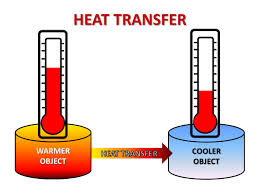
How does heat move?

a)

In many directions

b)

from warm places to cooler places

c)

from cold places to warm places

d)

Both B and C

2.
The heat from a lamp allows a lizard to remain warm. This is an example of which type of heat transfer?
a)
radiation
b)
conduction
c)
convection
d)
insulation
3.

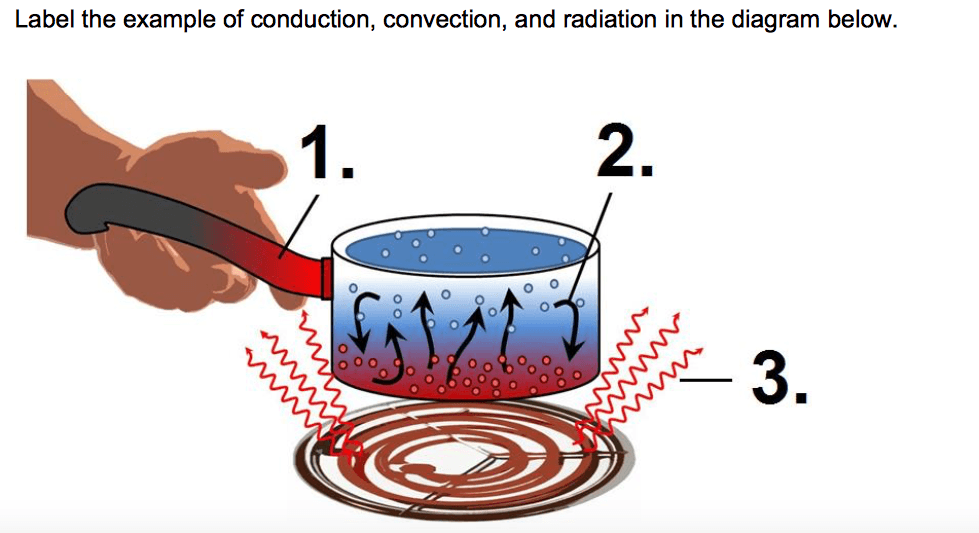
What type of thermal energy transfer is number 1 pointing to?

a)

Convection

b)

Conduction

c)

Radiation

d)

Insulation

4.

What type of thermal energy transfer is number 3 pointing to?

a)

Convection

b)

Conduction

c)

Radiation

d)

Insulation

5.

How does heat energy reach the Earth from the Sun

a)

Convection

b)

Radiation

c)

Conduction

d)

Insulation

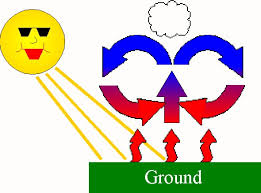
6.
a)

Conduction

b)

Convection

c)

Radiation

7.
a)

Conduction

b)

Convection

c)

Radiation

8.

Warm air rises and the cool air sinks

a)
conduction
b)
convection
c)
radiation
9.
Jordan places a hot spoon into a container of ice cream. How does this help him scoop  out the ice cream? 
a)
The coolness from the ice cream is conducted to the spoon making it easier to scoop out.
b)
The coolness from the ice cream is radiated to the spoon making it easier to scoop out.
c)
The warmth of the spoon is conducted to the ice cream  making it easier to scoop out.
d)
The warmth of the spoon is radiated  to the ice cream making it easier to scoop out.
10.
Which best describes the process of convection?
a)
Convection is the primary way  heat travels  through rays.
b)
Convection is the primary way heat travels  through metals.
c)
Convection is the primary way heat travels  through appliances.
d)

Convection is the primary way heat travels through liquids and gasses.
11.
Which is an example of heat being transferred by conduction?
a)
a furnace heating the air in a school
b)
an ice cube melting in a person’s hand
c)
a pot of water on a stove boiling
d)
the sun heating water in a swimming pool
12.
Heat transfers from an area of ____temperature to an area of ___ temperature.
a)
high to low
b)
low to high
c)
high to high
d)
It can travel high to low and low to high. 
13.
A crayon placed on a dark driveway in bright sunlight melted into a colorful puddle. What caused the crayon to melt?
a)
Solar radiation heated the driveway and then heat transferred to the crayon by conduction.
b)
Solar radiation heated the driveway and then heat transferred to the crayon by radiation.
c)
Solar convection heated the driveway and then heat transferred to the crayon by radiation.
d)
Solar convection heated the driveway and then heat transferred to the crayon by conduction.
14.

How does heat energy reach the Earth from the Sun

a)

Convection

b)

Radiation

c)

Conduction

d)

Insulation

15.

Which is the best surface for reflecting heat radiation?

a)

Shiny white

b)

Dull white

c)

Shiny black

d)

Dull black

16.

What is the definition of CONDUCTION?

a)

When heat is transferred from objects like rays of light or electromagnetically.

b)

a hot liquid or air that expands, becomes less dense, and rises or becomes more dense, and sinks.

c)

When thermal energy transfers by collisions between particles.

d)

When heat transfers through the heater or AC in your house.

17.

Air circulating from the ventilation system

a)

Conduction

b)

Convection

c)

Radiation

18.

Holding a snowball

a)

Conduction

b)

Convection

c)

Radiation

19.

Heat transfer is also called...

a)

Thermal Energy

b)

Conduction

c)

Convection

d)

Radiation

20.

Vaporization is the change from

a)

Liquid to Gas

b)

Solid to Liquid

c)

Gas to Solid

d)

Solid to Gas

21.

Water vapor is an example of what phase of matter?

a)

Solid

b)

Liquid

c)

Gas

22.

What occurs when a liquid becomes a solid?

a)

Freezing

b)

Melting

23.

What occurs when a gas becomes a liquid?

a)

Melting

b)

Condensation

24.

What state of matter has its own shape and a definite volume?

a)

Solid

b)

Liquid

c)

Gas

25.

What state of matter takes the shape of its container and has a definite volume?

a)

Solid

b)

Liquid

c)

Gas

26.

What state of matter takes the shape of its container and doesn't have a definite volume?

a)

Solid

b)

Liquid

c)

Gas

27.

When ice cubes form, heat is

a)

Added

b)

Removed

28.

Anything that takes up space and has mass is

a)

Matter

b)

Mass

29.

What happens to water while it is boiling?

a)

Condensation

b)

Evaporation

30.

Three basic states of matter

a)

Energy, Solids, Gases

b)

Solids, Gases, Plasma

c)

Solids, Gases, Liquids

d)

Solids, Liquids, Plasma