
 Worksheets
Topic 1 Semester Exam Review
Total questions: 193
Worksheet time: 6hrs 54mins

Calculate m∠ABC.
45°
60°
105°
15°

Calculate m∠DEF.
180°
60°
120°
80°

If m∠RST = (12x -1)°, m∠RSU = (9x -15)°,
and m∠UST = 53°, find each measure.
x = 13
m∠RST = 155°
m∠RSU = 102°
x = 3
m∠RST = 35°
m∠RSU = 12°
x = 22
m∠RST = 263°
m∠RSU = 183°
x = 8
m∠RST = 95°
m∠RSU = 57°


LJ = 20, find KL


If RT=36, find the value of x.
3
4
5
6


What is the distance between AB
0
8
9
7
Identify all the ACUTE angles...
37o
135o
23o
4o
175o


Which term is shown in the diagram?
Parallel
Perpendicular
Intersecting

Which term is shown in the diagram?
Parallel
Perpendicular
Intersecting
Parallel lines cross one another, or intersect.
true
false

What type of line does the picture represent?
Parallel
Intersecting
Perpendicular
different measure
same measure
greater measure
less measure


Collinear points are points that lie on the same line.
True
False

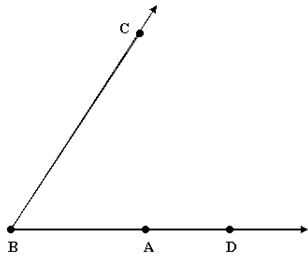
Which statement is a true statement about the diagram
Ray BA and ray BC are opposite rays.
Ray BA and ray BC have opposite directions.
Points A and C are the endpoints of ray BA and ray BC respectively.
Point B is the endpoint of ray BA and ray BC.
What is a ray?
A part of a line that is straight, has 1 endpoint, and continues in 1 direction
Another name for line segment
A straight path that continues in both directions and does not end
Points that are used to show segments of lines
If point C lies on line AB between A and B, then ray CA and ray CB are _____________________.
opposite rays
collinear points
coplanar points
segments

The definition of a circle is
set of all points in a plain that are the same distance from a point called the center
the distance around a share
a large figure
a pizza, orange, plum, or watermelon

The distance all the way around the circle is called the...
radius
diameter
circumference
area

Name the angle with one arc
< FIE
< EIR
< FIR
< RIE


Angles are measured using a ______.
compass
protractor
ruler
thermometer

What is the measure of
the given angle?
21°
159°
19°
161°


Part of a line that has a beginning, but no end is called a...
line segment
ray
angle
plane
Which word best describes a set of 3 or more different points that are all on the same line.
Coplanar
Line-up
Collinear
Sightline
In Euclidean geometric terms, which of the below would be the best description of a Circle?
A set of points in a plane that are all equidistant from a common segment.
A set of points in a plane that are all equidistant from a common point.
A set of points in a plane that are all equidistant from a common ray.
A set of points in a plane that are equidistant from a point and a line.

A flat surface that goes on forever in all directions...
Line
Plane
Axis
Point
In Euclidean geometric terms, which of the below would be the best description of a LINE?
It is a straight object that begins at a point and extends forever in one direction.
It is a straight object that extends infinitely in opposite directions without any width or thickness.
It is a straight object that consists of all of the points that are equal distance from a common point.
It is a straight object that consists of all of the points that exist between two different points.

Which Postulate would you use to find HG?
Segment Addition Postulate
Angle Addition Postulate
Segment Bisector
Angle Bisector
Find measurement for PR.
9
7
10
Identify all the OBTUSE angles...
37o
135o
23o
4o
175o


Points that lie in the same plane.
Collinear
Intersection
Parallel Planes
Coplanar
A collection of collinear points that have a distinct beginning and end.
Point
Segment
Line
Plane
Two rays that share a common endpoint.
Angle
Plane
Vertex
Line
The common endpoint of two rays that make up an angle.
Angle
Vertex
Line
Plane
Two coplanar lines that meet to form four right angles.
Parallel
Perpendicular
Intersecting
Skew
If 2 points determine a line, how many points determine a plane?
2 non-collinear points
3 collinear points
3 non-collinear points
2 coplanar points
Which of the following is a good definition for a circle?
All points equidistant from a single point
A round polygon
A continuous curve
Two semi-circles put together




Find the distance between (5, 0) and (1,0).
4
6
3
2.5
Find the midpoint of the line segment with the given endpoints (3,9) and (5,9)
(-1,0)
(4,9)
(6,7)
(7,9)

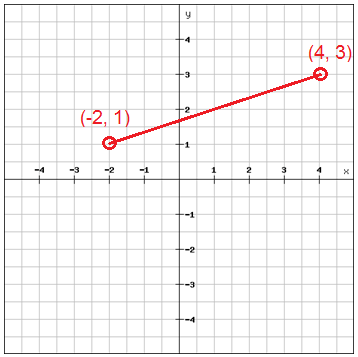
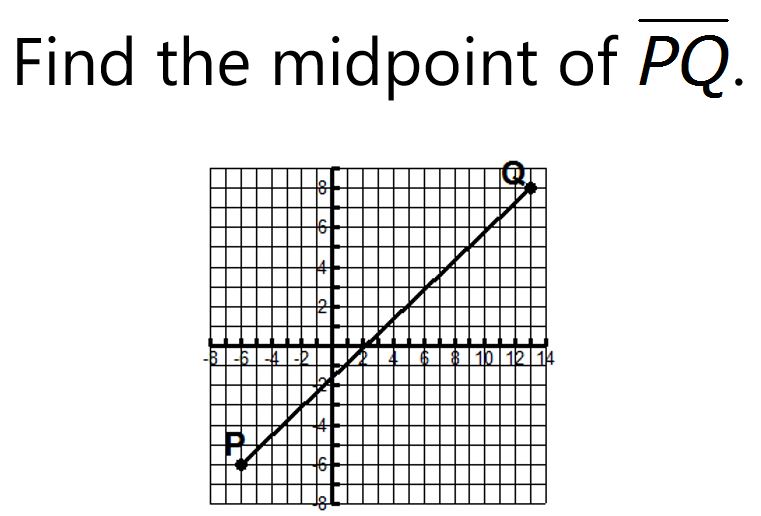
Find the midpoint of the segment on the graph. (Hover over picture to expand)
(1,0)
(7,-9)
(4,-3)
(-1,2)
Find the other endpoint of the line segment with the given endpoint (1,-9) and midpoint (-9,3)
(-19,15)
(5,-6)
(-4,-3)
(6,2)
Which of the following is the correct midpoint formula given two endpoints (x1, y1) and (x2, y2)?
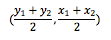
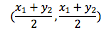
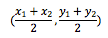

Directed line segment AB is partitioned by point P into a ratio of 1:3. Which of the following represent this relationship?
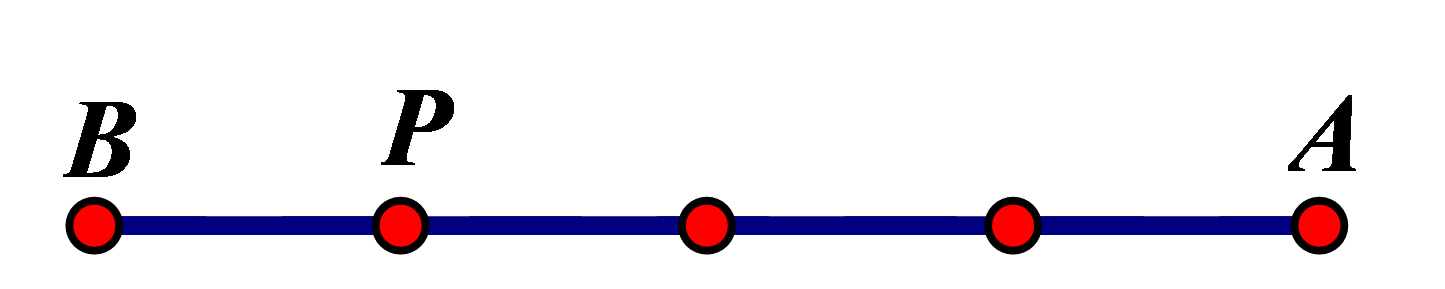

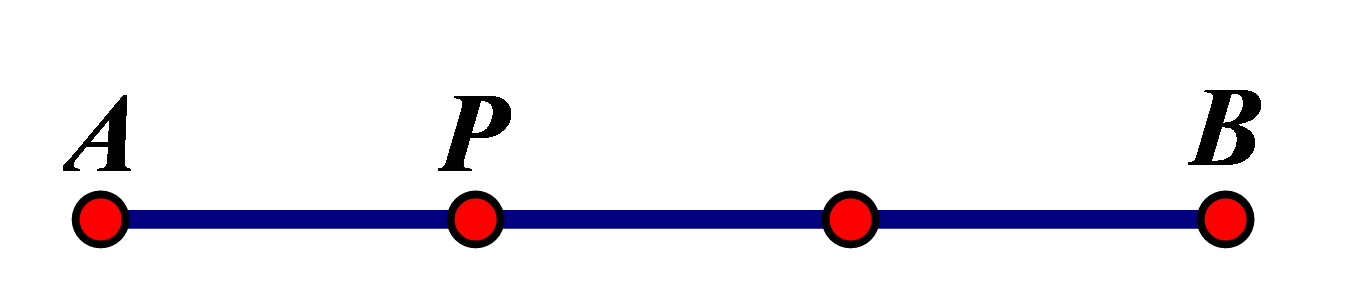
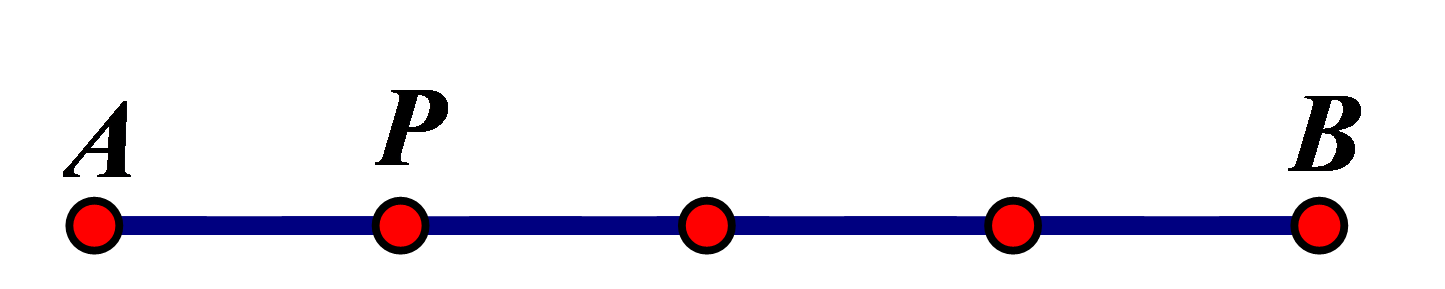
Find the point P that partitions the line segment AB given the ratio.
A (3, 5) B(4, 3) with the ratio 1:3
(3.75, 2.5)
(3.25, 4.5)
(4.75, 1.5)
(5.75, 1.5)

Find the point that is 2/5 of the distance from C to D.
(-1, 2)
(0, 0)
Which of the following is the correct midpoint formula given two endpoints (x1, y1) and (x2, y2)?
The middle of a line is called the _______________.
endpoint
midpoint
slope
distance
Find the midpoint of the line segment with the given endpoints (3,9) and (5,9)
(-1,0)
(4,9)
(6,7)
(7,9)
Find the midpoint of the line segment with the given endpoints (6,-6) and (-10,-10)
(8,2)
(-26,-14)
(0,-10)
(-2,-8)
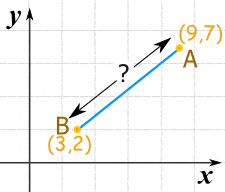
What is the distance between AB
0
8
9
7
Which of the following formulas is the distance formula?
(2x1+x2, 2y1+y2)
(x2−x1)2+(y2−y1)2
a2+b2=c2
x2−x1y2−y1
Find the distance between (2,3) & (4,1)
3
5.66
2.83
2.79

and (-8, 14)
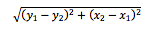
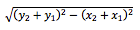
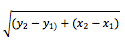
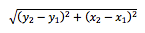
Given two points (x1, y1), (x2, y2) the distance between them is:
(3, 1)
(3.5, 1)
(4, 1)
(2, 0)


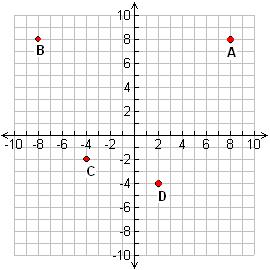

Find the distance between points A and B.
5
6
10
14
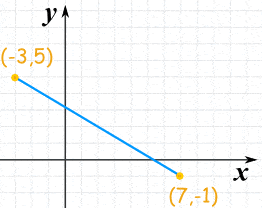

Find the distance between points A and B.
4.1
5.1
4.6
3.8

Find the distance between points A and B.
53
7.3
7.2
7


How many feet did the frisbee travel?
244 feet
345 feet
18 feet
16 feet

Find the distance between the points.
4
8
17
34

Find the distance between the points.
7
18
29
65

Find the distance between the points.
6
13
26
26

Find the distance between "Home" and the "Library".
41
18
9
3

The midpoint of AB = ?
(a)
The midpoint of CE = ?
(a)
The midpoint of CD = ?
(a)
The midpoint of BD = ?
(a)
The midpoint of BE = ?
(a)

The midpoint of AB = ?
(a)
The midpoint of DG = ?
(a)
The midpoint of FC = ?
(a)
The midpoint of GE = ?
(a)
The midpoint of GB = ?
(a)
Find the point P that is 72 from point A to Point B, given the following points:
A (-5, 8) B(9, 3)
Find the point P that is 43 of the distance from A to B, given the following points:
A (3, 5) B(4, 3)
Find the point P that is 113 of the distance from A to B, given the following points: A (-6, -6) B(-2, 1)
Find the point P that is 52 of the distance from A to B, given the following points: A(-3,-5) and B(5,0)
(0.5,-2.2)
(0.2,-3)
(1/5, -5/2)
(0,-2)
Find the point P that is 51 of the distance from A to B, given the following points: A (7, -2) B(4, 0)
Find the point P that is 41 of the distance from A to B, given the following points: A(-1,2) and B(7,14)
(2, 10)
(6, 8)
(3, 5)
(1, 5)
Find the point P that is 31 of the distance from A to B, given the following points:
A(-2 4) and B(7, -2)
(5, 2)
(1, 2)
(5, -6)
(9, 2)
Find the point that is 2/5 of the distance from C to D.
(-1, 2)
(0, 0)
(4, 4)
(-3, 0)

Which reason justifies the statement?
Subtraction Property of Equality
Combine Like Terms
Division Property of Equality
Addition Property of Equality

Which reason justifies the statement?
Addition Property of Equality
Multiplication Property of Equality
Subtraction Property of Equality
Division Property of Equality

Which reason justifies the statement?
Division Property of Equality
Addition Property of Equality
Multiplication Property of Equality
Subtraction Property of Equality

Which reason justifies the statement?
Combine Like Terms
Multiplication Property of Equality
Division Property of Equality
Addition Property of Equality

Which reason justifies the statement?
Combine Like Terms
Distributive Property of Equality
Multiplication Property of Equality
Division Property of Equality

Which reason justifies the statement?
Subtraction Property of Equality
Combine Like Terms
Addition Property of Equality
Substitution Property of Equality


What is step 2?
Distributive Property
Multiplication property of equality
Division property of equality
Substitution property

What is step 6?
Subtraction property of equality
Division property of equality
Addition property of equality
Given

What is step 2?
Given
Subtraction Property of Equality
Division Property of Equality
Multiplication Property of Equality
Addition Property of Equality


What is always the 1st reason of a proof?
Given
Reason
Prove
Statement

What should be the reason for step 4?
Reflexive Property of Equality
Subtraction
Division
Substitution


Give the Reason for #1.
Given
Segment Addition Property
Addition Property of Equality
PQ + QR = PR
Transitive Property of Equality

What is the correct reason for
Reason #3?
Definition of a Straight Angle
Prove
Definition of a Supplementary Angles
Transitive Property

What is a two-column proof? #17
a proof in which the statement and reason for each step are written in boxes
a proof in which the steps are written in the left column and the corresponding reasons are written in the right column
a proof in which the statements and corresponding reasons are written in complete sentences

Which of the following choices are in the correct order to fill in the proof?
Given; Segment Addition Postulate; Substitution; Definition of midpoint; Addition; Simplify
Given; Definition of midpoint; Addition; Simplify; Segment Addition Postulate; Substitution
Given; Substitution; Addition, Simplify; Definition of midpoint; Segment Addition Postulate

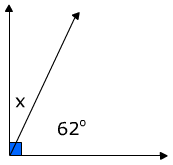
What is the measure of angle x?
(a)

What is the measure of angle x?
(a)

What type of pair are angle x and the angle that measures 35° ?
Supplementary
Complementary
Vertical


Two angles added together to equal 90 degrees is:
Supplementary
Complementary
Right
Vertical



Find y
(a)
angles supplementary to the same angle or to congruent angle are congruent
congruent supplements
congruent complements
linear pair
vertical
angles supplementary to the same angle or to congruent angle are congruent
congruent supplements
congruent complements
linear pair
vertical

What is the justification?
Definition of congruence
Reflexive Property of Congruence
Segment Addition Postulate
Definition of Midpoint

What is the justification?
Segment Addition Postulate
Definition of Midpoint
Addition Property of Equality
Complement Theorem

What is the justification?
Definition of Supplementary Angles
Vertical Angles Theorem
Definition of an Angle Bisector
Angle Addition Postulate

What is the justification?
Congruent Supplements Theorem
Vertical Angles Theorem
Definition of Supplementary Angles
Definition of Complementary Angles

What is the justification?
Transitive Property of Equality
Subtraction Property of Equality
Division Property of Equality
Substitution Property of Equality

What is the justification?
Congruent Complements Theorem
Angle Bisector Theorem
Angle Addition Postulate
Division Property of Equality

What is the justification?
Congruent Complements Theorem
Definition of Perpendicular
Definition of a Right Angle
Definition of Complementary Angles

What is the justification?
Substitution Property of Equality
Definition of Supplementary Angles
Angle Addtion Postulate
Addition Property of Equality

What is the justification?
Definition of Congruence
Segment Addition Postulate
Transitive Property of Congruence
Definition of Midpoint

What is Reason #2?
Definition of a Linear Pair
Definition of Congruent Angles
Angle Addition Postulate
Definition of a Right Angle
The definition of a linear pair includes:
(select all that apply)
Two angles share a vertex
Two angles make a straight angle
The sum of the measures of a linear pair are 180*
Two angles that are complementary angles

Solve for x.
20
25
120
180

