
 Worksheets
Topic 2 Semester Exam Review
Total questions: 241
Worksheet time: 5hrs 8mins


If lines are parallel with a transversal, then these two angles are...
Supplementary Angles
Corresponding Angles
Alternate Exterior Angles
Parallel Angles
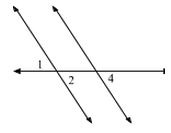
Find the measure of angle 4

No
Yes, Corresponding angles are congruent
Yes, Alternate Interior angles are congruent
Yes, Alternate Exterior angles are congruent

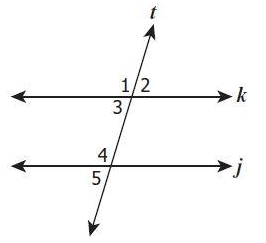
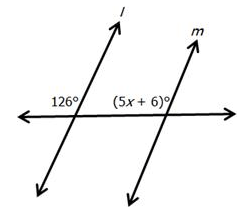


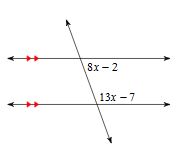

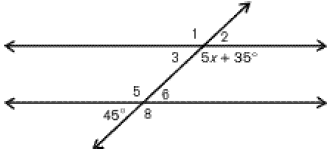
What is the relationship of the angles?
Corresponding angles
Consecutive interior angles
Alternate interior angles
alternate exterior angles

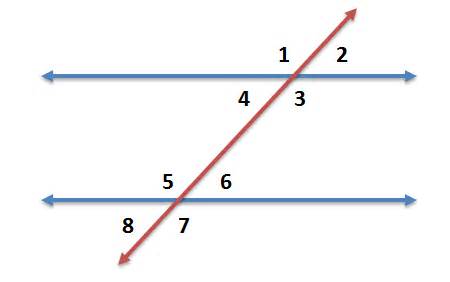
Which pair of angles are corresponding angles?
∠ 7 and ∠ 4
∠ 2 and ∠ 6
∠ 8 and ∠ 1
∠ 2 and ∠ 8

Which of the following terms best describes the relationship between ∠w and ∠x ?
Corresponding angles
Same-side interior angles
Alternate interior angles
Same-side exterior angles
True or False. Given two parallel lines cut by a transversal, their corresponding angles are conguent.
TRUE
FALSE

If ∠1 = 27° , find the measure of ∠4 .
27°
153°
63°
90°

Name the corresponding angle to ∠4 .
∠8
∠6
∠2
∠5
Name the alternate interior angle to ∠3 .
∠4
∠5
∠6
∠8

In this figure, parallel lines a and b are intersected by line c. Which pair of angles are not supplementary?
∠1 and ∠6
∠3 and ∠8
∠2 and ∠7
∠4 and ∠6

Find y.
80°
100°

Solve for y.
y=55
y=35
y=70
y=45

Identify each pair of angles.
alternate exterior
same-side interior
corresponding
alternate interior

Identify each pair of angles.
corresponding
alternate exterior
alternate interior
same-side interior

Identify each pair of angles.
vertical
corresponding
alternate exterior
alternate interior


Alternate exterior angles are outside of the parallel lines and on opposite sides of the ...
angle
measurement
transversal
vertex
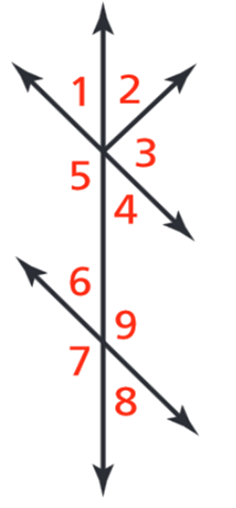
Which angle is a vertical angle to with ∠7 ?
∠1
∠5
∠3
∠6
∠9

11) Given the two parallel lines cut by a transversal,
What is the measure of ∠4 if m∠8=76° ?
(a)
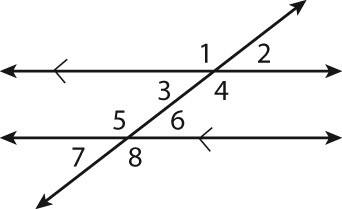


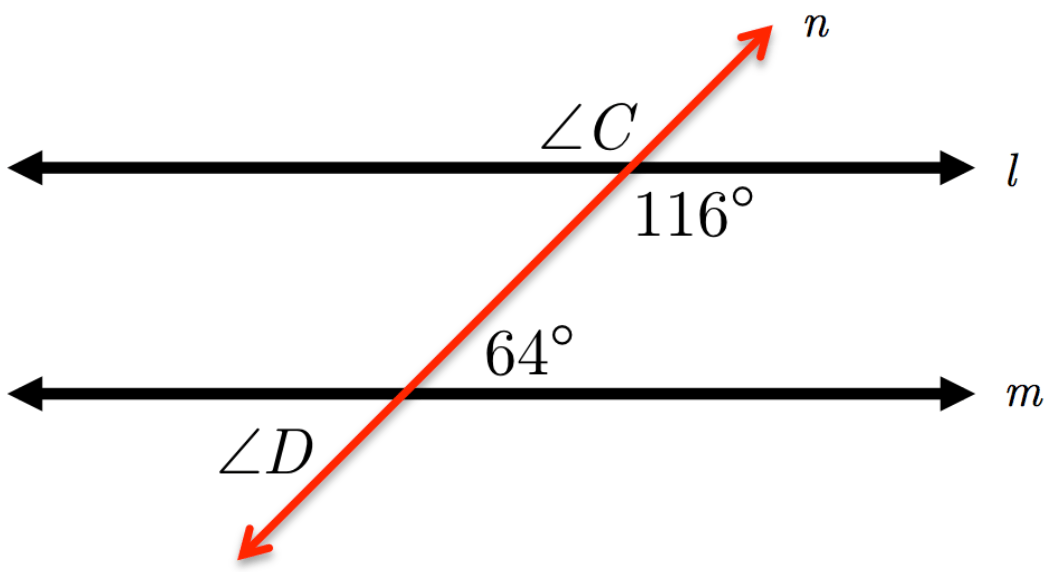
5) True or False.
If the following parallel lines are cut by a transversal, would∠2 and ∠6 be corresponding?
True
False
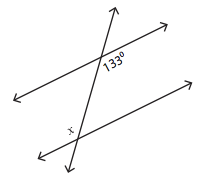
Find the value of x.
x = 133
x = 47
x = 180
x = 90


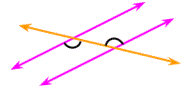
What are alternate interior angles?
A pair of angles on the outer side of two lines cut by a transversal, but on opposite sides of the transversal
The angles opposite of each other when two lines cross
A pair of angles on the inner side of two lines cut by a transversal, but on opposite sides of the transversal
Two angles in the same position when parallel lines are cut by a transversal
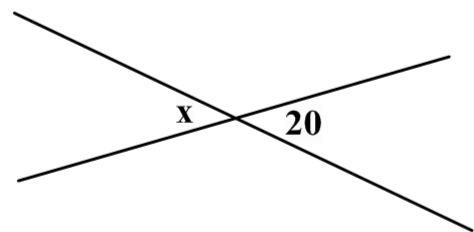

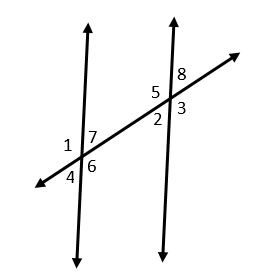
What angle is vertical to ∠1 ?
∠7
∠4
∠6
∠2
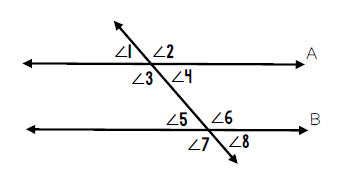
Which of the following is NOT an example of supplementary angles?
∠7 and ∠8
∠2 and ∠3
∠1 and ∠7
∠6 and ∠4

What angle is vertical to ∠5 ?
∠3
∠1
∠6
∠2

What angle corresponds to ∠3 ?
∠4
∠5
∠8
∠7


What is the relationship of the angles?
Corresponding angles
Consecutive interior angles
Alternate interior angles
alternate exterior angles
Which of the following terms best describes the relationship between ∠w and ∠x ?
Corresponding angles
Same-side interior angles
Alternate interior angles
Same-side exterior angles

Consecutive Interior
What angle corresponds to ∠5 ?
∠7
∠5
∠3
∠2
If ∠1 = 27° , find the measure of ∠4 .
27°
153°
63°
90°
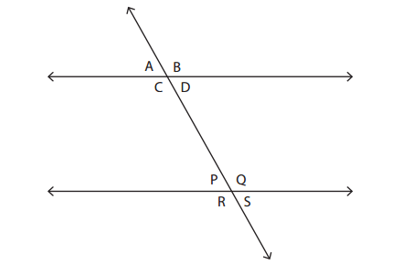

If angle 2 is 70 degrees, what is the measure of angle 1?
70 degrees
20 degrees
110 degrees
180 degrees
Solve for y.
y=55
y=35
y=70
y=45


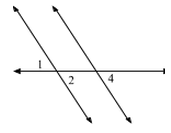
Find the measure of angle 4




Find the measure of the angle indicated that makes
u∥v .44 °
97undefined
120undefined
134undefined
Find the measure of the angle indicated that makes
u∥v .44 °
97undefined
120undefined
134undefined

Find the measure of the angle indicated that makes
u∥v .61 °
78undefined
89undefined
95undefined

Find the measure of the angle indicated that makes
u∥v .58 °
64undefined
68undefined
115undefined

Use the figure to determine if lines u and v are parallel.
If m∠A=10x+5 and m∠B=75 , determine the value of x that supports
-10
-3
5
7

Use the figure to determine if lines u and v are parallel.
If m∠A=11x and m∠B=12x−5 , determine the value of x that supports
4
5
7
10

Use the figure to determine if lines u and v are parallel.
If m∠A=39x+3 and m∠B=40x , determine the value of x that supports
2
3
5
10

Use the figure to determine if lines u and v are parallel.
If m∠A=4x+6 and m∠B=3x+17 , determine the value of x that supports
-9
6
8
11

Use the figure to determine if lines u and v are parallel.
If m∠A=8x+12 and m∠B=10x−6 , determine the value of x that supports
2
7
9
12

Which lines are parallel, and why?
m || n because corresponding angles are congruent
m || n because alternate interior angles are congruent
p || q because corresponding angles are congruent
p || q because alternate interior angles are congruent

Which lines are parallel, and why?
m || n because corresponding angles are congruent
m || n because alternate interior angles are congruent
p || q because corresponding angles are congruent
p || q because alternate interior angles are congruent

Which lines are parallel, and why?
m || n because corresponding angles are congruent
m || n because alternate interior angles are congruent
p || q because corresponding angles are congruent
p || q because alternate interior angles are congruent

Which condition would prove s || t?
Angle 1 is 108 degrees.
Angle 2 is 108 degrees.
Angle 3 is 72 degrees.
Angle 1 is 72 degrees.
Angle 2 is 72 degrees.
Which condition would prove u || v?
Angle 1 is 108 degrees.
Angle 2 is 108 degrees.
Angle 3 is 72 degrees.
Angle 1 is 72 degrees.
Angle 2 is 72 degrees.

Which condition would prove a || b ?
Angle 1 is 60 degrees.
Angle 2 is 120 degrees.
Angle 3 is 120 degrees.
Angle 1 is 120 degrees.
Angle 3 is 60 degrees.
Which condition would prove g || h ?
Angle 1 is 60 degrees.
Angle 2 is 120 degrees.
Angle 3 is 120 degrees.
Angle 1 is 120 degrees.
Angle 3 is 60 degrees.

Which line is parallel to c ?
a
b
d
none

According to the angle measurements given, which lines are parallel?
e || f
e || g
e || h
f || g
f || h
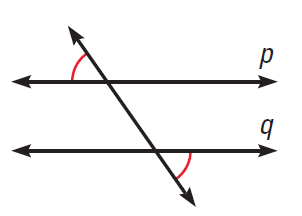
Which reason explains why the two lines are parallel?
Corresponding Angles Converse
Alt. Interior Angles Converse
Alt. Exterior Angles Converse
Consecutive Int. Angles Converse
Not Enough Information to Prove Parallel

Which reason explains why the two lines are parallel?
Corresponding Angles Converse
Alt. Interior Angles Converse
Alt. Exterior Angles Converse
Not Enough Information to Prove Parallel
Vertical Angles Theorem

Which reason explains why the two lines are parallel?
Corresponding Angles Converse
Alt. Interior Angles Converse
Alt. Exterior Angles Converse
Consecutive Interior Angles Converse
Not Enough Information to Prove Parallel
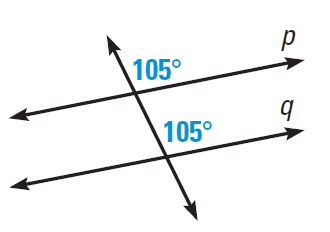
Which of the following is the reason the two lines are parallel?
Corresponding Angles Converse
Alt. Interior Angles Converse
Alt. Exterior Angles Converse
Consecutive Int. Angles Converse
Not Enough Information to Prove Parallel
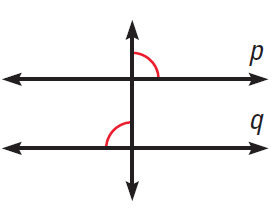
What is the reason the two lines are parallel?
Corresponding Angles Converse
Alt. Interior Angles Converse
Alt. Exterior Angles Converse
Consecutive Int. Angles Converse
Not Enough Information to Prove Parallel

What is the reason the two lines are parallel?
Corresponding Angles Converse
Alt. Interior Angles Converse
Alt. Exterior Angles Converse
Consecutive Int. Angles Converse
Not Enough Information to Prove Parallel

What is the reason the two lines are parallel?
Corresponding Angles Converse
Alt. Int. Angles Converse
Alt. Ext. Angles Converse
Consecutive Interior Angles Converse
Vertical Angles

Why are the two lines parallel?
Corresponding Angles Converse
Alternate Interior Angles Converse
Alternate Exterior Angles Converse
Consecutive Interior Angles Converse
Linear Pair Postulate

Why are the two lines parallel?
Corresponding Angles Converse
Consecutive Interior Angles Converse
Alt. Ext. Angles Converse
Alt. Ext. Angles Converse
Not Enough Information to Prove Parallel

Why are the two lines parallel?
Corresponding Angles Converse
Alt. Int. Angles Converse
Alt. Ext. Angles Converse
Consecutive Int. Angles Converse
Not Enough Information to Prove Parallel

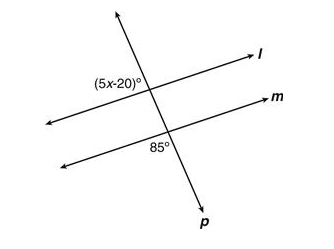
What is the reason these two lines are parallel?
Corresponding Angles Converse
Alt. Int. Angles Converse
Alt. Ext. Angles Converse
Vertical Angles Theorem
Consecutive Int. Angles Converse

Why are these two lines parallel?
Vertical Angles Theorem
Corresponding Angles Converse
Alt. Int. Angles Converse
Alt. Ext. Angles Converse
Not Enough Information to Prove Parallel

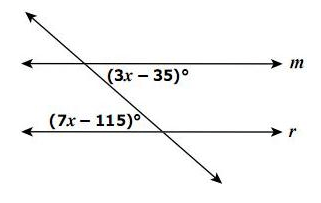
What value of x would make the lines parallel?
13
35
37
78
102


No
Yes, corresponding angles are congruent
Yes, consecutive interior angles are congruent
Yes, Alternate exterior angles are congruent

No
Yes, corresponding angles are congruent
Yes, consecutive interior angles are congruent
Yes, Alternate interior angles are congruent

No
Yes, Corresponding angles are congruent
Yes, Alternate Interior angles are congruent
Yes, Alternate Exterior angles are congruent
No
Yes, Corresponding angles are congruent
Yes, Alternate Interior angles are congruent
Yes, Alternate Exterior angles are congruent

No
Yes, Corresponding angles are congruent
Yes, Alternate Interior angles are congruent
Yes, Alternate Exterior angles are congruent

No
Yes, Corresponding angles are congruent
Yes, Alternate Interior angles are congruent
Yes, Alternate Exterior angles are congruent

No
Yes, Consecutive Interior angles are supplementary
Yes, Alternate Interior angles are congruent
Yes, Alternate Exterior angles are congruent

No
Yes, Consecutive Interior angles are supplementary
Yes, Consecutive Interior angles are congruent
Yes, Alternate Exterior angles are congruent

m∥n because Alternate Interior angles are congruent
p∥q because Alternate Interior angles are congruent
m∥n because Consecutive Interior angles are congruent
Neither pair of lines is parallel

m∥n because Alternate Exterior angles are congruent
p∥q because Alternate Exterior angles are congruent
p∥q because Corresponding angles are congruent
Neither pair of lines is parallel

m∥n because Corresponding angles are congruent
m∥n because Consecutive Interior angles are congruent
p∥q because Corresponding angles are congruent
Neither pair of lines is parallel

m∥n because Alternate Exterior angles are congruent
m∥n because Alternate Interior angles are congruent
p∥q because Alternate Interior angles are congruent
Neither pair of lines is parallel

Converse of Corresponding Angles Postulate
Corresponding Angles Postulate
Converse of Consecutive Interior Angles Theorem
Converse of Alternate Interior Angles Theorem

Consecutive Interior Angles Theorem
Converse of Consecutive Interior Angles Theorem
Converse of Alternate Interior Angles Theorem
Converse of Corresponding Angles Theorem

Yes, vertical angles are congruent
No, vertical angles are not enough to prove lines parallel
Yes, corresponding angles are congruent
Yes, alternate interior angles are congruent

Yes, corresponding angles are congruent
Yes, alternate exterior angles are congruent
Yes, alternate interior angles are congruent
No, those angles have no relationship

100° - Consecutive Interior Angles are congruent
80° - Consecutive Interior Angles are supplementary

126° - Corresponding Angles are congruent
54° - Corresponding Angles are supplementary
126° - Alternate Interior Angles are congruent

71° - Alternate Exterior Angles are congruent
109° - Alternate Exterior Angles are supplementary
71° - Alternate Interior Angles are congruent

97° - Alternate Exterior Angles are congruent
83° - Alternate Exterior Angles are supplementary
97° - Corresponding Angles are congruent

x = 6
x = 10
x = 30
x = 5

x = 7
x = 3
x = 1/7
x = 9

x = 72/17
x = 12
x = 6
x = 4.2

x = 8
x = 68/9
x = 12.4
x = -3

Which two angles are the remote interior angles to Angle W?
Angle X and Angle Y
Angle X and Angle Z
Angle Y and Angle Z
Angle Z and Angle W

Find the measure of each angle indicated.
70°
170°
10°
40°

Find the measure of each angle indicated.
5°
165°
65°
60°

Find the measure of each angle indicated.
50°
120°
30°
20°

Find the measure of each angle indicated.
105°
75°
55°
115°

Find the measure of each angle indicated.
95°
185°
55°
100°

Find the measure of each angle indicated.
180°
190°
30°
20°

Find the measure of each angle indicated.
94°
30°
40°
86°

Find the measure of each angle indicated.
60°
130°
50°
110°

Which of the following angles are remote interior angles to
∠d ?∠a and ∠b
∠a and ∠c
∠b and ∠d
∠a, ∠b, and ∠c

Find the measure of the indicated angle.
(a)

Find the measure of the indicated angle.
(a)

Find the measure of each angle indicated.
(a)

Find the value of k.
(a)

Solve for x.
(a)

Find x.
(a)

Find the ?
(a)
Find the measure of each angle indicated.
(a)
Find the measure of each angle indicated.
(a)

What is the value of x?
(a)
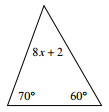


If two angles in a triangle are 45° and 75° , what is the measure of the third angle?
75°
90°
60°
70°
The angles inside an equilateral triangle are all ...
20 degrees
50 degrees
60 degrees
45 degrees
A student is trying to construct triangles using four different sets of angles. The angles in each set are given below. Which set will form a triangle?
45°, 65°, 70°
150°, 110°, 100°
50°, 50°, 50°
90°, 90°, 90°

Will the following three angles for a triangle?
30°, 60°, 90°
yes
no

Find x.
75 degrees
45 degrees
15 degrees
30 degrees

Find x.
60 degrees
90 degrees
50 degrees
180 degrees


Solve for x.
x = 7
x = 8
x = 6
x = 9


Find the value of x
1
15
11
3

Find the value of x
16
2
6
8
Find the measure of each angle indicated.
70°
170°
10°
40°
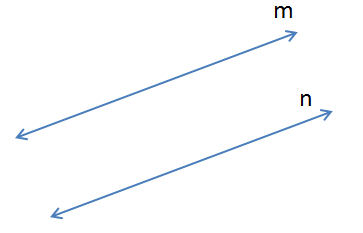
The slopes of parallel lines are...
the same
opposite
always different
Parallel lines have _________ slopes.
the same
different
opposite reciprocal
opposite
Which of the following lines are parallel?


What is the slope of the following line? y=−32x +7
7
32
−32
23
What would be the slope of a line that is parallel to y=3x−6 ?
−6
−3
31
3
What is the first step when trying to write an equation of a parallel line?
Pick out the y-intercept (b)
Pick out the slope (m)
Plug in x and y
Solve for b
When writing an equation of a line that is parallel, what should your last step be?
Solve for b.
Write your equation using the m and the b that came in the problem at the beginning.
Write your equation in y = m x + b form using your m and the new b.
Give up, who knows!
What is the equation of a line that is parallel to y = 3x - 7 and goes through (2, 1) ?
y=3(2)−7
y=3x−7
y=3x+1
y=3x−5
What is the equation of a line that is parallel to y=32x+5 and goes through (6,−7) ?
y=32x−7
y=32x−11
y=32x−3
y=32x−9
Which equation is parallel to:
y = 5/7x +2
y = -7/5x +1
y = 7/5x +4
y = -5/7x -3
y = 5/7x +5
Which two equations below are parallel?
y = 2x + 1 and y = -1/2x + 1
y = 2x + 3 and y = -2x + 3
y = 2x - 1 and y = 1/2x - 1
y = -x + 4 and y = -x + 2
y = 3x - 3
These lines are...
y = 3/2x + 9
These lines are...
What is the slope of this line?
y = 5/7x +2
y = 4x + 9
These lines are...
m = 3/4
m = 3/4
m = 4
The following represents slopes of two lines. Which answer choice describes the two lines?
m=−31 and m=−31 .
Parallel
Perpendicular
Neither
m = 7 and m = -7
What is the slope of a line perpendicular to 5?
5
1/5
-1/5
-5
What is the slope of a line perpendicular to -10/3
-10/3
10/3
3/10
-3/10
Line 1: (15, 20), (17, 18)
Line 2: (-22, -18), (-20, -16)
The two lines are _____________________.
Parallel
Perpendicular
Neither
Line 1: (−1, 2), (2, 3)
Line 2: (0, 0), (3, 1)
These two lines are ______________________
Parallel
Perendicular
Neither

Which two lines are parallel?
Line A and Line B
Line A and Line C
Line B and Line C

Which two lines are perpendicular?
Line A and Line B
Line B and Line C
Line A and Line C

Are the lines shown Parallel, Perpendicular, or Neither?
Parallel
Perpendicular
Neither

Are the lines shown parallel. perpendicular, or neither?
Parallel
Perpendicular
Neither

Are the lines shown parallel. perpendicular, or neither?
Parallel
Perpendicular
Neither
If a line has a slope of -1/7 a line that is perpendicular has a slope of what?
7
-7
-1/7
1/7

What describes the slope of the line shown on the graph?
Positive
Negative
Zero
Undefined

What is the slope of the line shown in the graph?
Positive
Negative
Zero
Undefined

Which equation matches the graph?
y=−41x+2
y=41x+2
y=4x+2
y=2x+4
What is the slope (m) of the line?
y=45x−9m=−9
m=−45
m=45
5 units right and 4 units up
can't be determined
What is true about slope (m)? Select all that apply?
m=runrise
m=change in xchange in y
m=x2−x1y2−y1
m is always constant
m is the steepness of a line
What is the slope (m) parallel to the line?
y=21x+3m=3
m=21
m=−21
m=−2
What is the slope (m) perpendicular to the line?
y=23x−4m=−4
m=23
m=32
m=−32
Are these lines parallel, perpendicular, or just intersecting (not at a right angle)?
Feel free to graph if needed.
parallel
perpendicular
intersecting (not at a right angle)
Are these lines parallel, perpendicular, or just intersecting (not at a right angle)? Feel free to graph if needed. y=−32x+3 and y=34x−1
parallel
perpendicular
intersecting (not at a right angle)
What is the equation of the line that is parallel to y=5x+7 and goes through the point (0, -2)?
Feel free to graph.
y = 5x - 2
y = -2x + 7
y = 5x-10
y = -1/5x - 2


(5, 7) and (3, 10)
(-3, -1) and (1, -9)
Find the equation of the line that passes through the points (-2, 3) and (-1, 7)
y = 1/4x + 2
y = -4x - 5
y = 4x + 5
y = 4x + 11
Find the equation of the line that passes through the points (2, -6) and (0, -3)
y=−23x−3
y=23x+3
y=32x−6
y=−23x−6

