Wayground logo

Free Printable Worksheets

Font size

S
M
L
XL
Worksheets

Natural Selection Review

Total questions: 20

Worksheet time: 13mins

Name
Class
Date
1.

The process of individuals that have physical or behavioral traits that better suit their environment and cause them to survive better and reproduce more is called...

a)

divergent evolution

b)

descent with modification

c)

natural selection

d)

mimicry

2.

Natural selection acts on ____, not ____.

a)

individuals, populations

b)

populations, individuals

3.

What does it mean for an individual to be "fit"?

a)

high likelihood of becoming fossilized

b)

has multiple habitats

c)

makes more healthy offspring

d)

has more mates

4.

What explains why individuals develop certain traits? (i.e. long neck in giraffes, colorful feathers in peacocks, webbed feet in ducks)

a)

they are beneficial to them and make them more fit

b)

they help them acquire more food

c)

they make them easier to fossilize

d)

they are easier to pass down to offspring

5.

What is the cause of ALL genetic variation?

a)

mutations

b)

evolution

c)

adaptations

d)

non-random mating

6.

Process of mating specific organisms to create offspring with desired traits

a)

natural selection

b)

random mating

c)

selective breeding

d)

evolution

7.

What word describes a trait that helps an organism survive in its environment?

a)

natural selection

b)

mutation

c)

camouflage

d)

adaptation

8.

How do you "win" at natural selection?

a)

survive

b)

go extinct

c)

survive & reproduce

9.
Which organisms are most likely to survive?
a)
the best adapted
b)
the fastest
c)
the strongest
d)
the most domesticated (tamed)
10.
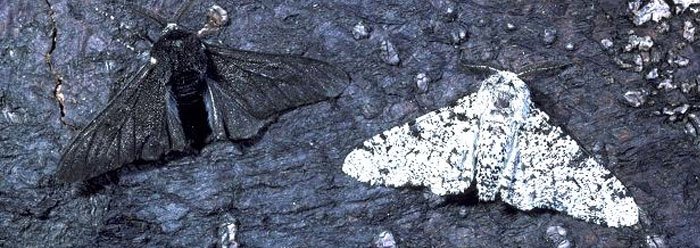
The trees these moths used to live on were white, but have been covered in soot from coal factories. Which moth will be more successful in this environment?
a)
Dark moth
b)
Light moth
c)
Both will be equally successful
d)
Neither will be successful
11.
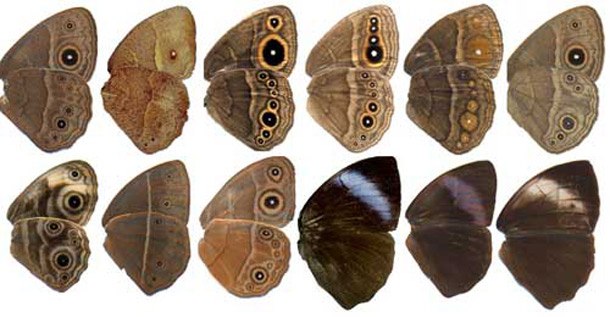
These moths are all the same species. The differences between their wings is an example of ________________
a)
Natural Selection
b)
Variation
c)
Homeostasis
d)
Extinction
12.
Which of the following explains adaptation.
a)
An individual organism changes to meet its needs in the environment. These changes pass down to their offspring.
b)
The species as a whole changes their characteristics.
c)
Beneficial traits allow organism to survive and pass on those traits
d)
New characteristics arise in a species as needed.  If these traits are helpful, they are passed down.
13.
Evolution works by 
a)
individuals changing to suit their environment
b)
Individuals learned new traits and pass them on
c)
sudden change in the environment cause a species change 
d)
small changes pass down through many generations
14.
Mutations are important because they bring about
a)
death of the organism in which they develop
b)
genetic variation needed for a population to evolve
c)
benefits for the individual, not for the population
d)
Hardey-Weinberg equilibrium within a population
15.
What is another name for natural selection?
a)
survival of the smartest
b)
survival of the fastest
c)
survival of the biggest
d)
survival of the fittest
16.

Individuals undergo evolution.

a)

True

b)

False

17.

Natural selection results in change in a population's _____________ traits over time.

a)

inherited

b)

acquired

18.
Magda is a tall, 11 year old drummer. She has a scar on her right cheek. She is good at swimming. Which of her traits did Magda most likely inherit?
a)
height
b)
the scar
c)
ability to swim
d)
ability to play drums
19.
Which of the following is a factor in natural selection?
a)
Individuals of species compete with one another to survive.
b)
All species are genetically diverse.
c)
Individuals better able to adapt to changes leave more offspring.
d)
All are correct 
20.

Charles Darwin observed that finches of different species on the Galápagos Islands have many similar physical characteristics, this supports the hypothesis that these finches

a)

are twins

b)

acquired traits through use and disuse.

c)

all eat the same type of food.

d)

descended from a common ancestor.