
 Worksheets
Magnet - Solutions, Acids and Bases Practice Multiple Choice
Total questions: 61
Worksheet time: 7hrs 2mins


What is the molarity of a solution containing 4.26 g of KCl in 1.25 L of solution? *Change g to mol first, molar mass of KCl = 74.55 g/mol*
3.41 M
0.0457 M
0.0571 M
0.0714 M
Sodium chloride (NaCl) and sucrose (C12H22O11) both dissolve in water. Which solution is able to conduct electricity?
sucrose because it is a covalent molecule and nonelectrolyte
sucrose because it is an ionic compound and electrolyte
sodium chloride because it is an ionic compound and electrolyte
sodium chloride because it is a covalent molecule and nonelectrolyte
Which of the following solutions would contain the highest concentration of hydronium ions, H3O+?
0.10 M HCl
0.10 M HF
0.10 M CH3COOH
0.10 M NaCl
_______ are corrosive substances characterized as having a strong smell, a sour taste, and a _______.
What is the pH of a soultion of 0.035 M NaOH
1.46
12.54
2.86 x 10⁻¹³
where [H+] and [OH-] are equal
pH=0
pH=14
pH=7

Given the equation:
H2SO4 + H2O ↔ H3O+ + HSO4- 1
What is the acid?
H2SO4
H2O
H3O+
HSO4- 1
Given the equation HF + H2O ↔ H3O+ + F-1
Which is the conjugate acid?
HF
H2O
H3O+
F-1
By definition, a Bronsted-Lowry base is a:
proton donor
proton acceptor
Increases the concentration of H3O+
Increases the concentration of OH-
Given the equation:
PO43‑ + H2O ↔ HPO42‑ + OH-
Which species is the conjugate acid?
PO43‑
H2O
HPO42‑
OH-
The term "amphoteric" mean
like an aligator
goes from land to water
behaves like an acid or base
is afraid of reptiles
Given the equation:
NH3 + H2O ↔ OH‑1 + NH4+1
Which species is the conjugate base?
NH3
H2O
OH‑1
NH4+1

HCl + KOH --> H2O + KCl
If a student uses 25.0 mL of a 0.5M solution of KOH, what is the molarity of the acid if 15.0mL of acid neutralized?
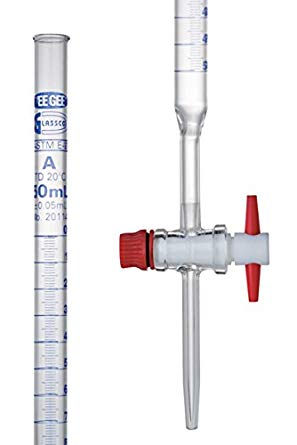
What is this piece of apparatus called
Pipette
Burette
Janette
Cuvette
Which of the following would be a weak base?


How many moles of BaCl2 are formed in the neutralization of 393 mL of 0.171 M Ba(OH)2 with aqueous HCl?
1.15 mol
0.0672 mol
0.0336 mol
2.30 mol

How many moles of HNO3 would be needed to react with 85 mL of 0.75 M KOH?
110 mol
1.1 mol
.11mol
0.064 mol
64 mol
How many mL of 0.50 M HNO3 would be needed to react with 85 mL of 0.75M KOH?
130 mL
0.13 mL
32 mL
0.032 mL
How many grams of water could form in this reaction if 85.0mL of 0.750M KOH are completely neutralized?
1.15g
282g
31.9g
113.g
Solid iron (II) sulfide reacts with hydrochloric acid to form hydrogen sulfide gas and aqueous iron (II) chloride:
FeS (s) + 2 HCl (aq) --> H2S (g) + FeCl2 (aq) If 145 mL of HCl is needed to completely react with 25 g of iron (II) sulfide, what is the concentration of the HCl solution?
3.1 M
0.68 M
2.7 M
9.0M
3.9 M
How many mL of 0.5M HNO3 would be needed to react with 85mL of 0.75M KOH?
127.5mL
0.1275mL
31.9mL
0.031875mL
What is [HCl] if 25.00 mL of HCl neutralizes 20.00 mL of 0.100 M KOH?
0.160 M
0.0800 M
0.0400 M
0.500 M
If 25.0 mL of H3PO4 are neutralized by 42.6 mL of 0.103 M Ca(OH)2, what is [H3PO4]?
0.176 M
0.263 M
0.117 M
0.0585 M
Identify the true statement about the following reaction:
F- + H2O --> HF +OH-
H2O is a bronsted lowry base
H2O is not an acid or base according to either model
H2O is a bronsted lowry acid
H2O is an arrhenius acid
HNO3 + H2O → H3O+ + NO31-
NO31- is the conjugate base of
H2O
HNO3
H3O+
none of the above
Label the acid, base, conjugate acid and conjugate base.
Click on the conjugate base.
Click on the conjugate acid.
After a base has accepted an H+ ion, it becomes a(n)
An acid
A Base
A Conjugate Acid
A Conjugate Base
Label the acid, base, conjugate acid and conjugate base.
What is the conjugate acid of CO3-2?
HCO3
HCO3-
CO2
CO2-

What is NH4+ classified as?
Acid
Base
Conjugate Acid
Conjugate Base
The conjugate acid of HCO3- is ___ and the conjugate base of HCO3- is ___.
A Bronsted Lowry base:
donates H+ to another substance
accepts H+ from another substance
produces H+
produces OH-

In which of the reactions does HCl donate a proton and thus act as an acid?
A, only
B, only
both A and B
neither A nor B
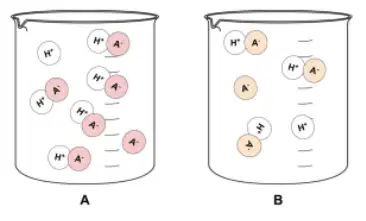
Which beaker shows a weaker acid?
Beaker B because the substance dissociates less
Beaker A because the substance dissociates less
Beaker B because the substance dissociates more
Both beakers show acids of the same strength
Beaker A because the substance dissociates more

Which beaker shows a stronger acid?
Beaker B because the substance dissociates less
Both beakers show acids of the same strength
Beaker A because the substance dissociates more
Beaker A because the substance dissociates less
Beaker B because the substance dissociates more

Which beaker shows a weaker acid?
Both beakers show acids of the same strength
Beaker B because the substance dissociates more
Beaker A because the substance dissociates more
Beaker B because the substance dissociates less
Beaker A because the substance dissociates less

List the following acids on order of increasing strength:
hydrocyanic, hypochlorous, citric, acetic
acetic, citric, hydrocyanic, hypochlorous
acetic, citric, hypochlorous, hydrocyanic
acetic, hydrocyanic, citric, hypochlorous
List the following acids from strongest to weakest:
hydrocyanic, hypochlorous, citric, acetic
acetic, citric, hydrocyanic, hypochlorous
acetic, citric, hypochlorous, hydrocyanic
acetic, hydrocyanic, citric, hypochlorous


