
NEW
Font size
 Worksheets
Unit 5 APES
Total questions: 21
Worksheet time: 21mins
What are properties of the soil determined by
time
parent material
climate
topography
ALL of these determine the properties of the soil
The climate affects the type of soil that is created. Which of the following biomes would result in rapid weathering, leaching of nutrients, decomposition of organic detritus due to a lot of rain and warm temperatures.
Tundra
Coniferous Forest (Boreal Forest)
Deciduous Forest
Tropical Rain Forest
How does compacting soil from anthropogenic means impede water drainage?
Drying at deeper layers of soil
Waterlogging-water not draining
preventing soil development
Each of these is an affect of compacted soil
Which of the following has the greatest permeability?
gravel
sand
clay
silt

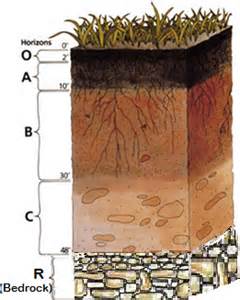
Why might very old soil be nutrient poor in the picture above?
more organic material is present
plants and water leaching nutrients
less biodiversity
soil is compacted
What horizon is decomposed organic material and is most pronounced in forests
O horizon
A horizon
E horizon
D horizon
Which of the following is NOT a soil service?
plant growth
cycling of nutrients
physical weathering
water storage and filtration
Which type of boundary is described with: Plates push towards each other, Creates subduction, Creates volcanoes, Causes earthquakes
Convergent
Divergent
Transform/ Strike-Slip
What type of boundary causes the following: Plates here push away from each other, May have ridges or volcanoes, May cause sea floor spreading May also cause earthquakes less frequently
Convergent
Divergent
Transform/ Strike-slip

What type of event will occur at this boundary?
Earthquake
Volcano Eruption
Tornado
Mountain Building
The rate at which water flows through the soil is called soil percolation or ______.
Groundwater
Permeability
Soil Pores
Porosity

What are the proportions of sand, silt, and clay for the soil at point X ?
5% Sand, 95% Silt, 5% Clay
5% Sand, 20% Silt, 5% Clay
65% Sand, 30% Silt, 10% Clay
60% Sand, 30% Silt, 10% Clay
molten rock (magma) in the mantle as it heats up, rises, cools down and sinks
convection
conduction
radiation
volcanoes

At which of the following sites would activity result in volcanoes, island arcs, and mountains?
A
B
C
D
Soil, vegetation, & rocks that are removed to get to an ore deposit below
reserve
ore
overburden
tailings
Acid mine drainage results from the release of what element from the mineral pyrite?
sulfur
carbpm
chlorine
nitrogen
Restoring land to its original state after mining has finished is called __.
reclamation
remediation
restoration
redemption
Commercially valuable deposits of concentrated minerals
tailings
ore
overburden
metals
Which of the following is the most destructive and most difficult to reclaim?
strip mining
open pit mining
mountaintop mining
subsurface mining

