wayground logo

Free Printable Worksheets

Font size

S
M
L
XL
Worksheets

1st Semester Exam Review

Total questions: 110

Worksheet time: 5hrs 1mins

Name
Class
Date
1.

Alternate exterior angles are outside of the parallel lines and on opposite sides of the ...

a)

angle

b)

measurement

c)

transversal

d)

vertex

2.

Alternate interior angles are on the ________ of the parallel lines but on opposite sides of the transversal.

a)

Outside

b)

Inside

c)

Opposite

d)

Vertex

3.

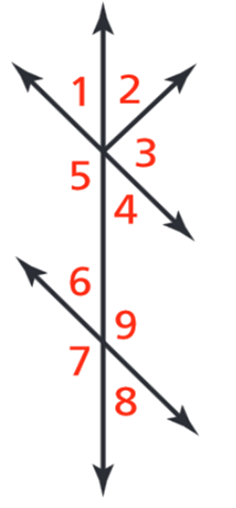
Which angle is a vertical angle to with 7\angle7  ?

a)

1\angle1  

b)

5\angle5  

c)

3\angle3  

d)

6\angle6  

e)

9\angle9  

4.

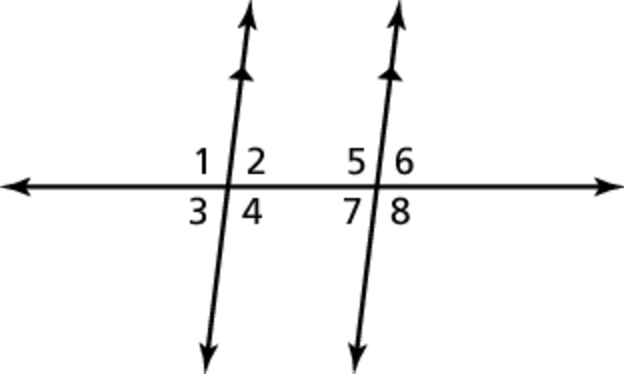
2) Given the following two parallel lines cut by a transversal.


Which pair of angles represents corresponding angles?

a)

1\angle1  and  6\angle6  

b)

6\angle6  and 5\angle5  

c)

7\angle7  and 8\angle8  

d)

4\angle4  and 8\angle8  

5.

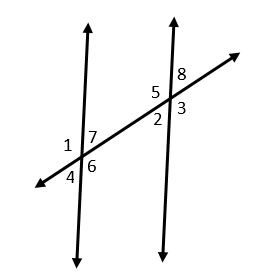
11) Given the two parallel lines cut by a transversal,

What is the measure of 4\angle4  if  m8=76°m\angle8=76\degree  ?


(a)  

6.

Which pair of angles must be supplementary so that r is parallel to s?

a)

∠2 and ∠3

b)

∠5 and ∠6

c)

∠4 and ∠10

d)

∠6 and ∠14

7.
What value of x proves that line p is parallel to line r?
a)
14
b)
12.5
c)
15
d)
25
8.

4) Given the following two parallel lines cut by a transversal.


Which pair of angles represents alternate exterior angles?

a)

4\angle4 and 8\angle8

b)

7\angle7 and 5\angle5

c)

1\angle1 and 2\angle2

d)

6\angle6 and 5\angle5

9.

Which pair of angles is an example of corresponding angles?

a)

1 and 8\angle1\ and\ \angle8  

b)

3 and 7\angle3\ and\ \angle7  

c)

4 and 5\angle4\ and\ \angle5  

d)

2 and 5\angle2\ and\ \angle5  

10.

Which pair of angles is an example of consecutive interior angles?

a)

1 and 8\angle1\ and\ \angle8  

b)

3 and 7\angle3\ and\ \angle7  

c)

4 and 5\angle4\ and\ \angle5  

d)

2 and 5\angle2\ and\ \angle5  

11.

Which pair of angles is an example of alternate interior angles?

a)

1 and 8\angle1\ and\ \angle8  

b)

3 and 7\angle3\ and\ \angle7  

c)

4 and 5\angle4\ and\ \angle5  

d)

2 and 5\angle2\ and\ \angle5  

12.

Which pair of angles is an example of alternate exterior angles?

a)

1 and 8\angle1\ and\ \angle8  

b)

3 and 7\angle3\ and\ \angle7  

c)

4 and 5\angle4\ and\ \angle5  

d)

2 and 5\angle2\ and\ \angle5  

13.

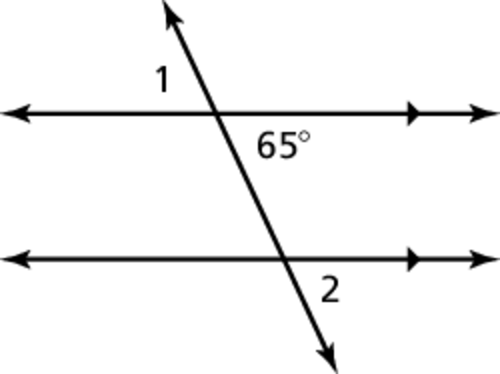
Find m1.m\angle1.  

a)

180°180\degree  

b)

65°65\degree  

c)

115°115\degree  

14.

Find m2.m\angle2.  

a)

65°65\degree  

b)

180°180\degree  

c)

115°115\degree  

15.
Identify the property of equality.
If 9=x, then x=9
a)
Reflexive
b)
Symmetric
c)
Transitive
d)
Substitution
16.
Identify the property used here:
39=39
a)
Reflexive
b)
Symmetric
c)
Transitive
d)
Substitution
17.
Simplify the expression with the distributive property
6(x + 3)
a)
6x + 3
b)
6x + 18
c)
x + 3
d)
9x
18.
What is always the 1st statement in reason column of a proof?
a)
Prove
b)
Given
c)
Reason
d)
Statement
19.
Step 2 is what
a)
Substitution property (simplify)
b)
Multiplication property of equality
c)
Division property of equality
d)
Distributive Property
20.
What is step 4
a)
Substitution property (simplify)
b)
Addition property of equality
c)
Subtraction property of equality
21.
What is step 6
a)
Subtraction property of equality
b)
Addition property of equality
c)
Division property of equality
22.
Step 1 is what
a)
addition property of equality
b)
given
c)
subtraction property of equality
d)
prove
23.
What is reason 2?
a)
Addition Property of Equality
b)
Subtraction Property of Equality
c)
Multiplication Property of Equality
d)
Division Property of Equality
24.
What are the missing numbers in this pattern?
23, 33, ___, 53, ___, 73
a)
32, 62
b)
42, 63
c)
43, 63
d)
42, 62
25.
    2x + 6 = 14
a)
x = 4
b)
x = 10
c)
x = -4
d)
x = 3
26.
Solve  3x - 7 = 32
a)
13
b)
-13
c)
12
d)
-12
27.
What is reason 2?
a)
Addition Property of Equality
b)
Subtraction Property of Equality
c)
Multiplication Property of Equality
d)
Division Property of Equality
28.
a)
100°
b)
80°
c)
90°
d)
180°
29.
a)
100°
b)
80°
c)
90°
d)
180°
30.
a)
100°
b)
80°
c)
90°
d)
180°
31.
What are complementary angles?
a)
Angles that add up to 180°
b)
Angles that add up to 90°
c)
Angles that are equal to each other
d)
Angles that are opposite of each other when lines intersect.
32.
What are supplementary angles?
a)
Angles that add up to 180°
b)
Angles that add up to 90°
c)
Angles that are equal to each other
d)
Angles that are opposite of each other when lines intersect
33.
What are vertical angles?
a)
Angles that are adjacent to each other
b)
Angles that add up to 180°
c)
Angles that are opposite of each other when lines intersect
d)
Angles that add up to 90°
34.
If angle ∠ABD is 67°. What is ∠DBC?
a)
180°
b)
90°
c)
67°
d)
23°
35.
Which are pairs of vertical angles?
a)
∠COB & ∠COA
b)
∠AOD & ∠AOC
c)
∠COB & ∠AOD
d)
∠BOD & ∠AOD
36.
If ∠COB is 124°, then what is ∠BOD? How are they related?
a)
56°, they are supplementary
b)
90°, they are complementary
c)
124°, they are vertical
37.
Find the value of x
a)
-5
b)
28
c)
19
d)
-3
38.
a)
2x-6=7x+4
b)
2x-6+7x+4=90
c)
2x-6+7x+4=180
d)
2x-6+7x+4=360
39.
a)
2x-6=7x+4
b)
2x-6+7x+4=90
c)
2x-6+7x+4=180
d)
2x-6+7x+4=360
40.
Name the relationship: complementary, linear pair, vertical, or adjacent
a)
A
b)
B
c)
C
d)
D
41.

Find the length indicated.

(a)  

42.

Find the length indicated.

(a)  

43.

Find the length indicated.

(a)  

44.

Write an equation that correctly models the lengths shown.

a)

2x + 20 + x + 21 = 9

b)

2x + 20 + 9 = x + 21

c)

9 + x + 21 = 2x + 20

d)

2x + 20 - 9 = x + 21

45.

Find the indicated length.

(a)  

46.

Write an equation that correctly models the lengths shown.

a)

3x + 2 + 6 = 2x - 2

b)

2x - 2 + 6 = 3x + 2

c)

6 - 3x - 2 = 2x - 2

d)

2x + 2 + 3x + 2 = 6

47.

Write an equation that could be used to relate the lengths of the segments shown.

a)

8 + x + 3 = -17 + 2x

b)

x + 3 + -17 + 2x = 8

c)

8 + -17 + 2x = x + 3

48.

Write an equation that could be used to relate the lengths shown.

a)

4 + 3x + 2 = 7x - 2

b)

7x - 2 + 4 = 3x + 2

c)

7x - 2 + 3x + 2 = 4

49.

Write an equation that could be used to relate the lengths of the segments shown.

a)

9 - x = 2x - 19

b)

9 + x = 2x -19

c)

x + 2x - 19 = 9

d)

9 + 2x - 19 = x

50.

Part of a line that has a beginning, but no end is called a...

a)

line segment

b)

ray

c)

angle

d)

plane

51.

A flat surface is called a...

a)

plane

b)

line

c)

point

d)

ray

52.

Part of a line that has a beginning and an end is called a...

a)

ray

b)

plane

c)

angle

d)

line segment

53.
Find measurement for QT.
a)
10
b)
6
c)
-10
d)
2
54.
Find measurement for QS.
a)
7
b)
4
c)
3
d)
1
55.
What direction is an undefined slope?
a)
horizontal
b)
vertical
56.
Are these two lines parallel, perpendicular or neither?
y = -1/3x - 5
y = 1/3x + 2
a)
Parallel
b)
Perpendicular
c)
Neither
57.
A line is perpendicular to    y = 2x - 7.
What is the slope of this line? 
a)
-2
b)
1/2
c)
-1/2
d)
2
58.
Are the lines parallel, perpendicular, or neither?
a)
Parallel
b)
Perpendicular
c)
Neither
59.
Write an equation for a line parallel to the line
y = 1/3x - 4 through (-3, 2)
a)
y = 2/3x +3
b)
y = -1/3x + 3
c)
y = 1/3x + 3
d)
y = -5/3x + 3
60.

Two lines that are parallel will have ...

a)

Slope that is opposite reciprocals

b)

No slope

c)

Slope that is the same

d)

none of the above

61.

Two lines that are perpendicular lines have ...

a)

Slope that is opposite reciprocals

b)

No Slope

c)

Slope that is the same

d)

none of the above

62.
What slope is perpendicular to:  
m = 5/8
a)
-5/8
b)
5/8
c)
-8/5
d)
8/5
63.
What slope is parallel to:  
m = 3/4
a)
4/3
b)
3/4
c)
-3/4
d)
-4/3
64.
A line is perpendicular to    y = 2x - 7.
What is the slope of this line? 
a)
-2
b)
1/2
c)
-1/2
d)
2
65.
Which of these represents point-slope form of a linear equation?
a)
y - y1 = m(x - x1)
b)
Ax + By = C
c)
y = mx + b
d)
y=kx
66.
Which of these represents slope-intercept form of a linear equation?
a)
y - y1 = m(x-x1)
b)
Ax + By = C
c)
y = mx + b
d)
y=kx
67.
Which of these represents standard form of a linear equation?
a)
y - y1 = m(x-x1)
b)
Ax + By = C
c)
y = mx + b
d)
y=kx
68.
For the equation
y - 3 = 2(x + 4),
the line has a slope of 2 and contains what point?
a)
(-4, 3)
b)
(3, -4)
c)
(-3, -4)
d)
(-4, -3)
69.
For the equation
y + 1 = -3 (x - 5),
the line contains the point (5, -1) and has a slope of?
a)
-1
b)
1
c)
-3
d)
5
70.
Write the equation in point-slope form of the line that passes through the given point and has the given slope.
(4, -7); m = -1/4
a)
y +7 = -1/4(x - 4)
b)
y - 4 = -1/4(x + 7)
c)
y + 4 = -1/4(x - 7)
d)
y - 7 = -1/4(x - 4)
71.
Write the equation in point-slope form for the line that contains the points
(-2, -3), (4, 3)
a)
y - 3 = 1(x - 2)
b)
y + 3 = 1(x + 2)
c)
y -3 = -1(x + 2)
d)
y + 3 = -1(x - 2)
72.
For the equation 
y - 4 = -1/3(x - 7), 
what are the coordinates for the point?
a)
(4, 7)
b)
(-7, - 4)
c)
(7, 4)
d)
(-4, -7)
73.
Write the equation of a line parallel to the one pictured through the point (3,1) in point slope form.
(HINT: PARALLEL LINES HAVE THE SAME SLOPE)
a)
y - 1 = 1/2(x - 3)
b)
y + 1 = 1/2(x + 3)
c)
y - 1 = - 1/2(x - 1)
d)
y + 1 = - 1/2(x + 3)
74.
Write the equation of a line perpendicular to the one pictured through the point (3,1) in point slope form.
(HINT: PERPENDICULAR LINES - FLIP AND SWITCH)
a)
y - 1 = 1/2 (x - 3)
b)
y + 1 = 2 (x + 3)
c)
y - 1 = - 1/2 (x - 1) 
d)
y - 1 = - 2 (x - 3)
75.
Write an equation in slope-intercept form that has m = 5/4 through (-4, -3)
a)
y = 5/4x + 2
b)
y = -5/4x + 2
c)
y = 2x - 5/4
d)
y = 3/4x + 2
76.

Write an equation in slope intercept form that is parallel to y = 2x +3 and passes through the point (3, -4).

a)

y = 2x + 10

b)

y = 2x -10

c)

y = -2x -10

d)

y= -2x - 2

77.

Write an equation in slope intercept form that is perpendicular to y = -3x + 4 and passes through the point (9,5).

a)

y = 3x - 32

b)

y = -3x + 22

c)

y = 1/3x - 8

d)

y = 1/3x + 2

78.

Write an equation that is parallel to y = 4 and passes through the point (8, -3)

a)

y = 3x - 11

b)

y = -3

c)

y = -3x

d)

y = x

79.

Write an equation in standard form that is perpendicular to y = 1/4x + 2 and passes through the origin.

a)

y = -4x - 0

b)

4x + y = 0

c)

y = 4x - 2

d)

x - 4y = 0

80.

Calculate m∠ABC.

a)

45°

b)

60°

c)

105°

d)

15°

81.

Calculate m∠DEF.

a)

180°

b)

60°

c)

120°

d)

80°

82.
Find the value of ∠A.
a)
25 degrees
b)
30  degrees
c)
35 degrees
d)
90 degrees
83.

 Find HIW\angle HIW  if  HIJ = 164°\angle HIJ\ =\ 164\degree  and  WIJ = 140°\angle WIJ\ =\ 140\degree  

a)

HIW = 304°\angle HIW\ =\ 304\degree  

b)

HIW=16°\angle HIW=16\degree  

c)

HIW=40°\angle HIW=40\degree  

d)

HIW=24°\angle HIW=24\degree  

84.

ECD=122°\angle ECD=122\degree  and  BCE=36°\angle BCE=36\degree . Find the measure of  BCD\angle BCD  . 

a)

BCD=158°\angle BCD=158\degree  

b)

BCD=86°\angle BCD=86\degree  

c)

BCD=58°\angle BCD=58\degree  

d)

BCD=144°\angle BCD=144\degree  

85.

Find  PSR\angle PSR  if  TSP=54°\angle TSP=54\degree  and  TSR =138°\angle TSR\ =138\degree  

a)

TSR=192°\angle TSR=192\degree  

b)

TSR=84°\angle TSR=84\degree  

c)

TSR=42°\angle TSR=42\degree  

d)

TSR=126°\angle TSR=126\degree  

86.

Solve for x if ABD=x+67\angle ABD=x+67 ,    ABC=104°\angle ABC=104\degree , and  DBC = x+51\angle DBC\ =\ x+51   .

a)

x = 53

b)

x = 37

c)

x = 7

d)

x =  7-7  

87.

JKU=3x9, UKL=138°\angle JKU=3x-9,\ \angle UKL=138\degree  and    JKL=15x3\angle JKL=15x-3  . Solve for x. 


a)

x = 49

b)

x = 9.4 

c)

x = 11

d)

x = 8.3

88.

Find x if    STB=x+49, BTU=x+108\angle STB=x+49,\ \angle BTU=x+108 , and  STU=141°\angle STU=141\degree  . 


a)

x =  8-8  

b)

x = 33

c)

x = 92

d)

x = 39

89.

(x,y) becomes (-x,y)

a)

Reflections over y-axis

b)

Reflections over x-axis

c)

Rotation of 90 CW

d)

Rotation of 180

90.

(x,y) becomes (-y,-x)

a)

Rotation of 180

b)

Rotation of 90 CCW

c)

Reflection over y=-x

d)

Reflection over x-axis

91.

(x,y) becomes (-x,-y)

a)

Reflection over y=x

b)

Reflection over y=-x

c)

Rotation of 90 CW

d)

Rotation of 180

92.

(x,y) becomes (-y,x)

a)

Rotation of 270 CW

b)

Rotation of 90 CW

c)

Reflection over y=-x

d)

Reflection over y-axis

93.

(x,y) becomes (x+3,y)

a)

Translated up 3

b)

Translated Left 3

c)

Translated Right 3

d)

Dilated by 3

94.

(x,y) becomes (x,y+3)

a)

Translated up 3

b)

Translated Left 3

c)

Translated Right 3

d)

Dilated by 3

95.

(x,y) becomes (3x,3y)

a)

Translated up 3

b)

Translated Left 3

c)

Translated Right 3

d)

Dilated by 3

96.

(x,y) becomes (-x,y)

a)

Rotated 180

b)

Reflected over x-axis

c)

Reflected over y-axis

d)

Rotated 90 Clockwise

97.

(x,y) becomes (y,x)

a)

Reflected over y=x

b)

Reflected over x-axis

c)

Reflected over y-axis

d)

Rotated 180

98.

The image shows what type of transformation?

a)

Rotation

b)

Translation

c)

Reflection

99.

What quadrant is the image now in?

a)

I

b)

II

c)

III

d)

IV

100.

What does dilation mean?

a)

a transformation that enlarges or reduces a figure

b)

a transformation that flips a figure

c)

a transformation that turns a figure

d)

a transformation that slides a figure

101.

What kind of transformation is this?

a)

Reflection

b)

Translation

c)

Rotation

102.

What kind of transformation is this?

a)

Rotation

b)

Reflection

c)

Translation

103.
Determine how to translate triangle ABC to triangle A'B'C'.
a)
right two, down five
b)
right two, down 9
c)
left two, up 9
d)
left two, down 5
104.
Determine where X' would be if you translated X 3 units to the left and 9 units down.
a)
(-4, 4)
b)
(-10, 2)
c)
(-4, -5)
d)
(-1, 5)
105.
Which answer shows a reflection across the y-axis?
a)
a
b)
b
c)
c
d)
d
106.
Identify the transformation from ABC to A'B'C'.
a)
90o clockwise rotation
b)
90o counter clockwise rotation
c)
Reflection across the y-axis
d)
Reflection across the x-axis
107.
Identify the transformation from C to D.
a)
90o Clockwise Rotation
b)
180o Rotation
c)
270o Clockwise Rotation
d)
360o Rotation
108.
Identify the transformation from ABC to A'B'C'.
a)
(x+8, y+4)
b)
(x-8, y-4)
c)
(x+4, y+8)
d)
(x-4, y-8)
109.
Describe the transformation shown in the graph.
a)
Reflect over x-axis
b)
Reflect over y-axis
c)
Rotate 270 degrees CCW
d)
Rotate 90 degress CCW
110.
Name the image of C(6, -4) under a rotation 90 degrees counterclockwise about the origin.
a)
C'(4, 6)
b)
C'(-4, -6)
c)
C'(6, 4)
d)
C'(-6, -4)