wayground logo

Free Printable Worksheets

Font size

S
M
L
XL
Worksheets

The last one was deleted, but here is a better version of it!!!!

Total questions: 218

Worksheet time: 5hrs 2mins

Name
Class
Date
1.

The layer of Earth labeled as A is called

a)

mantle

b)

asthenosphere

c)

crust

d)

core

2.

The layer of Earth labeled as B above is called

a)

The mantle

b)

The lithosphere

c)

The crust

d)

The core

3.

The layer of Earth labeled as C above is called

a)

the mantle

b)

the outer core

c)

the inner core

d)

the asthenosphere

4.

The layer of Earth labeled as D above is called

a)

The mantle

b)

the inner core

c)

the outer core

d)

the crust

5.

The layer of earth that is responsible for the Earth's magnetic field is...

a)

The lithosphere

b)

The athenosphere

c)

the outer core

d)

the inner core

6.

The lithosphere is best described as

a)

an area of rigid material made up of the crust and the upper part of the mantle

b)

an area of rock found in the mantle

c)

the fluid like material the plates are "floating" on

d)

an area of melted rock found deep in the mantle

7.

The convection currents that fuel plate tectonics are found in which layer of the earth?

a)

in the crust

b)

in the lithosphere

c)

in the core

d)

in the mantle

8.

The asthenosphere can best be described as

a)

The rigid rock material found in the upper mantle

b)

the plastic-like area of the upper mantle that the lithosphere "floats" on

c)

The melted rock material found deep in the mantle

d)

The liquid iron and nickel that move in the core

9.

Which statement best compares and contrasts the inner and outer cores?

a)

The inner and outer core both are made of iron and nickel, but the metals are in a liquid state in the outer core. On the other hand, the iron and nickel are solid in the core due to the high pressure

b)

The inner core is made of solid iron and nickel The outer core is made of liquid iron and nickel.

c)

The outer core is solid iron and nickel, whereas the same material is in a liquid state in the inner core because it is so hot at that depth.

d)

The inner and outer core are both metal and part of the layers of Earth. They are different too.

10.

Which of Earth’s layers is the thickest?

a)

crust

b)

inner core

c)

mantle

d)

outer core

11.

Particles of hot soup rise slowly in a pot simmering on a stove. As the hot soup nears the surface, it begins to cool. The cooler soup sinks, forming a constant movement of soup that moves energy toward the surface of the pot. This constant movement of the soup in the pot is showing

a)

convection

b)

conduction

c)

radiation

d)

magnetism

12.

Heat you feel but are not directly touching the heat source is called

a)

conduction

b)

convection

c)

radiation

d)

magnetism

13.

Pressure increases with depth toward the center of Earth. In which layer would you expect pressure to be the greatest?

a)

crust

b)

mantle

c)

outer core

d)

inner core

14.

The sides of a pot as you're cooking gets warmer, an example of

a)

conduction

b)

convection

c)

radiation

d)

magnetism

15.

Standing next to a campfire, you feel the heat warming your hands. This is an example of

a)

conduction

b)

convection

c)

radiation

d)

magnetism

16.

What do scientists use to infer the density and composition of materials below Earth's surface?

a)

Volcanic Waves

b)

Oceanic Waves

c)

Earthquake Waves

d)

Tsunami Waves

17.

How would you describe our Earth's crust?

a)

brittle and rocky

b)

soft and rocky

c)

soft and sandy

d)

soft and plastic

18.
The oceanic crust is ________  dense than the continental crust.
a)
more
b)
less
c)
softer
d)
None of these
19.

Part of uppermost mantle and the crust are grouped by scientists into the _______________________?

a)

Upper Mantle

b)

Asthenosphere

c)

Lithosphere

d)

Lower Mantle

20.
In this part of the mantle the rocks are so hot they begin to flow like melted plastic.
a)
Lower Mantle
b)
Asthenosphere
c)
Lithosphere
d)
Upper Mantle
21.
How do geologists learn about Earth's interior?
a)
direct evidence from rock samples and indirect evidence from seismic waves
b)
direct evidence from seismic waves and indirect waves from rock samples
c)
direct evidence from rock waves, and indirect evidence from seismic samples
d)
direct evidence from wave samples and indirect evidence from seismic rocks
22.

What are the features of Earth's mantle?

a)

made of iron and nickel, there are two layers, a liquid outer and solid inner

b)

made of hot but solid rock; upper part can flow

c)

layer of solid rock including dry land and ocean floor.

d)

cold, brittle thin layer of low density solid rock

23.

Seismic waves are produced by what?

a)

ocean currents

b)

wind

c)

air pressure

d)

earthquakes

24.

The oceanic crust is most like ________ in composition.

a)

granite

b)

basalt

c)

sand

d)

iron

25.

Pressure and temperature ________ as you move deeper below Earth's surface

a)

increase

b)

decrease

c)

stay the same

26.

What is the thinnest layer of the Earth?

a)

Mantle

b)

Core

c)

Crust

27.

Your feet are on

a)

The crust

b)

The mantle

c)

The core

28.

The hottest layer of the Earth is

a)

The crust

b)

The mantle

c)

The outer core

d)

The inner core

29.
Which layer of the Earth is the most dense?
a)
Crust
b)
Inner core
c)
Mantle
d)
Outer core
30.
Which layer represents the lithosphere?
a)
A
b)
B
c)
C
d)
D
31.
Which letter represents the entire mantle?
a)
A
b)
C
c)
D
d)
F
32.

A scientist who studies Earth's processes and the history that shaped it is called a......

a)

geologist

b)

biologist

c)

astronomer

d)

hydrologist

33.

What rock is typical of continental crust?

a)

basalt

b)

gabbro

c)

pumice

d)

granite

34.
The energy from the sun is created by a process called:
a)
nuclear fission
b)
nuclear fusion
c)
nuclear reaction
d)
nuclear core
35.
Energy is created in the core when two _____________ atoms join together to form a ______________ atom.
a)
helium, hydrogen
b)
carbon, hydrogen
c)
nitrogen, helium
d)
hydrogen, helium
36.
When we look at the sun, what layer are we viewing?
a)
photosphere
b)
chromosphere
c)
corona
d)
convection zone
37.
What layer gives the sun it's reddish color during a solar eclipse?
a)
convection zone
b)
corona
c)
chromosphere
d)
photosphere
38.
What layer of the sun's atmosphere gives the sun its "white halo" during a solar eclipse?
a)
chromosphere
b)
photosphere
c)
corona
d)
atmosphere
39.
The particles of the corona extends into space for millions of kilometers and spreads into streams of electrically charged particles called:
a)
coronal discharge
b)
solar flares
c)
coronal ejection
d)
solar winds
40.
Areas of gas on the sun's surface that are cooler than gases around them are called:
a)
corona
b)
prominences
c)
sunspots
d)
solarspots
41.
The number of sunspots on the sun varies in a cycle that is about how long?
a)
6-8 years
b)
10-11 years
c)
12-15 years
d)
365 days
42.
Huge loops of reddish gas that connect sunspots are called:
a)
prominences
b)
solar flares
c)
coronal loops
d)
solar wind
43.
When prominences erupt into space releasing gas and energy we call this: 
a)
solar winds
b)
coronal outburst
c)
solar flares
d)
auroras
44.
The sun makes up about _________ percent of the solar system's total mass.
a)
98
b)
95
c)
99.8
d)
98.9
45.
What layer can be seen here?
a)
chromosphere
b)
corona
c)
photosphere
d)
core
46.
Which number represents a solar flare?
a)
7
b)
8
c)
9
d)
10
47.
Which sun feature is shown by number 10?
a)
solar flare
b)
solar prominence
c)
sun spot
d)
solar wind
48.
These colored bands of light in the sky are called ___.
a)
auroras
b)
solar flares
c)
solar prominences
d)
sun spots
49.
Which sun feature is shown here?
a)
solar flare
b)
aurora
c)
solar prominence
d)
sun spot
50.
This layer surrounds the core and transfers energy in the form of electromagnetic energy.
a)
chromosphere
b)
radiative zone
c)
convective zone
d)
photosphere
51.
The sun is made up mostly of _____.
a)
helium
b)
hydrogen
c)
nitrogen
d)
oxygen
52.
Which sun features are shown here?
a)
solar flares
b)
solar prominences
c)
sun spots
d)
aurora
53.
This layer contains currents of rising and sinking gas that carry energy to the surface.
a)
radiative zone
b)
corona
c)
chromosphere
d)
convective zone
54.
What stage will our Sun enter in the next 5 billion years?
a)
Main Sequence
b)
Protostar
c)
White Dwarf
d)
Red Giant
55.
In a nuclear fusion reaction, what element is produced?
a)
Oxygen
b)
Hydrogen
c)
Helium
d)
Nitrogen
56.

What is the process of turning sunlight into sugar?

a)

Chemosynthesis

b)

Cellular Respiration

c)

Chlorophyll

d)

Photosynthesis

57.
Which has the SHORTEST wavelength and, therefore, the highest frequency/most energy
a)
Radio waves
b)
Ultraviolet Rays
c)
Gamma Rays
d)
X-rays
58.
Which has the LONGEST wavelength and, therefore, the lowest frequency/energy
a)
Gamma Rays
b)
Radio Waves
c)
Visible Light
d)
Infrared rays
59.
Which section of the spectrum is the ONLY one we can see?
a)
X-rays
b)
Visible Light
c)
Gamma Rays
d)
Ultraviolet Rays
60.
Which of the following electromagnetic waves is given off as heat? 
a)
Radio Waves
b)
Infrared Rays
c)
Visible Light
d)
Gamma Rays
61.
The distance between two crests or two troughs of a wave is called:
a)
frequency
b)
amplitud
c)
wavelength
d)
hertz
62.
All electromagnetic waves have the same...
a)
frequency
b)
speed
c)
wavelength
d)
energy
63.
Cell phones use_____________waves.
a)
Microwaves
b)
Gamma
c)
XRays
d)
Radio 
64.
________________ are waves used by cops to test the speed of your car with RADAR.
a)
Ultraviolet
b)
Infrared
c)
Radio
d)
Microwaves
65.
This type of EM wave can cause skin cancer. 
a)
microwaves
b)
ultraviolet ray
c)
radio
d)
infrared
66.
Airport security is an example of _________.
a)
infrared rays
b)
radio waves
c)
x-rays
d)
gamma rays
67.
_______ carry the greatest amount of energy. 
a)
x-rays
b)
gamma rays
c)
infrared rays
d)
visible light
68.
This type of EM wave shows a break in bones.
a)
gamma ray
b)
x-ray
c)
brokenometer
d)
radio wave
69.

Earth's Magnetic field is created by

a)

the movement of molten metal in the earth's outer core

b)

YOUR MOM!!!

c)

the movement of the earth's crust

d)

lava flowing out of the earth

70.

Harmful electromagnetic waves shielded from the Earth by our magnetic field...

a)

radio and gamma

b)

gamma and X-rays

c)

X-rays and visible light

d)

gamma and infrared

71.
The type of plate boundary where two plates come together is a .....
a)
Convergent Boundary
b)
Divergent Boundary
c)
Transform Boundary
d)
Plate Boundary
72.
Which of the following causes Earth's tectonic plates to move?
a)
Energy from the Sun
b)
Magnetic Pole Reversal
c)
Convection currents in the mantle
d)
Faults in Mountain Ranges
73.
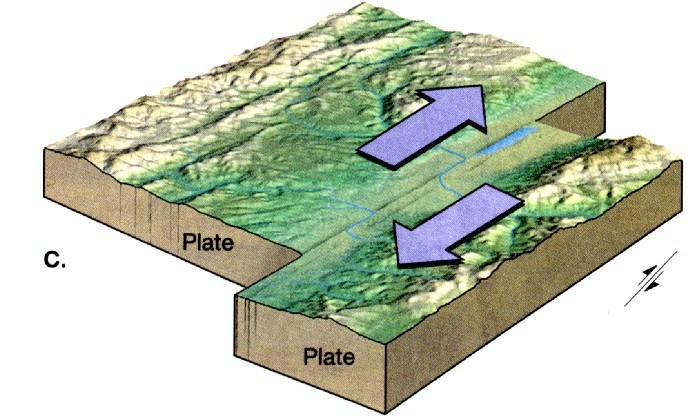
What type of plate boundary is this?
a)
Plate
b)
Divergent
c)
Convergent
d)
Transform
74.
What type of event will occur at this boundary?
a)
Earthquake
b)
Volcano Eruption
c)
Tornado
d)
Mountain Building
75.
A divergent boundary occurs when plates ....
a)
Pull apart
b)
Come together
c)
Slide past each other
d)
subducting
76.

Which of the following is the name of the ancient supercontinent formed 280 million years ago?

a)

Pangea

b)

Gondwanda

c)

Laurasia

d)

Neverland

77.

Which of the following is NOT evidence to support the theory of plate tectonics?

a)

Fossils

b)

Matching Mountain Ranges across Atlantic

c)

Glacial Scratches

d)

Sand Erosion

78.
What type of plate boundary is this?
a)
Transform
b)
Convergent
c)
Divergent
d)
Plate
79.
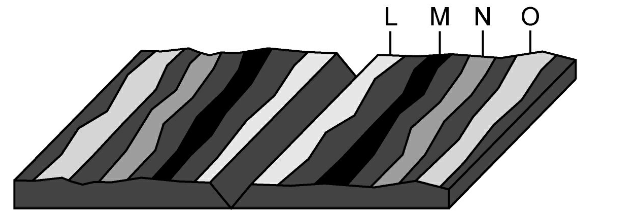
Where would the oldest rock be found?
a)
L
b)
M
c)
N
d)
O
80.
How is it possible for new crust to be formed without increasing the surface area of the Earth?
a)
Crust is destroyed at the same time it is created
b)
New crust is underwater where it sinks
c)
New crust breaks more easily than old crust
81.

Mountains are created when....

a)

Two continental plates collide

b)

Two oceanic plates pull apart

c)

An oceanic plate subducts under an oceanic plate

d)

Two continental plates pull apart

82.

Which of these layers is ALL solid iron and nickel?

a)

inner core

b)

outer core

c)

lithosphere

d)

mesosphere

83.
Which of the following occurs because of convection currents?
a)
Tectonic plates on the crust move.
b)
The mantle increases in size.
c)
Pressure in the crust increases.
d)
Pressure in the crust decreases.
84.
Scientists think that convection currents that move the plates flow in Earth's
a)
Continental crust
b)
Oceanic crust
c)
Asthenosphere
d)
Lithosphere
85.

The mantle of Earth is made partly of weak rock that can be deformed. When this weak rock rises and sinks, this is called ______________.

a)

a conduction current

b)

a hot spot

c)

a volcanic eruption

d)

a convection current

86.
As you travel from the inner core to the crust, how would temperature, pressure and density of the material change?
a)
They would all increase
b)
They would all decrease.
c)
They would stay the same.  
d)
Temperature would decrease, but pressure and density would increase. 
87.

Where does the heat come from that drives this convection current in the mantle?

a)

sun

b)

crust

c)

mantle

d)

core

88.
Which is true about hotter material in the mantle?
a)
more dense, sinks
b)
less dense, sinks
c)
less dense, rises
d)
more dense, rises
89.
During sea floor spreading, molten material rises up from the mantle...
a)
along the continents
b)
at the mid ocean ridges
c)
deep ocean trenches
d)
at north and south poles
90.
Which of the following is where one plate slides under another plate?
a)
submarine zone
b)
divergence zone
c)
subduction zone
d)
lower zone
91.

Associated with transform boundaries.

a)

volcanoes

b)

mountains

c)

trenches

d)

earthquakes

92.

This land formation occurs at a divergent boundary.

a)

mid ocean ridge

b)

deep ocean trench

c)

pacific hot spot

d)

rift valley

93.
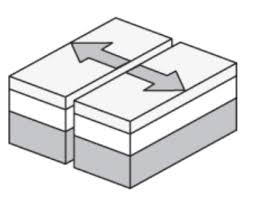
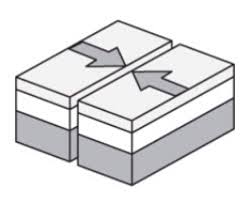
Name the boundary
a)
convergent boundary
b)
divergent boundary
c)
transform boundary
d)
sergent boundary
94.

Name the boundary

a)

convergent boundary

b)

divergent boundary

c)

transform boundary

d)

sergent boundary

95.
Name the boundary
a)
convergent boundary
b)
divergent boundary
c)
transform boundary
d)
sergent boundary
96.

This layer of Earth is the thickest part...

a)

crust

b)

outer core

c)

mantle

d)

inner core

97.
Which layer of the Earth is liquid iron?
a)
Crust
b)
Mantle
c)
Outer Core
d)
Inner Core
98.

What feature is represented at A?

a)

trench

b)

mid-ocean ridge

c)

rift valley

d)

transform fault

99.

Which will most likely form when movement along a plate boundary forces a landmass to be pulled apart?

a)

volcanic island arc

b)

continental rift

c)

oceanic trench

d)

continental mountains

100.

Which will most likely occur before a volcanic eruption?

a)

an increase in mud flow

b)

an increase in lava flow

c)

an increase in shallow earthquake activity

d)

an increase in acid rain production

101.

Which geographic features form as a result of continental-continental convergent plates?

a)

volcanic islands

b)

rift valleys

c)

oceanic trenches

d)

continental mountain ranges

102.

Where are most volcanoes located?

a)

at divergent boundaries, transform boundaries, and hot spots

b)

at convergent boundaries, divergent boundaries, and hot spots

c)

at convergent boundaries, hot spots, and transform boundaries

d)

at divergent boundaries, convergent boundaries, and transform boundaries

103.
When the visible (lit) portion of the moon is increasing, the moon is:
a)
waning
b)
full
c)
waxing
d)
new
104.
When the Earth is between the moon and sun, it is most likely a:
a)
new moon
b)
full moon
c)
waxing crescent
d)
waxing gibbous
105.
Changes in the moon's appearance are
a)
phases
b)
eclipses
c)
stages
d)
cycle
106.

Sheldon on Big Bang Theory says "The moon looks larger than the stars!" What explains this?

a)

The moons soaks up the stars' light.

b)

The moon is larger than Earth.

c)

The moon is larger than stars.

d)

The moon is closer to Earth than stars.

107.
Name the moon phase
a)
Waxing Gibbous
b)
Waxing Crescent
c)
Waning Crescent
d)
Waning Gibbous
108.
Name the moon phase
a)
Waning Crescent
b)
Waxing Crescent
c)
Waning Gibbous
d)
Waxing Gibbous
109.
During the phases of the Moon, the Moon appears to change shape.  This change in appearance is due to the Moon...
a)
physically changing size and shape.
b)
moving closer and then farther away from Earth.
c)
reflecting a different amount of light due to alignment with Earth and the Sun.
d)
having craters on its surface.
110.
As the moon's shape appears to get smaller, we say that the moon is _.
a)
swelling
b)
waxing
c)
waning
d)
disappearing
111.
What Moon phase is this?
a)
Full Moon
b)
Waxing Gibbous
c)
New Moon
d)
Half Moon
112.
What Moon phase is this?
a)
Last Quarter
b)
New Moon
c)
Third Quarter
d)
First Quarter
113.
 True or False: The moon does not produce its own light.
a)
True
b)
False
114.
Which of these statements about the Moon's atmosphere are TRUE?
a)
Moon has a thin atmosphere with few clouds
b)
Moon has a thin atmosphere but no clouds
c)
Moon has almost no atmosphere
115.

About how old is the Moon?

a)

4.6 billion years

b)

2.6 billion years

c)

900 million years

d)

4.6 million

116.

Today the moon has the greatest effect on Earth's

a)

year

b)

seasons

c)

ocean tides

d)

daylight hours

117.

At which moon position would a person on earth see a full moon?

a)

A

b)

B

c)

C

d)

D

118.

At which moon position would a person on earth see a new moon

a)

A

b)

B

c)

C

d)

D

119.

A large, flat land area composed of dark lava flows on the surface of the moon is _______

a)

Highlands

b)

Maria

c)

Rille

d)

Craters

120.

What is the approximate age of our solar system?

a)

4.6 billion years

b)

460 million years

c)

46 billion years

d)

13.8 billion years

121.

Which theory explains how the universe formed?

a)

nebular theory

b)

big bang theory

c)

raisin bread theory

d)

theory of relativity

122.

Which theory explains how our solar system formed?

a)

nebular theory

b)

big bang theory

c)

gravitational theory

d)

theory of spontaneous generation

123.

Balls of ice, snow, rock, and dust that orbit the sun in very oval orbits...

a)

asteroids

b)

planetismals

c)

comets

d)

meteoroids

124.
A nebula starts to collapse because of:
a)
A nearby star shining it's light
b)
A passing spaceship
c)
A passing comet
d)
Gravity
125.

As a nebula collapses it also begins to

a)

expand

b)

rotate

c)

shake

d)

turn to ice

126.

A nebula collapses down into

a)

a compact disc

b)

an irregular cloud

c)

an accretion disk

d)

a circular disk

127.

What forms in the very center of the accretion disk?

a)

A sun

b)

A planet

c)

A dwarf planet

d)

A planetesimal

128.
What is forming in the accretion disk away from the center?
a)
Light
b)
Protostars
c)
Planetesimals
d)
Hydrogen
129.
The planetesimals keep:
a)
Colliding and breaking apart
b)
Colliding and sticking together
c)
Colliding and bouncing around
d)
Breaking down into smaller pieces
130.
The shape of the planets and dwarf planets after accumulating all their material is:
a)
Irregular
b)
A Sphere
c)
An Oval
d)
A disk
131.

The order of the formation of the solar system:

Solar nebula - accretion disk- nuclear fusion - sun - planetesimals - planets

a)

True

b)

False

132.
Which of the following are the closest to the sun?
a)
terrestrial planets
b)
gas giant planets
133.

The main force at play during making of our solar system

a)

strong force

b)

weak force

c)

gravity

d)

electrostatic force

134.

A cloud of gas and dust from which bodies in space are formed

a)

photosphere

b)

nebula

c)

solar flare

d)

black hole

135.
Sometimes I am called a "dirty snowball". I have a hydrogen cloud, coma, and a nucleus. I am invisible except when near the sun. What am I?
a)
Asteroid
b)
Star
c)
Meteor
d)
Comet
136.

Where are asteroids found?

a)

between Earth and Venus

b)

between Jupiter and Saturn

c)

between Saturn and Uranus

d)

between Mars and Jupiter

137.

What do the outer planets have in common?

a)

They are much larger than Earth and are made mainly of hydrogen and helium

b)

They are about the same size as Earth and are mostly made of hydrogen and helium

c)

They are must larger than Earth and are mainly made of iron.

d)

They are the same size as Earth and are mainly made of iron.

138.
A massive explosion of a star is called . . .
a)
supernova
b)
nebula
c)
pulsar
d)
black hole
139.
The composition of the outer planets atmospheres is similar to the gases in the __________.
a)
Mercury
b)
Venus
c)
Sun
d)
Earth
140.
What are the three qualifications of an inner planet?
a)
has an elliptical orbit, has a rocky surface, and no atmospere
b)
has an elliptical orbit, has rings, and a rocky surface
c)
has an elliptical orbit, has a rocky surface, and is position between the Sun and the Asteroid Belt.
d)
has an elliptical orbit, a rocky surface, and is positioned between the Asteroid Belt and Pluto
141.

What if you lived on Mars...how does its orbit around the sun make things different for you?

a)

Colder because we are farther from the sun

b)

Warmer because we are closer to the sun

142.

What if you lived on Mars, how does its orbit around the sun make things different for you?

a)

Shorter orbit = shorter year

b)

Longer orbit = longer year

143.

What if we lived on a gas giant, how would things be different?

a)

No rocky surface or oxygen

b)

Hard rocky surface

144.

What if we lived on a gas giant, how would things be different?

a)

Year would be much longer

b)

Year would be much shorter

145.
A celestial cloud of dust and gas is called . . .
a)
nebula
b)
supernova
c)
accretion disc
d)
bombardment
146.
What caused the solar nebula to contract and spin?
a)
a supernova
b)
an asteroid impact
c)
radiation
d)
random motion
147.
What celestial body eventually evolved into our modern solar system?
a)
a nebula
b)
a supernova
c)
a quasar
d)
a galaxy
148.
When the inner planets (and moons) were bombarded by asteroids, what did the asteroids leave behind?
a)
craters
b)
calderas
c)
mountains
d)
valleys
149.

Why is Mercury covered with craters, but Earth is not?

a)

Earth's atmosphere protects Earth and it's surface has weathered and eroded.

b)

Earth's moon blocks asteroids.

c)

Asteroids just missed Earth.

d)

Most asteroids land in Antarctica.

150.

If a star is being observed from Earth and it's light has shifted towards the red side of the electromagnetic spectrum it would be...

a)

Moving towards the Earth

b)

Moving away from the Earth

c)

This is a trick question that cannot be answered

d)

It isn't a star, it is a very large blueberry.
151.
The vast majority of galaxies in our universe are moving away from us.  We know this because we observe __________ in the galaxies absorption spectra.
a)
Redshift
b)
Blueshift
c)
Turbulance
d)
Superposition
152.

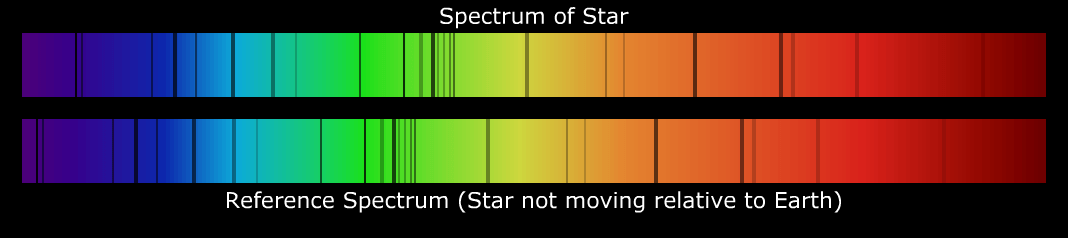
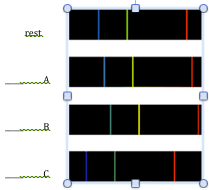
Use the image to identify the motion of the object relative to Earth. Compare the absorption spectra of the star to what the star would look like if it were not moving at all relative to Earth. (bottom is reference)

a)

It is not moving

b)

It is moving away from Earth (Redshift)

c)

It is moving towards Earth (Blueshift)

d)

It is moving towards Earth (Redshift)
153.
Why is the light from distant galaxies red-shifted?
a)
They produce more red light than nearby galaxies
b)
They are moving away from us
c)
The longer wavelengths are filtered out more by dust
d)
They are moving toward us
154.

Based on Doppler effect, which of the galaxies is moving away from Earth?

a)

A

b)

B

c)

C

d)

A and B

155.

Evidence suggests that the whole Universe is expanding and that it might have started billions of years ago from one place with the big bang.

a)
True
b)
False
156.

Hubble observed that galaxies are

a)
expanding
b)
moving away from us
c)
moving towards us
d)
standing still
157.
The event that marks the beginning of our known universe
a)
Theory of Evolution
b)
Big Bang Theory
c)
Cell Theory
d)
Blackhole theory
158.
Which piece of evidence supports the Big Bang theory?
a)
The more distant galaxies are moving the slowest
b)
The more distant galaxies are moving the quickest
c)
The more distant galaxies are moving towards us
d)
Galaxies and space is not changing
159.
What does the Big Bang theory suggest?
a)
The universe was just there
b)
The Milky Way is the only solar system
c)
The universe is continually expanding
d)
The universe started as a point and is moving towards each other
160.

What is cosmic background radiation?

a)

Evidence of a large explosion in the universe leaving radiation behind

b)

It is the life force that supports the universe

c)

Evidence of blackholes actually existing

d)

Evidence of that the universe is heating
161.
Which type of rock results from melting and cooling of magma?
a)
Igneous
b)
Metamorphic
c)
Sedimentary
d)
Extrusive
162.
Which type of rock forms from extreme heat and pressure?
a)
Igneous
b)
Sedimentary
c)
Organic
d)
Metamorphic
163.
Which type of igneous rock forms above ground?
a)
Intrusive
b)
Organic
c)
Extrusive
d)
Foliated
164.
Coal is an example of a _______ sedimentary rock.
a)
Chemical
b)
Organic
c)
Clastic
d)
Intrusive
165.
A metamorphic rock changes into an igneous rock by what two processes?
a)
Melting and cooling
b)
Extreme heat and pressure
c)
Compaction and cementation
d)
Weathering and erosion
166.
Which type of metamorphic rock has minerals in bands or stripes?
a)
Nonfoliated
b)
Coarse grained
c)
Fine grained
d)
Foliated
167.
Wind, water, and ice breaking down rock is called
a)
Erosion
b)
Deposition
c)
Compaction
d)
Weathering
168.
What type of texture does a SLOWLY cooling, intrusive igneous rock have?
a)
Foliated
b)
Nonfoliated
c)
Coarse grained
d)
Fine grained
169.
Lava which cools on Earth's surface forms an
a)
metamorphic rock
b)
intrusive igneous rock
c)
extrusive igneous rock
d)
foliated metamorphic rock
170.
Magma cooling and hardening below Earth's surface forms an
a)
Intrusive igneous rock
b)
Extrusive igneous rock
c)
Foliated metamorphic rock
d)
Organic sedimentary rock
171.
Scientists classify rocks by their composition and
a)
chemicals
b)
size
c)
color
d)
texture
172.
What is the MAIN way rocks are classified?
a)
Their color and shapes
b)
How they form
c)
Mineral bands
d)
Where they form
173.
Sediment being moved from one area to another is called
a)
erosion
b)
deposition
c)
weathering
d)
compaction
174.
A naturally occurring solid mixture of minerals and organic matter is a
a)
mineral
b)
rock
c)
composition
d)
pebble
175.
Sediment being dropped off and laid to rest
a)
Deposition
b)
Erosion
c)
Weathering
d)
Lithification
176.
This rock was found near the mouth of a volcano. What type of rock is this?
a)
Sedimentary
b)
Igneous
c)
Metamorphic
177.
When sediments are pressed together tightly, this is called ____________.
a)
Compaction
b)
Cementation
c)
Weathering
d)
Erosion
178.
This rock was formed by smaller pieces of rock that settled at the bottom of a lake millions of years ago. What type of rock is this?
a)
Sedimentary
b)
Igneous
c)
Metamorphic
179.

This rock started as lava that cooled and then was heated and put under pressure over time. What type of rock is this?

a)

Sedimentary

b)

Igneous

c)

Metamorphic

180.
This rock started as molten magma. What type of rock is this?
a)
Sedimentary
b)
Igneous
c)
Metamorphic
181.
This rock is made from tiny pieces of other rocks that settled to the bottom of a valley millions of years ago. What type of rock is this?
a)
Sedimentary
b)
Igneous
c)
Metamorphic
182.
This rock was molten magma that slowly cooled under the ground. What type of rock is this?
a)
Sedimentar
b)
Igneous
c)
Metamorphic
183.
This rock cooled on the outside of a volcano and contained air bubbles when it was forming. What type of rock is this?
a)
Sedimentary
b)
Igneous
c)
Metamorphic
184.
After lots of time, pressure, and heat, you get this kind of rock. What type of rock is this?
a)
Sedimentary
b)
Igneous
c)
Metamorphic
185.
Each rock type can follow only one pathway of the rock cycle.
a)
True
b)
False
186.
Fossils are often found in ____________ because it is formed from the remains of once living things.
a)
metamorphic
b)
magma
c)
igneous
d)
sedimentary
187.
This rock was formed by lots of fossils that settled on top of each other over time. What type of rock is this?
a)
Sedimentary
b)
Igneous
c)
Metamorphic
188.
Rock that forms when minerals form from solutions or sediment from older rocks get pressed and cemented together.
a)
Sedimentary Rock
b)
Metamorphic Rock
c)
Igneous Rock
189.
Cooling & crystalization produce
a)
igneous rocks
b)
metamorphic rocks
c)
sedimentary rocks
190.
The process when rocks break into smaller pieces due to exposure to natural elements is called
a)
erosion
b)
weathering
c)
sediments
191.
The wobble in Earth's rotation caused by the gravitational pull of the moon is called
a)
barycenter
b)
precession
c)
nutation
d)
convection
192.
This image shows
a)
barycenter
b)
precession
c)
nutation
d)
elliptical orbits
193.
Which statement is true?
a)
A.  Earth rotates around the sun and revolves on its axis.
b)
A.  The sun revolves around Earth over a 24-hour time period.
c)
A.  Earth rotates on its axis, and revolves around the sun.
d)
A.  Earth revolves around the sun and the moon.
194.

What season is the Northern Hemisphere at letter A?

a)

Winter

b)

Summer

c)

Spring

d)

Fall

195.
When the Northern Hemisphere is pointing towards the sun, what season is the Southern Hemisphere?
a)
Winter
b)
Spring
c)
Fall
d)
Summer
196.
What are the reasons for the seasons?
a)
Earth's tilt and rotation.
b)
Earth's rotation and revolution.
c)
Earth's tilt and revolution.
d)
Earth's tilt and resolution
197.
What causes day and night?
a)
revolution of Earth
b)
rotation of Earth
c)
orbit of Earth
d)
The moon blocks the Sun
198.

At position A, which hemisphere would have winter?

a)

Northern hemisphere

b)

Southern hemisphere

199.
What is barycenter?
a)
The difference in mass between two objects in space
b)
The mass of an object in space
c)
The center of mass between two objects in space
d)
The mass of two objects in space
200.
About how long does it take Earth to make one complete rotation on its axis at the equator?
a)
12 hours
b)
24 hours
c)
29.5 days
d)
365 days
201.

Why would Florida be warmer on average than other northern locations in the United States?

a)

Florida is closer to sea level than inland areas

b)

Sunlight shines more directly on Florida for more hours each day

c)

Heat energy is transferred to land because of ocean currents

d)

Seasonal changes take place later in the year because Florida is close to the equator

202.

What keeps the Earth and other planets in orbit?

a)

The sun

b)

Gravity

c)

Earth's magnetic field

d)

Tides

203.
The study of the moon, stars, and other objects in space is called
a)
botany
b)
biology
c)
geology
d)
astronomy
204.
What time of the year is the Earth slightly closer to the Sun in the Northern Hemisphere?
a)
in the summer
b)
in the winter
c)
in the fall
d)
in the spring
205.
What effect does the Moon have on the Earth?
a)
It gives us day and night.
b)

It causes nutation.

c)
It gives us years.
d)
It makes us rotate on our axis.
206.
How long does it take the moon to revolve around the Earth?
a)
24 hours
b)
365 days
c)
28 days
d)
12 hours
207.
Planets orbit the Sun in a shape called a(n)
a)
circle
b)
ellipse
c)
focus
d)
perihelion
208.
The place where a planet is closest to the Sun as it orbits the Sun is called the
a)
perihelion
b)
aphelion
209.
Where is the planet moving faster
a)
Position A to B
b)
Position B to C
c)
Position H to I
d)
Position I to J
210.
A planet moves __________ when it is farthest from the sun.
a)
faster
b)
slower
211.
Kepler's third law of planetary motion describes a relationship between the
a)
shape of orbit and location of Sun.
b)
orbital velocity and position in orbit
c)
distance from the Sun and length of year.
d)
path of epicycle and position.
212.
The hemisphere where you live.
a)
equator
b)
southern
c)
northern
d)
eastern
213.
What happens when the area in which you live tilts away from the sun?
a)
It is summer.
b)
It is spring.
c)
It is winter.
d)
It is fall.
214.

Which season is taking place in the Northern Hemisphere in Position 1?

a)

Winter

b)

Spring

c)

Summer

d)

Fall

215.
The earth's tilt is ______________degrees.
a)
0
b)
90
c)
23.5
d)
41
216.
Eastern North Carolina is warmest during the summer because
a)
that is when it is closest to the sun
b)

that is when it is receiving the most direct sunlight

c)
that is when it is receiving the least direct sunlight
d)
that is when it is furthest from the sun
217.
The Earth's axis changes direction (but the angle does NOT change).
a)
Nutation
b)
Precession
c)
Barycenter
d)
Revolution
218.
Sunlight hits Earth’s surface most directly at the _______. Because of this, this particular area doesn't experience seasons.
a)
north pole
b)
south pole
c)
equator