Worksheets
Orchestra I Final Exam
Total questions: 30
Worksheet time: 23mins
True or False: A staff has 5 lines and 4 spaces.
True
False
The two numbers presented at the beginning of a piece of music to show rhythmic divisions (beats per measure)
Key Signature
Sharps and Flats
Time Signature
Clef Signature
What is the rhythmic value that contains one beat?
Whole note
Half note
Quarter note
Eighth note
What is the rhythmic value that contains four beats?
Whole note
Half note
Quarter note
Eighth note
How many sharps does the key of D Major contain?
1
2
3
None
A collection of notes that start and end on the same note is called a___.
Chord
Star
Arpeggio
Scale
What is the thin piece of wood that is held up by the strings?
Bridge
Fingerboard
Soundpost
The only numbers possible in the bottom of a time signature are:
1, 2, 3, 4, 5
1, 2, 4, 6, 8
1, 2, 4, 8, 16
1, 4, 16, 8, 5
When playing piano (soft), your bow should be near the:
Bridge
Fingerboard
Pegs
F-holes
A ____ sign raises the pitch of a note by a half step
Flat
Sharp
Natural
Repeat
The time signature 6/4 means:
6 Eighth notes per measure
6 Quarter notes per measure
4 Quarter notes per measure
6 Quarter notes in the song
Which dynamic marking means to medium soft
Piano
Piannissimo
Mezzo Forte
Mezzo Piano
The key signature of G Major has ___ sharp(s).
2
3
1
None
The tiny screws at the top of a violin/viola/cello tailpiece help students:
Tune their instrument
Adjust their tone
Make vibrato longer
Add more bow weight
What does a natural sign do?
Makes every note natural for the entire piece.
Cancels out the sharp or flat sign that comes before it.
Which aspect of playing deals with the accuracy of the pitches performed?
Intonation
Tempo
Style
Tone
Choose the correct answer choice that spells the D Major scale correctly
D E F G A B C D
D E F# G A B C# D
D E F# G A B C D
D E F# G A B C#
True or False: The distance between E and "F#" is a whole step.
True
False
True or False: The distance between B and C is a whole step.
True
False
What is a half step
Smallest distance in a song
Smallest distance between two notes
Largest distance between two notes
Two half steps
What is a whole step?
Smallest distance in a song
Smallest distance between two notes
Largest distance between two notes
Two half steps
Using the scale formula, select the correct answer choice for the G Major scale.
G A B C D E F G
G A B C D E F# G
G A B C D E F
A B C D E F# G A
Which answer choice displays the correct whole step distance?
D Eb
C# D
F Gb
A B
Dynamics refers to the speed of a piece
True
False
Tempo refers to the speed of a piece
True
False
Which clef sign is used by viola players?
Treble
Alto
Bass
Viola
What does the top number mean in a time signature?
How many beats per measure
How many measures in the piece
How many notes in a measure
How many beats in a piece
What does the flat sign do to a note?
Lowers the pitch of a note by a half step
Raises the pitch of a note by a half step
Cancels out a sharp
Lowers the pitch of a note by a whole step
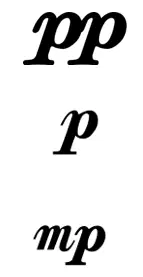
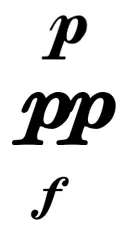
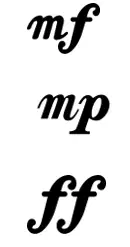
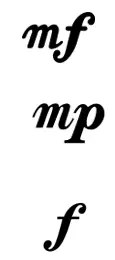
Which answer choice contains the correct dynamic range from top to bottom, softest to loudest?
Which time signature means "3 Quarter Notes per measure"?