Wayground logo

Free Printable Worksheets

Font size

S
M
L
XL
Worksheets

Waves Quiz

Total questions: 30

Worksheet time: 1hrs 12mins

Name
Class
Date
1.

The highest point on a wave is:

a)

the crest

b)

the trough

c)

the top

d)

the coast

2.

Which word is used to identify the distance between points C & G?

a)

Amplitude

b)

Crest

c)

Frequency

d)

Wavelength

3.

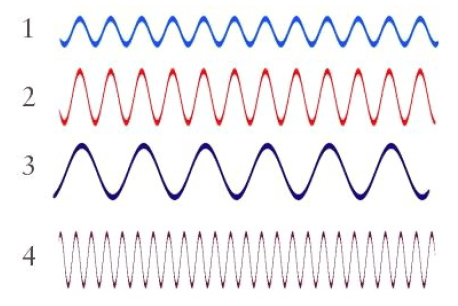
Which wave in the diagram has the greatest frequency?

a)

1

b)

2

c)

3

d)

4

4.

Which wave in the diagram has the greatest wavelength?

a)

1

b)

2

c)

3

d)

4

5.
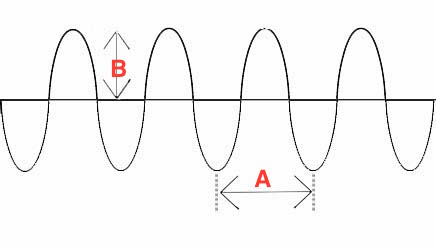
What property of the wave is represented by the letter "B"?
a)
amplitude
b)
crest
c)
trough
d)
wavelength
6.
The highest point on a wave is:
a)
the crest
b)
the trough
c)
the top
d)
the coast 
7.
The lowest point on a wave is the:
a)
Amplitude
b)
Crest
c)
Trough
d)
Wavelength
8.
What are the parts of a longitudinal wave?
a)
Compressions and rarefactions
b)
Crests and troughs
c)
Compressions and crests
d)
Rarefactions and troughs
9.
Which wave is pictured?
a)
Transverse
b)
Longitudinal
c)
Both
d)
Neither
10.
Sound needs a medium to travel through.  What is a medium?
a)
solid, liquid, gas
b)
open space
c)
waves
d)
nothing
11.

How often a wave occurs in a second is the wave's __________________

a)

crest

b)

frequency

c)

wavelength

d)

resting point

12.
The frequency of a wave is measured in __________________. 
a)
inches
b)
hertz
c)
periods
d)
eras
13.
Any material that a wave travels through is called a ____________________.
a)
vibration
b)
compression
c)
medium
d)
crest
14.
In longitudinal waves, the parts where the coils are spread apart are called what?
a)
rarefactions
b)
compressions
c)
mechanicals
d)
longitudes
15.
As the frequency of a wave increases, the __________________ decreases.
a)
amplitude
b)
resting point
c)
wavelength
d)
crest
16.

Waves transfer _______.

a)

particles

b)

matter

c)

energy

17.

Frequency is how many waves pass a point in 1 second. If 100 waves pass a given point in 4 seconds, what is the wave's frequency?

a)

25 Hz

b)

100 Hz

c)

4 Hz

d)

400 Hz

18.

Examples of ________ waves include visible light, xrays, ultraviolet, and radio waves.

a)

transverse

b)

longitudinal

19.

In this diagram of a transverse wave, C is showing the wave's _____ and D is showing the wave's _____.

a)

crest, amplitude

b)

trough, amplitude

c)

crest, wavelength

d)

trough, wavelength

20.
When the frequency of a wave increases, what happens to the wavelength?
a)
The wavelength is not directly affected by the frequency of a wave.
b)
The wavelength increases.
c)
The wavelength decreases.
d)
More specific information is needed to form a conclusion about the wavelength.
21.
which material does sound travel the fastest?
a)
solid 
b)
liquid 
c)
gases
22.

You can't hear sounds in outer space because there is no

a)

medium

b)

light

c)

energy

d)

heat

23.
What kind of wave is pictured?
a)
Transverse
b)
Longitudinal
c)
surface
d)
none of the above
24.
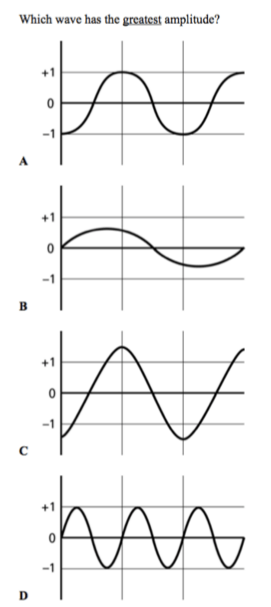
Which wave has the greatest amplitude?
a)
A
b)
B
c)
C
d)
D
25.

What is the amplitude of this wave?

a)

4

b)

8

c)

2

d)

6.3

26.

What is the wavelength of this wave?

a)

4

b)

8

c)

3.3

d)

6.3

27.
Which of the following can sound travel through?
a)
solid
b)
liquid
c)
gas
d)
all of the above
28.
What kind of wave is pictured below?
a)
compressional wave
b)
transverse wave
c)
sound wave
d)
mechanical wave
29.
How would a person measure the wavelength on this sound wave?
a)
dense to less dense
b)
trough to crest
c)
compression to compression
d)
beginning of illustration to the end
30.

As wavelength decreases, the crests of the wave:

a)

become wider

b)

become shorter

c)

get closer together

d)

get farther apart