
 Worksheets
Honors Review - Solutions, Acids, & Bases (SPS6abcde)
Total questions: 121
Worksheet time: 2hrs 20mins
The substance doing the dissolving
solute
solvent
solution
solubility
The substance that dissolves in a solution
solvent
solution
solute
solubility curve
This is a physical combination of one substance dissolved in another
solvent
solute
solubility
solution
Which scenario would dissolve the fastest.
sugar cubes in cold water
powdered sugar in hot water
sugar cubes in hot water
powdered sugar in cold water.
Select the statements that are true
stirring will make a substance dissolve slower
grinding up a substance will make it dissolve faster
heating up a substance will make it dissolve faster
grinding slows down the rate at which something can dissolve because it gives it more surface area
All but one effect the rate at which something dissolves
agitation
temperature
pressure
surface area

If 40g of KBr were added to a 100g of water at 20 degrees Celsius the solution would be...
supersaturated
unsaturated
saturated
complete solution

If 150g of NaClO3 were added to a 100g of water at 60 degrees Celsius the solution would be...
saturated
supersaturated
unsaturated
over saturated

If 60g of KNO3 were added to a 100g of water at 20 degrees Celsius the solution would be...
over saturated
supersaturated
saturated
unsaturated

If 40g of KBr were added to a 100g of water at 80 degrees Celsius the solution would be...
unsaturated
over saturated
supersaturated
saturated

If the pH level is between 1 and 6.9 it is
basic
acidic
neutral
soluble

If the pH level is between 7.1 and 14 it is
acidic
soluble
basic
neutral

If the pH level is 7.0 it is
basic
acidic
soluble
neutral

If red litmus paper turns blue when placed in a substance what is the pH?
acidic
neutral
basic
soluble

Which household item would be the strongest base?
drain cleaner
milk
water
bleach

Which household item would be the strongest acid?
coffee
blood
battery acid
lemon
If baking soda has a pH of 9 it would be
basic
acidic
neutral
soluble
What would distilled water be on the pH scale?
acidic
basic
soluble
neutral

According to the pH range which substance is more acidic than lemon juice?
Hydrochloric acid
cabbage
milk
What combination would dissolve a solid solute the fastest?
high temperature, no stirring
no heat, no stirring
sugar cube, no heat
high temperature, stirring

How much KNO3 solute is saturated at 40 degrees?
75
55
65
85
A solution in which more solute can be added and dissolved; below the maximum amount of solute
saturated
unsaturated
supersaturated
Which of the following statements is true concerning acids and bases?
acids and bases don't react with each other
acids mixed with bases neutralize each other
acids mixed with bases make stronger bases
acids mixed with bases make stronger acids
Which is the correct set of acid properties?
sour taste, corrosive, change litmus from red to blue
sour taste, corrosive, change litmus from blue to red
sweet taste, slippery, change litmus from blue to red
sour taste, slippery, change litmus from blue to red

Vinegar, fruit juice, and cola are examples of:
salts
neutral substances
bases
acids

Is laundry detergent an acid or a base?
Acid
Base
Neither (Neutral)
Ammonia is found in many household products, including window cleaner. What is the likely pH of ammonia?
3
7
8
12
6

Process in which an ionic compound separates into its positive and negative ions
Dissociation
Saturated solution
Solubility
Solution

Maximum amount of a solute that can be dissolved in a given amount of solvent at a given temperature
Dissociation
Saturated solution
Solubility
Solution

Any solution that contains more solute than a saturated solution at the same temperature
Solute
solvent
Supersaturated solution
Unsaturated solution

Any solution that can dissolve more solute at a given temperature
Solute
solvent
Supersaturated solution
Unsaturated solution

Compound that forms hydrogen ions (H+) in solution
acid
base
strong base
indicator

A base that completely dissociates into metal ions and hydroxide ions in aqueous solution
acid
base
strong base
indicator

A compound that produces hydroxide ions in solution
acid
base
strong base
indicator

A compound that changes color in the presence of an acid or a base
acid
base
strong base
indicator

A base that does not dissociate completely into ions in solution.
Neutralization
strong acid
weak acid
weak base

An acid that ionizes completely in aqueous solution
Neutralization
strong acid
weak acid
weak base

An acid that is only partially ionizes in aqueous solution
Neutralization
strong acid
weak acid
weak base

The scale used to specify how acidic or basic an aqueous solution is
Neutralization
pH
weak acid
weak base


Kool-Aid - Powder, sugar, and water ... Identify the solvent
water
powder
sugar
powder and sugar
NaOH may be found in drain cleaners and as a component of soaps. Is NaOH an acid or a base?
Acid
Base
Neither (Neutral)
A solution with a pH of 8.6 would be a(n)
Acid
Base
Neutral
Acid and Base
This ion is responsible for the properties of acids
Sodium ion
Hydronium ion
Hydroxide ion
Oxide ion
This ion is responsible for the properties of bases
Sodium ion
Hydrogen ion
Hydroxide ion
Oxide ion
If 150g of NaClO3 were added to a 100g of water at 60 degrees Celsius the solution would be...
saturated
supersaturated
unsaturated
over saturated
If 60g of KNO3 were added to a 100g of water at 20 degrees Celsius the solution would be...
over saturated
supersaturated
saturated
unsaturated
Which is a characteristic of a base?
tastes sour
found mostly in foods
feels slippery
turn litmus paper red
A sour taste is a characteristic of:
acids
bases
neutral
pH scale
it dissolves so many solutes.
the Earth is mostly made of it.
humans are mostly comprised of it.
it's so useful.


Weak acids or bases ionize only partially, so they form solutions that are called ____ electrolytes.
weak
strong
neutral
_______ are corrosive substances characterized as having a strong smell, a sour taste, and a _______.
acidic or basic.
The substance in the beaker
relative volume
temperature
relative pH
chemical formula
exact pH

This picture of a football is here for no reason.
Click CONTINUE to move on.
CONTINUE
I don't follow directions.
What if I don't like football?
Is this for a grade?
What factor has the least effect on the rate (speed) of solubility?
The size of the container
The temperature of the water
The surface area of the solute
The force of the stirring/mixing
Solutes lower the freezing point of water by
stopping water molecules from moving
forming crystals
making it harder for water to form crystals
making the water molecules move faster
Sodium hydroxide, potassium hydroxide, & magnesium hydroxide all produce hydroxide ions in water & are therefore
salts
acids
bases
low in pH
If you add a small amount of hydrochloric acid to 4 liters of water, what type of solution would you expect to have?
concentrated solution
basic solution
dilute solution
saturated solution
The pH scale
is numbered from 1 to 12
measures the concentration of bases
measures the concentration of acids
measures the concentration of hydrogen ions
A base forms hydrogen ions when it dissolves in water
True
False
The solute is the part of a solution present in the largest amount
True
False

Which of the following is NOT a property of acids?
corrosive
sour taste
turns litmus paper blue
feels watery
As one moves up the pH scale from 1 to 14, what happens to the concentration of H+ in the solution?
concentration of H+ decreases
concentration of H+ increases
concentration of H+ stays the same
A pH of 1 is how many times more acidic than a pH of 2?
2
20
10
100
If a solution has a pH scale of 9, the solution is
acidic
alkaline
neutral
saturated
During an experiment about the rate of dissolving you test temperature. In one beaker you use room temperature water, one beaker you use hot water and the last beaker you use ice water. In what order would the beakers dissolve the solute from slowest to fastest?
hot, cold, room temperature.
cold, hot, room temperature.
cold, room temperature, hot.
hot, room temperature, cold.

In this model what is being changed about the solution?
There is more solvent being added making it concentrated.
There is more solute being added making it concentrated.
There is heat being added to speed up the rate of dissolving.
There is nothing special about this model.

The picture shows how you might change an variable in an experiment about what affects the rate of dissolving. What results do you expect to see?
A will dissolve slowest because it has the largest number of particles.
D will dissolve slowest because it has the smallest surface area.
All pieces will dissolve at an equal rate.
C will dissolve slowest because it has the most bonds between sugar molecules.

Look at the solubility curve - as a GENERAL rule (that means there are exceptions, as always, in science) what trend can be states about how temperature affects the solubility of the compounds shown.
Temperature has NO affect.
The relationship is inversely proportional - as temperature increases, the solubility decreases.
The relationship is directly proportional - as temperature increases, the solubility increases.
It varies - the solubility will increase and then decrease when it reaches a certain temperature.
If you were testing what might affect the rate of dissolving of sugar, you could test the affect of agitation (shaking, stirring, etc). Which of the following BEST explains how this will change how fast the solute will dissolve.
Stirring the solution exposes the solute to fresh solvent more quickly.
Stirring helps more solvent evaporate.
Stirring causes more ions to precipitate out of solution.
Stirring equalizes the water temperature.

How many grams of KCl will dissolve in 100mL of water at 75oC?
35 grams
40 grams
45 grams
50 grams

The table shows the pH values of a sample of substances. According to the substances, which is most acidic.
Stomach acid
Oven cleaner
Eggs
Milk
Acids will neutralize a base, and bases will neutralize acids. If you add a base to a solution containing a strong acid, what will happen to the pH of the solution?
The pH will increase.
The pH will decrease.
The pH will stay the same.

You can buy salt in different forms - granulated (like what you have on your table), course ground (kosher salt) and rock salt (for making ice cream).
If you used the rock salt as the solute in a rate of dissolving investigation, which of the following WOULD NOT increase the rate at which the rock salt would dissolve?
Crushing the solute.
Stirring the solution.
Heating the solution.
Increasing the amount of solute.
These can burn you if they are strong enough.
Acids
Bases
Water
Acids & Bases
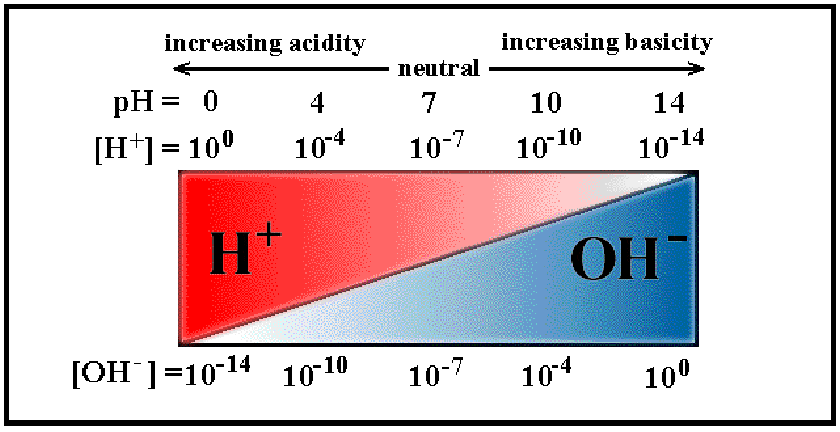
True or false: a neutral solution has equal amounts of H+ and OH-.
True
False
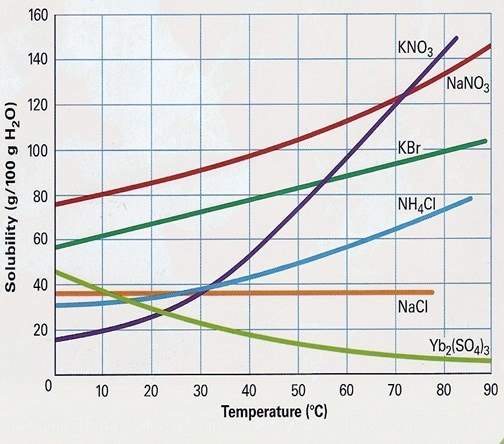
Determine the solubility for the substances at 55'C and arrange them in order from lowest to highest solubility.
NaCl, NH4Cl, KBr, NaNO3
NaCl, NH4Cl, NaNO3, KBr
NH4Cl, NaCl, NaNO3, KBr
NaNO3, KBr, NH4Cl, NaCl
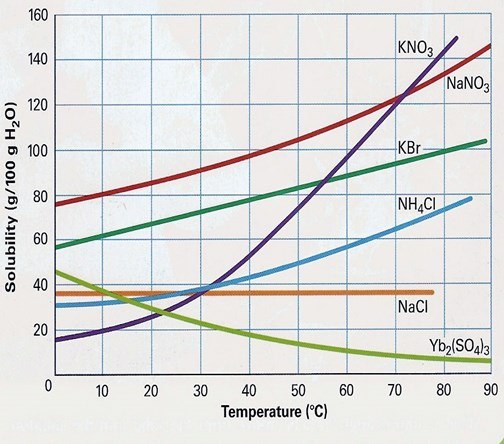
At 30'C, which substance has the lowest solubility?
KNO3
KBr
NaCl
Yb2(SO4)3
How do you know when you have a saturated solution?
You don't see anymore material in the solution. It has dissolved.
The material dissolves and no more will dissolve because you see it collect at the bottom.
The solution is bubbling and cloudy.
The solution is clear and there is nothing at the bottom.
How can a scientist safely tell whether an unknown solution is salt in
water or sugar in water?
by tasting the solution
by smelling the solution
by testing the electrical conductivity of the solution
by filtering the solution
What is one way to increase the solubility of sugar in water?
Heat the water.
Chill the water.
Increase the amount of sugar.
Decrease the amount of sugar.
Bases feel slippery and taste sour.
True
False
Acids are (a) , which means that they “eat away” at other materials.

Conducts electricity (has electrolytes)
acid
base
both an acid and a base
(Acid Base or Salt) NaOH
acid
base
salt
(Acid Base or Salt) HCl
acid
base
salt
(Acid Base or Salt) NaCl
acid
base
salt


Based on the chart, which of the acids would be the best conductor of electricity?
HCl
NH3
NaOH
KOH

Solubility decreases as temperature increases
Solubility decreases as temperature decreases
Solubility decreases as concentration increases
Solubility is not affected by temperature
Solubility and temperature have a direct relationship

