
 Worksheets
STAAR Brain Dump
Total questions: 81
Worksheet time: 41mins
What does perpendicular mean?
opposite reciprocal slope
same slope
proportional
non-proportional
What does parallel mean?
opposite reciprocal slope
same slope
proportional
non-proportional
How do you know where to shade a linear inequality?
If y is negative shade below
If y is positive shade above
If the sign has a line underneath it shade above
If y is greater than the other side, shade above. If y is less than the other side, shade below. If y is negative, flip the sign

Where should this graph be shaded?
Above
Below

Where should this graph be shaded?
Above
Below

Where should this graph be shaded?
Above
Below

Where should this graph be shaded?
Above
Below

Where should this graph be shaded?
Above
Below

Where should this graph be shaded?
Above
Below
Equation of line with undefined slope going through (2, 7)
y=7
x=2
y=2
x=7
Equation of line with zero slope going through (-4, 9)
y=-4
x=9
y=9
x=-4
Equation of line with zero slope going through (11, 14)
y=14
x=14
y=11
x=11
Equation of line with undefined slope going through (22, 33)
y=33
x=22
y=22
x=33
"Rate of change of y with respect to x" means....
y-intercept
equation
slope
intersection point

What should I do when i see this?
Find the shaded region
Plug in the number 2 for x and y
Change the top one to y= form and graph to see where they cross
y-y / x- x

What should I do when i see this?
Find the shaded region
Plug in the number 2 for x and y
Write 2 equations, then graph them to see where they cross
y-y / x- x
Domain is talking about...
x's, look up and down
x's, look left to right
y's, look up and down
y's, look left to right
Range is talking about...
x's, look up and down
x's, look left to right
y's, look up and down
y's, look left to right
In real world problems, the domain numbers are USUALLY....
larger
smaller
In real world problems, the range numbers are USUALLY....
larger
smaller
The y-intercept represents.....
The rate at which y is changing with x
The ending y-value
Nothing
The initial or starting y-value
True or false: X-intercept is the same as slope
True, they are the same
False, x-intercept is where the line crosses the x-axis

What should I do when I see these answer choices?
Leave them like they are
Just delete the extra number with y
Get y alone by "cancelling out" or moving the extra numbers from that side
y - y / x - x

What should I do to find the y-intercept since I can't see it?
Use the ~ and some points
Just find the slope
Make your best estimate based on the graph
Use the x-intercept
If you have a real world domain WORD problem, you should usually select an answer that looks like...
[0, 5, 10, 15, 20, 25]
0 < x < 25
If you have a real world range WORD problem, you should usually select an answer that looks like...
[10, 30, 50, 70, 90, 110]
10 < y < 110
What strategy should you try every time you are stuck on a problem?
Put the equation into nsolve
Graph what the question gave you in desmos and see if the graph helps you answer
Select two points and do (y-y)/(x-x)
The butterfly method
What happens to the exponents when you multiply a base times a base? Example: a7⋅a2
The exponents multiply; Ans = a14
The exponents add; Ans = a9
The exponents subtract: Ans = a5
The exponents divide: Ans = a3.5
What happens to the exponents when you raise a power to a power? Example: (a7)2
The exponents multiply; Ans = a14
The exponents add; Ans = a9
The exponents subtract: Ans = a5
The exponents divide: Ans = a3.5
What happens to the exponents when you divide a base by a base?
Example: a2a7
The exponents multiply; Ans = a14
The exponents add; Ans = a9
The exponents subtract: Ans = a5
The exponents divide: Ans = a3.5
What happens to an exponent when it is negative?
Example: 3a−21
The piece with the negative exponent flips to the other side and becomes positive;
Ans = 31a2
Everything flips;
Ans = 13a2
Trick question, nothing happens: Ans = 3a−21
Just change it to positive:
Ans = 3a21
What do you have to do to an equation before you can graph it?
Make sure all the numbers are positive
Make sure all the numbers are even
Make sure y is alone
Make sure x is alone

For graphs like these, the DOMAIN is always:
All real numbers greater than or equal to zero
It depends on where it looks like the lines are
All real numbers less than or equal to zero
All real numbers
The word "zeros" means:
y-intercept
x-intercepts
slope
ones
The word "roots" means:
y-intercept
x-intercepts
slope
ones
The word "solutions" means:
y-intercept
x-intercepts
slope
ones
Since "zeros" means x-intercepts, if a question is asking you to find the zeros of an equation, what should you do?
Use nsolve to find the solution
Find the slope and work backwards
Graph the equation so you can SEE the x-intercepts!
Cross-multiply so you can find the zeros

This picture shows a line with:
Undefined slope
Zero slope
Slope of 1
This image is exponential, so it doesn't have a slope

This picture shows a line with:
Undefined slope
Zero slope
Slope of 1
This image is exponential, so it doesn't have a slope

What's the easiest way to solve this problem?
Plug in a point
Graph it in desmos
Nsolve
(y-y)/(x-x)
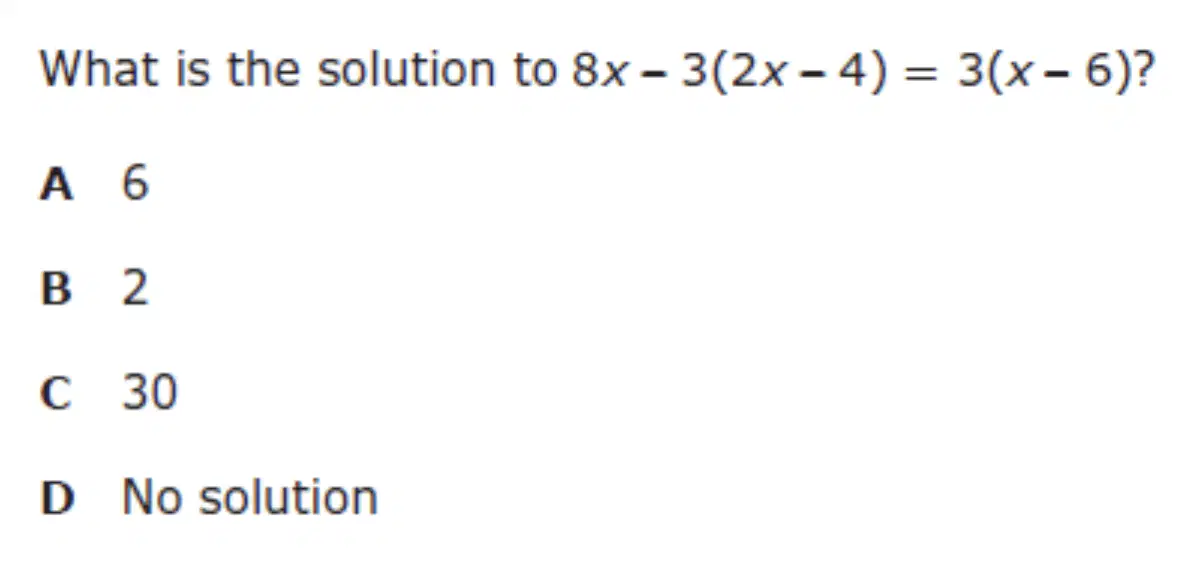
How should you solve this problem?
Distribute
Graph it in desmos
Nsolve
(y-y)/(x-x)

What can you use to solve this problem?
Distribute
Graph it in desmos
Nsolve
(y-y)/(x-x)
What does perpendicular mean?
Same slope; will never cross each other
Opposite reciprocal slopes (ex 35 −> −53 ; cross at a 90 degree angle
Positive and even
Negative and odd
What's NOT true when you see an equation in this form?
y=a(b)x
The a value is the y-intercept
If the b-value is greater than 1, that means the function is increasing
If the b-value is less than 1, that means the function is decreasing
The b-value is the x-intercept

What's NOT true about an "asymptote"?
The ONLY asymptotes you see in Algebra I are horizontal, NOT vertical
The asymptote we almost always see is
y = 0
It's the imaginary line that the graph never actually crosses; it's where the line flattens out
Sometimes we may have a vertical asymptote

How do you know where the shading on the graph should be?
If y is greater, it should be shaded above. If y is less, it should be shaded below. If y is negative, flip the sign before you shade
If y is greater, it should be shaded below. If y is less, it should be shaded above
If x is greater, it should be shaded above. If x is less, it should be shaded below
If the line is dotted, it should be shaded above. If the line is solid, it should be shaded below

How should you solve a SYSTEM OF EQUATIONS like this one?
Use Menu 413 to find the slope of both
Put them both in nsolve and multiply the answers
Change them to y = form, graph them, and find where they cross
Guess an x and y value and plug in to check if they work
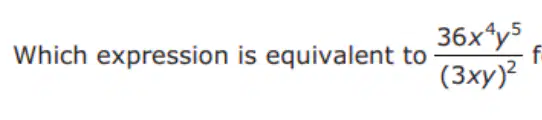
With a question like this, what should be the FIRST thing you do?
Add the exponents
Subtract the exponents
Multiply the exponents
Simplify the normal numbers in Desmos
When we're talking about QUADRATICS (the smiley face looking graphs), what does the word "solutions" mean?
vertex
y-intercept
x-intercept(s)
axis of symmetry
If you're stuck, but you have nothing to graph, try..............
giving up
eating soup
writing 2 equations based on the problem so then you'll have something to graph
adding all the numbers in the problem and then dividing by 4
When the problem has the word "models" in it ...
Do a regression! ~ ~ ~ ~ ~ ~ ~
Use the butterfly method
y - y / x - x
nsolve
What is slope-intercept form?
(y - y)/(x - x)
y=mx+b
y=a(b)^x
ax + by = c
True or false.... you can graph something in Desmos even if it has parentheses in it
True
False
"Narrower" means...
fatter
skinnier
taller
shorter
"Wider" means...
fatter
skinnier
taller
shorter
Horizontal means.....
up and down
side to side
Vertical means.....
up and down
side to side
What is the form of a linear equation?
y = mx + b
y = a(b)x
y = ax2+bx+c
What is the form of an exponential equation?
y = mx + b
y = a(b)x
y = ax2+bx+c
What is the form of a quadratic equation?
y = mx + b
y = a(b)x
y = ax2+bx+c
What is the definition of "asymptote"?
the line on which a function is flattening out
the line that cuts a parabola in half
the x-intercept
0
The equation of the asymptote is usually.....
y = 0
x = 0
If a problem mentions direct variation or direct proportion, that means you should use...
y1∼mx1+b
the butterfly method
graphing
y1∼a(b)x1
What does this symbol mean? 15 ± 4
Just add: 19
Just subtract: 11
Both add and subtract separately (2 answers): 11 and 19
Both add and divide (2 answers): 19 and 3.75
A HORIZONTAL stretch would make a parabola....
More narrow (skinny)
More wide (fat)
A VERTICAL stretch would make a parabola....
More narrow (skinny)
More wide (fat)
The y intercept is.....
What y is when x = 1
What y is when x = 0
Always the first y-value in the table
The average of the y's
If you have 2 points of a linear function, how can you get BOTH the slope and the y-intercept at one time?
nsolve
Use the ~
x−xy−y
use the butterfly method
How would you put in the calculator to solve this?
f(x) = 10x + 2, what is f(7)
7 + 2
10(7) + 2
10 + 2(7)
10 + 2
How would you put in the calculator to solve this?
f(x) = 4 + 8x, what is f(-3)
4 + 8
4 + -3
4 + 8(-3)
4(-3) + 8
What does f(3) = 12 mean?
When x is 3, y is 12
Point (3, 12)
When y is 3, x is 12
Point (12, 3)
x = 12/3
x = 3/12
What does f(20) = 5 mean?
When x is 20, y is 5
Point (20, 5)
When y is 5, x is 20
Point (5, 20)
x = 20/5
x = 5/20
What does domain mean?
The x-intercept
The y-intercept
ALL the x's touched by the function, from left to right
ALL the y's touched by the function, from down to up
What does range mean?
The x-intercept
The y-intercept
ALL the x's touched by the function, from left to right
ALL the y's touched by the function, from down to up
What does it mean when a SYSTEM of 2 equations has "no solution" ?
They are perpendicular
They cross more than once
They never cross
The domain and range are all real numbers
If a multiple choice question is asking "which expression is equivalent" to another, what can you try?
graphing to see what makes the same graph
use the ~
nsolve
choose the answer with the most similar numbers
What is the linear "parent function"?
f(x)=x
f(x)=x2
f(x)=(b)x
there's no such thing
What is the quadratic "parent function"?
f(x)=x
f(x)=x2
f(x)=(b)x
there's no such thing
What does it mean for a line to be more "steep" ?
higher on the graph
lower on the graph
more flat
less flat

Which line is the steepest?
red
blue
yellow
Which line is the least steep?
red
blue
yellow

