
 Worksheets
Quiz #2 - 2024-2025
Total questions: 10
Worksheet time: 2hrs 16mins

Select the true statement. Both dipsticks are from dogs. Dipstick #1 is on the left. Dipstick #2 is on the right.
Dipstick 2 is positive for glucose, ketones, blood and protein. Dipstick one is not positive for glucose, ketones, blood and protein.
Dipstick 1 is positive for glucose, ketones, blood and protein. Dipstick 2 is not positive for glucose, ketones, blood and protein
The results for dipstick 1 would be considered normal for a canine.
The feline proBNP test identifies cats at risk for cardiac disease. How many drops of conjugate and patient sample (serum or EDTA plasma) are used for this test?
5 drops conjugate + 5 drops patient sample
5 drops conjugate + 3 drops patient sample
5 drops conjugate + 4 drops patient sample
4 drops conjugate + 3 drops patient sample
On the Stago Max analyzer, which icon accesses the QC screen? **Sorry they are blurry!!


A urine calcium test is submitted. What do you do?
Report the calcium result from the urine dipstick.
Run the calcium on the supernatant on the Vitros.
Acidify the unspun urine, centrifuge, and run the calcium on the supernatant on the Vitros.
Don't run it. We don't run those!
You count 4 NRBCs on a differential. What do you do?
Correct the WBC on the Manual Diff before reporting. Use the formula:
Corrected WBC = WBC*(100/100+NRBC)
Add the appropriate comment about the corrected WBC count.
Don't correct the WBC. (We only correct WBCs for NRBCs when the NRBCs are ≥ 5)
Don't correct the WBC, but add the comment "NRBCs present".
What is the highest dilution that can be performed on the Vitros?
x 21
x 50
x 75
x 100

Identify the object indicated by the arrow.
normal platelet
enlarged platelet
schistocyte
reticulocyte

Identify the item indicated by the arrow.
neutrophil
basophil
Ummm... Not sure what it is. I'd call it an "other" and send for path review.
rubricyte

Canine urine. Identify the object indicated by the arrow.
squamous epithelial cell
RBC
WBC
bacteria
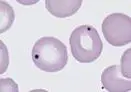
Name the inclusion in the canine RBCs. This is modified Wright's stain (not New Methylene Blue stain).
Erhlichia
NRBCs
Dohle bodies
Howell Jolly bodies

