
 Worksheets
40/40
Total questions: 40
Worksheet time: 25mins

The diagram shows the apparatus used to measure the rate of a chemical reaction.
For which reaction can the rate be measured using this apparatus?
2Na + Cl 2 → 2NaCl
NaOH + HCl → NaCl + H2O
Na2O + 2HCl → 2NaCl + H2O
Na2CO3 + 2HCl → 2NaCl + H2O + CO2
Copper(II) carbonate reacts with dilute sulfuric acid.
CuCO3(s) + H2SO4(aq) → CuSO4(aq) + CO2(g) + H2O(l)
Which changes always increase the rate of this chemical reaction?
1 increasing the concentration of sulfuric acid
2 increasing the size of the pieces of copper(II) carbonate
3 increasing the temperature
4 increasing the volume of sulfuric acid
1, 3 and 4
1 and 3 only
2 and 3
3 and 4 only
Calcium carbonate reacts with dilute hydrochloric acid to form bubbles of carbon dioxide. At a higher temperature, the same reaction is faster. Which row explains this observation?
collision rate increases and number of molecules with sufficient energy to react become more
collision rate increases and number of molecules with sufficient energy to react remain the same
collision rate stays the same and number of molecules with sufficient energy to react become more
collision rate stays the same and number of molecules with sufficient energy to react stay the same

A student adds dilute hydrochloric acid at two different temperatures to two different lumps of limestone. The lumps of limestone have the same mass. The carbon dioxide gas produced is collected in a gas syringe. The volume of carbon dioxide collected in 1 minute at each temperature is shown.
Which row describes and explains the results obtained at 50 °C compared with 25 °C?
reaction rate higher and energy of collisions is lower
reaction rate higher and energy of collisions is higher
reaction rate lower and energy of collisions is lower
reaction rate lower and energy of collisions is higher
Which change is a physical change?
Copper(II) carbonate changes colour from green to black when it is heated, and stays black when it cools.
Ethanol reacts with oxygen to form carbon dioxide and water.
Hydrogen peroxide decomposes into water and oxygen when it is boiled.
Ice forms liquid water when it is heated.

The apparatus shown is used to measure the rate of a reaction.
Which equation represents a reaction where the rate can be measured using this apparatus?
Mg(s) + 2HCl(aq) = MgCl2(aq) + H2(g)
HCl(aq)+NaOH(aq) = NaCl(aq)+H2O(l)
Fe(s)+CuSO4(aq) = Cu(s) + FeSO4(aq)
2Na(s)+Br2(l) = 2NaBr(s)

A liquid X reacts with solid Y to form a gas. Which two diagrams show suitable methods for investigating the rate (speed) of the reaction?
1 and 3
1 and 4
2 and 3
2 and 4
Which statements explain why increasing temperature increases the rate of a chemical reaction?
1 Heat makes the molecules move faster and collide more often.
2 Heat makes the molecules collide with more energy so they are more likely to react.
3 Increasing temperature lowers the activation energy for the reaction.
1 and 2
1 and 3
1 only
2 only
Which change in reaction conditions increases both the collision rate and the proportion of molecules with sufficient energy to react?
addition of a catalyst
increasing the concentration of a reactant
increasing the surface area of a reactant
increasing the temperature of the reaction
Which list contains only chemical changes?
melting, evaporating, dissolving
rusting, freezing, subliming
neutralisation, polymerisation, combustion
boiling, condensing, distillation
Which is a chemical change?
boiling water
cooking an egg
dissolving sugar
melting ice cubes
Dilute hydrochloric acid reacts with 1 g of limestone. Which conditions produce the fastest rate of reaction?
2 mol / dm3 hydrochloric acid and a single lump of limestone
4 mol / dm3 hydrochloric acid and a single lump of limestone
4 mol / dm3 hydrochloric acid and small pieces of limestone
4 mol / dm3 hydrochloric acid and powdered limestone

An experiment was carried out to find the rate of reaction when 1 g of solid X reacts with 100 cm3 of solution Y.
The experiment took place too quickly for measurements to be made. Which change could be made to slow down the reaction?
add a catalyst
decrease the concentration of solution Y
decrease the particle size of solid X
increase the temperature
Which changes increase the rate of reaction between calcium carbonate and dilute hydrochloric acid?
1 increasing the concentration of the acid
2 increasing the temperature
3 increasing the size of the pieces of calcium carbonate
1, 2 and 3
1 and 2 only
1 and 3 only
2 and 3 only

Zinc granules are reacted with excess dilute hydrochloric acid. The volume of hydrogen given off is measured at different times.
The results are shown on the graph, labelled experiment 1.
The results for a second experiment are also shown on the graph, labelled experiment 2.
Which change to the conditions was made in experiment 2?
The concentration of the hydrochloric acid was decreased.
The size of the zinc granules was decreased.
The surface area of the zinc granules was increased.
The temperature was increased.
Which of the following statements BEST describes COLLISION THEORY?
A. Atoms or molecules must collide with a sufficient amount of energy in order to react.
B. Catalyst can be recovered unchanged at the end of process.
C. Increasing the concentration of a reactant increases the rate of reaction.
D. Smaller pieces have a greater surface area, thus, providing much greater contact among the reactants and effecting more collisions.
2. The amount of energy required to break the bonds between the reacting molecules is known as _____.
A. Activated Complex
B. Activation Energy
C. Collision Theory
D. Law of Conservation of Mass
5. Which of the following is a SLOW chemical reaction?
A. rusting of iron
B. evaporation
C. melting
D. combustion
7. How will crushing a solid into a powder increase the reaction rate?
A. The activation energy barrier will be lowered.
B. The orientation of colliding particles will be improved.
C. The particles will collide with more energy.
D. The powdered form has more surface area.
Which does not increase the speed of a reaction?
adding a catalyst
increasing the concentration of one of the reactants
increasing the particle size of one of the reactants
increasing the temperature
Which of the following statements are correct for a catalyst.
1. A catalyst speeds up the reaction.
2. A catalyst does not take part in the reaction
3. A catalyst remains unchanged at the end of the reaction.
1, 3 only
1,2 and 3
1, 2 only
2, 3 only
Which piece of apparatus is essential to measure the speed of a reaction?
accurate balance
gas syringe
stop watch
thermometer
Why does powdering of calcium carbonate increase the speed of its reaction with an acid?
It increases the mass of calcium carbonate.
It increases the surface area of the calcium carbonate.
The powdered become more concentrated.
The powder floats on top of the acid.
How does a catalyst increase the speed of a reaction?
by increasing the collision frequency of particles
by increasing the speed of the particles
by increasing the temperature of the reaction
by lowering the activation energy
Which of the following apparatus is used to measure the volume of HCl accurately?
Burette
Measuring Cylinder
Beaker
conical flask
Adding a catalyst ___________ the activation energy.
Raises
Lowers
Doesn't affect
Inreases
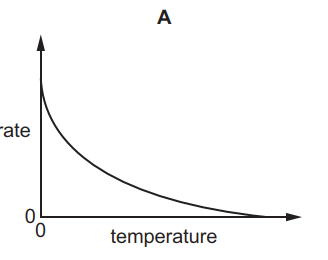
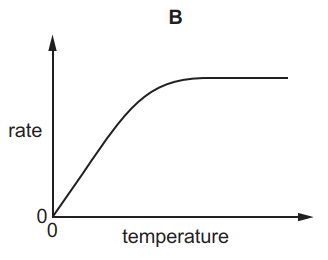
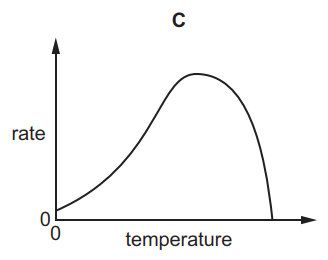
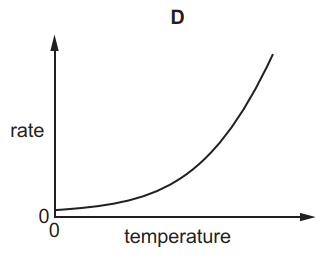
Which graph shows the effect of increasing temperature on the rate of reaction of calcium carbonate with dilute hydrochloric acid?
Which of the following are the factors that affecting the rate of reactions?
Size of reactants
Concentration of reactants
Temperature
Presence of catalyst
All of above
Which factor can only affects the rate of reaction when involved gases as the reactant?
Concentration of reactants
Pressure
Temperature
Size of reactants
Which of the following statement is correct?
Smaller size of reactants, smaller total surface area, higher reaction rate
Larger size of reactants, smaller total surface area, higher reaction rate
Smaller size of reactants, larger total surface area, higher reaction rate
Larger size of reactants, larger total surface area, higher reaction rate
If the temperature is reduced, a reaction rate will ______
increase
decrease
stay the same
The ____________ states that atoms, ions, or molecules must collide in order to react.
transition state
activation energy
rate law
collision theory
How does a catalyst increase the rate of a chemical reaction?
Provides lower energy route for the reaction so that a greater number of particles have enough energy to react.
Increased number of collisions increases the chance of a 'successful collision'
Particles collide faster and harder so a larger proportion have greater energy than the required activation energy.
How does temperature increase the rate of a chemical reaction?
Provides lower energy route for the reaction so that a greater number of particles have enough energy to react.
Increased number of collisions increases the chance of a 'successful collision'
Particles collide faster and harder so a larger proportion have greater energy than the required activation energy.
Greater number of 'active sites' available for a reaction to take place (referring to solids)
How does concentration increase the rate of a chemical reaction?
Provides lower energy route for the reaction so that a greater number of particles have enough energy to react.
Increased number of collisions increases the chance of a 'successful collision'
Particles collide faster and harder so a lagrer proportion have greater energy than the required activation energy.
Greater number of 'active sites' available for a reaction to take place (referring to solids)

