

wayground logo

Free Printable Worksheets

NEW

Font size

S
M
L
XL
Worksheets

Cell Membrane Review

Total questions: 16

Worksheet time: 9mins

Name
Class
Date
1.

In passive transport, the concentration gradient goes from..

a)

Low to low

b)

High to low

c)

Low to high

d)

High to high

2.
The cellular process in which materials are moved across a membrane from an area of low concentration to an area of high concentration is called
a)
Osmosis
b)
Simple Diffusion
c)
Active Transport
d)
Passive Transport 
3.
Osmosis is the diffusion of __________.
a)
water
b)
glucose
c)
air
d)
passive transport
4.
Which type of Passive Transport is being represented in this picture?
a)
Passive Diffusion
b)
Simple Diffusion
c)
Active Diffusion
d)
Facilitated Diffusion
5.
Large molecules are released by cell by 
a)
Endocytosis
b)
Exocytosis
c)
Passive transport
d)
Phagocytosis
6.
Bacteria are engulfed by
a)
Pinocytosis
b)
Receptor mediated endocytosis
c)
Exocytosis
d)
Phagocytosis
7.
What is the name for a molecule that has a polar head region and a hydrophobic tail region?
a)
Bihydrophicity
b)
Amphipathic
c)
Hydrophilic
d)
Dipolarity
8.
The function of the plasma membrane is....
a)
to regulate what enters and leaves the cell.
b)
fight bacteria and viruses that enter the cell.
c)
provide rigid support and protection to the cell.
d)
make sure each cell can move
9.

Which if the following is not a structural part of the cell (plasma) membrane?

a)

phospholipids

b)

cholesterol

c)

proteins

d)

DNA

10.

Phospholipids are made up of two parts. Which of the following correctly describes these two parts?

a)

hydrophobic head, hydrophilic tail

b)

hydrophobic head, hydrophobic tail

c)

hydrophilic head, hydrophobic tail

d)

hydrophilic head, hydrophilic tail

11.

Which image correctly shows the way phospholipids arrange themselves in the cell (plasma) membrane?

a)
b)
c)
d)
12.

The ability of the cell (plasma) membrane to control what substances can pass through is referred to as

a)

semi-barrier

b)

semi-permeable

c)

fully permeable

d)

fluid mosaic

13.

What is the "big idea" of the fluid mosaic model of plasma membranes?

a)

the plasma membrane creates a specialized FLUID that looks like a MOSAIC.

b)

the plasma membrane is a MOSAIC.

c)

the fluid mosaic model is NOT related to the plasma membrane.

d)

a plasma membrane is a MOSAIC of components that move FREELY and FLUIDLY.
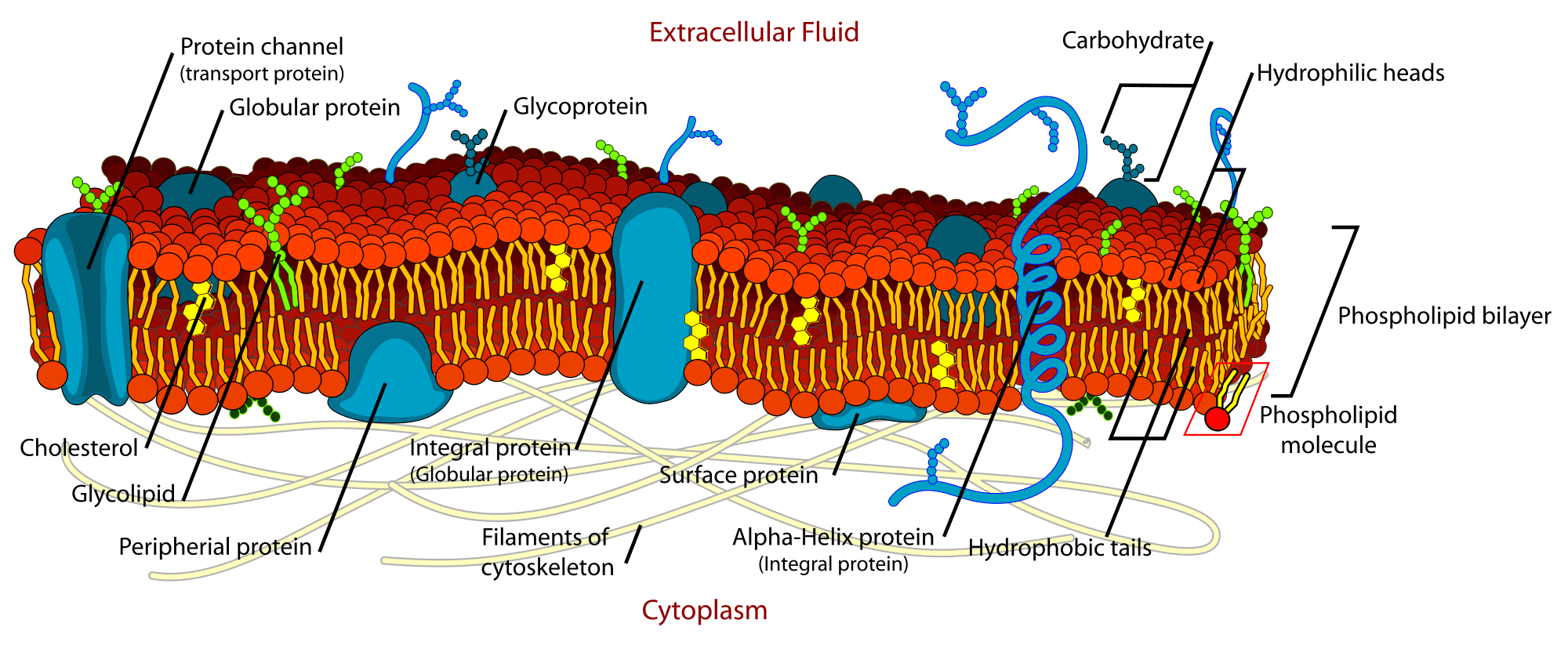
14.
What is this image?
a)
cell membrane
b)
proteins
c)
carbohydrates
d)
lipids
15.
What is NOT TRUE about the cell membrane
a)
It controls what enters and leaves the cell
b)
Semipermeable
c)
Phospholipid bilayer
d)
Contains digestive enzymes
16.
A type of active transport that brings particles into a cell when the cell membrane encloses a particle to make a vesicle
a)
Diffusion
b)
Passive Transport
c)
Active Transport
d)
Endocytosis
