
 Worksheets
Science Final Exam Review
Total questions: 46
Worksheet time: 55mins

What is a canyon?
a dig cliff
a deep, narrow valley with high, steep sides
a big duvet in the ground
It's the breaking up and moving of weathered rocks from one place to another
erosion
soil
magma

The process of breaking up rocks on Earth's surface is called...
sediment
erosion
weathering
deposition

A place on Earth’s surface that is higher than the land around it. It has a peak. It is called _____.
a valley
a cavern
an island
a mountain

What is the correct layers of the earth starting with the surface?
crust, outer core, inner core, mantle
mantle, outer core, inner core ,crust
crust, mantle, outer core, inner core
outer core, inner core , crust, mantle

This layer is directly below the crust.
Crust
Mantle
Outer Core
Inner Core

This layer is directly below the mantle.
Crust
Mantle
Outer Core
Inner Core

This layer is the innermost layer of the Earth.
Crust
Mantle
Outer Core
Inner Core

This layer is the thinnest layer and is made of solid rock.
Crust
Mantle
Outer Core
Inner Core

This layer includes all dry land and the Ocean floor.
Crust
Mantle
Outer Core
Inner Core
Fill in the blank.
Weathering is a ____________ process that changes Earth's surface.
Slow
Rapid

Rocks being broken apart is an example of:
Landslide
Erosion
Volcanic Eruption
Weathering

drought
flooding
weathering

erosion
drought
earthquake
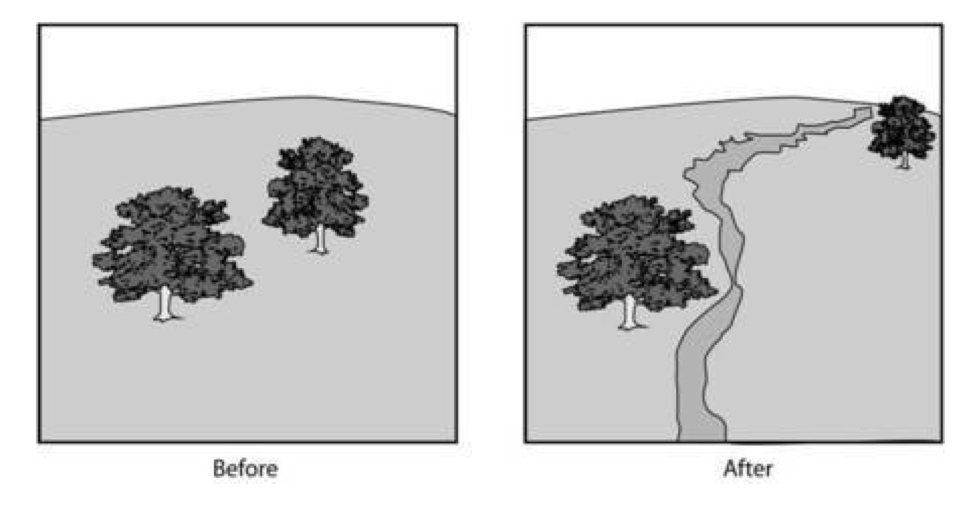
Which of the following most likely caused the change to the Earth's surface illustrated?
landslide
thunderstorm
sinkhole
earthquake
Which would be an example of a fast change to the Earth’s surface?
A mountain's top cracking open due to volcanic eruptions.
A valley getting deeper as a river runs through it.
A plain forming cracks when hot weather makes it dry.
A hill rising as the wind piles up loose sand.

The rock layers pictures here have split and been shifted. What most likely caused this change?
river
landslide
earthquake
volcano
Something that happens quickly to Earth's surface to make it different--
Earth's surface
Fast change
A river forming
A mountain forming
_______, _______, and __________ can carry soil away
select all apply
Wind
Water
mountain
Glaciers
All of the living and nonliving components that interact in an environment.
population
ecosystem
community
organism
Any living thing is called a.................
ecosystem
community
population
organism
Plants need _____ to make food.
light
protection
to stay warm
What organisms eat plants and animals to gain energy?
Producers
Consumers
Decomposers
The sun
Who can make their own food through a process known as photosynthesis after receiving energy from the sun?
Producers
Consumers
Decomposers
The sun
Which of these is not a producer?
Tree
Flower
Grass
Bird
Which of these is not a consumer?
Tiger
Squirrel
Fish
Apple Tree
Breaks down and feeds on the remains of other organisms
decomposer
consumer
producer
Choose the decomposer.
grass
elephant
bacteria
bird
Choose the consumer.
mushroom
horse
tree
grass


An animal that hunts and eats other animals for energy
prey
predator
decomposer

A snake is an example of a/an ….
community
organism
population
Snakes, mice, small birds, crickets, hawks, cactus live together in a specific area will make ….
organism
community
population

A group of snake lives together in a specific area will make ….
organism
community
population
A __________ includes all living and non-living things in an environment.
population
ecosystem
community

Which of the following is the herbivore?
P
Q
R
S



