
 Worksheets
Chemistry Isotopes
Total questions: 23
Worksheet time: 12mins

How many neutrons are in the isotope Carbon-14?
6
8
12
14

What is the complete symbol for a cobalt atom with a mass number of 60?
A
B
C
D

What is the mass-form for the isotope with 38 protons and 50 neutrons?
Stronium-88
Stronium-50
Tin-88
Tin-50
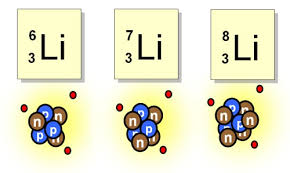
Isotopes are atoms of the same element that have different
principal chemical properties.
masses.
numbers of protons.
number of electrons.
As the mass number of an element's isotopes of an element increases, the number of protons
decreases.
increases.
remains the same.
doubles each time the mass number increases.
The average atomic mass of an element is the average of the atomic masses of its
naturally occurring isotopes.
two most abundant isotopes.
radioactive isotopes.
artificial isotopes.
The average atomic mass of an element
is the mass of its most abundant isotopes.
may not equal the mass of any of its isotopes.
cannot be calculated.
always adds up to 100.
The atomic mass of an element listed in the periodic table is the
average atomic mass.
relative atomic mass of the most abundant isotope.
relative atomic mass of the most abundant radioactive isotope.
mass number of the least abundant isotope.
Carbon-14 (atomic number 6), the radioactive nuclide used in dating fossils, has
6 neutrons.
8 neutrons.
10 neutrons.
14 neutrons.
What does the number 84 in krypton-84 represent?
the atomic number
the mass number
the sum of the protons and electrons
twice the number of protons
How do the isotopes of hydrogen-1 and hydrogen-2 differ?
Hydrogen-2 has one more electron than hydrogen-1.
Hydrogen-2 has one neutron, hydrogen-1 has none.
Hydrogen-2 has two protons; hydrogen-1 has one.
Hydrogen-2 has one proton; hydrogen-1 has none.
Which of the following equals one atomic mass unit?
the mass of one electron
the mass of one helium-4 atom
the mass of one carbon-12 atom
one-twelfth the mass of one carbon-12 atom
hydrogen-1 is called _________.
hydrogen (protoium)
deuterium
tritium
none of these
hydrogen-2 is called _________.
hydrogen (protoium)
deuterium
tritium
none of these
hydrogen-3 is called _________.
hydrogen (protoium)
deuterium
tritium
none of these
A fictitious element X is composed of 20 percent of the isotope X-50, 15 percent of the isotope X-51, and 65 percent of the isotope X-52. Estimate the mass of element X.
51.5 amu
5145 amu
135190.98 amu
50.95 amu
Calculate the atomic mass of silicon. The three silicon isotopes have atomic mass and relative abundances of 27.9769 amu (92.2297%), 28.9765 amu (4.6832%) and 29.9738 amu (3.0872%).
28.0853 amu
25166.4483 amu
2808.5389 amu
28.0546 amu
Gallium has two naturally occurring isotopes. The mass of gallium-69 is 68.9256 amu and it is 60.108% abundant. The mass of gallium-71 is 70.9247 amu and it is 39.892% abundant. Calculate the atomic mass of gallium.
4958.8597 amu
6972.3081 amu
70.0928 amu
69.7231 amu

