Worksheets
Characteristics of Functions
Total questions: 80
Worksheet time: 26mins


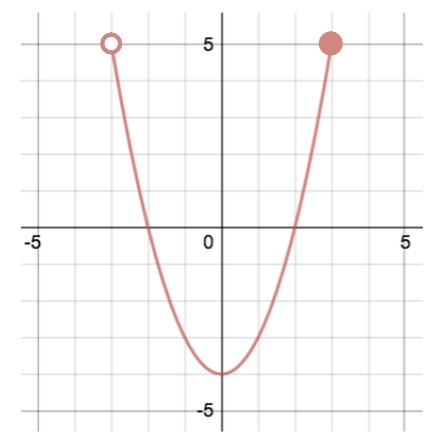


Find the function's x- and y-intercepts.
x-int (0,-3) and (0,1)
y-int (-4,0)
x-int (-3,0) and (1,0)
y-int (0,-4)
x-int (-4, 1)
y-int (-4, ∞)
x-int (-3,0) and (1,0)
y-int (0,-3)

Identify the intervals where the function is positive and where it is negative.
positive (-1, ∞) and negative (-∞, -1)
positive nowhere and negative (-1, -4)
positive (-∞,-3) and (1,∞) and negative (-3,1)
positive (-∞,∞) and negative (-4,∞)

Identify where the function is increasing and where it is decreasing.
increasing x > -1 and decreasing x < -1
increasing x < -1 and decreasing x > -1
increasing all real numbers and decreasing nowhere
increasing x < -3 or x > 1 and decreasing -3 < x < 1

Identify the function's x- and y-intercepts.
x-int (1,0) and y-int (0,-1)
x-int (0,1) and y-int (-1,0)
x-int (1,∞) and y-int (-∞,-1)
x-int none and y-int (-1,1)

Where is the function positive and where is it negative?
positive x > 1 and negative x < 1
positive x > 0 and negative x < 0
positive all real numbers and negative nowhere
positive x < 1 and negative x > 1

Where is the function increasing and decreasing?
increasing all real numbers and decreasing nowhere
increasing nowhere and decreasing all real numbers
increasing x > 1 and decreasing x < 1
increasing x < 1 and decreasing x > 1

Where is the function positive and where is it negative?
positive -2<x<1 and x > 3
negative x < -2 and 1<x<3
positive x < -1 and x > 2
negative -1 < x < 2
positive -1 < x < 4
negative 2 < x < -2
positive x < 3 and 1<x<-2
negative 3<x<1 and x>-2

What is the domain of the absolute value function?
(4, 0)
(0, 4)
(−∞,∞)
[4,∞)

What is the range of the absolute value function?
f(x)=−∣x−2∣+6?
[6, ∞)
(−∞, 6]
(6, ∞)
(−∞, ∞)

Identify the x-intercept of the graph.
(-4, 0)
(0, -2)
(0, -4)
(-2, 0

Identify the x-intercept(s)
(-1, 0)
(5, 0)
(5, 0) & (-1, 0)
(-1, 0) & (0, 1)
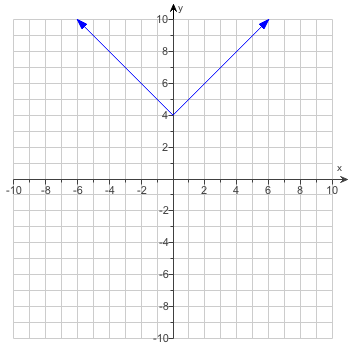
What is/are the x-intercept(s) of the absolute value function?
(0, 4)
none
(4, 0)
[4, infinity)


Where is the function positive?
0<x<4
at the vertex (2,4)
y≤4
−∞<x<∞

Is the graph increasing or decreasing?
Increasing
Decreasing
Both; increasing if x < 3, and decreasing is x > 3
Both; decreasing if x < 3, and increasing is x > 3

Is the function increasing or decreasing?
increasing
decreasing
increasing if x > 0 and and decreasing if x < 0
neither

What are the domain and the range of the function?
domain (-∞,∞) and range (-∞,∞)
domain (∞,-∞) and range (∞,-∞)
domain (-∞, 3] and range [3,∞)
domain (-∞,1] and range [1,∞)
Is the function increasing or decreasing?
increasing
decreasing
both
neither
On what interval is the graph decreasing?
y>3
y<3
y>1.5
y<4.5

What is the DOMAIN?
x≥0
x<0
All Real Numbers
{0, 1, 2, 3, 4,...}
Identify where the function is increasing and where it is decreasing.
increasing x > -1 and decreasing x<-1
increasing x < -1 and decreasing x > -1
increasing ꓣ and decreasing nowhere
increasing -1 < x < 4 and decreasing -3 < x < 1
Identify the intervals where the function is positive and where it is negative.
positive x > -1 and negative x < -1
positive nowhere and negative -4 < x < -1
positive x < -3 and x > 1 and negative -3 < x < 1
positive R and negative x < -4

Identify the function's domain and range.
domain -∞ to ∞ and range -∞ to ∞
domain -∞ to ∞ and range 4 to ∞
domain -∞ to ∞ and range -4 to ∞
domain -3 to 1 and range -4 to ∞

Let's call the graph f(x). Find f(5) = ___
25
30
35
40

What is the interval of increase?
All Real Numbers
(−∞,−2)
(−2,∞)
(−∞,4)

What is the interval of increase?
All Real Numbers
(0, 2)
(−3, ∞)
(1, ∞)

Identify the range of the function.
(1,∞)
[1,∞)
(2,∞)
[2,∞)

For the pictured function, at which interval is it decreasing?
(-∞, 2)
(-2, 0)
(0, ∞)
(-3, 1)
Which ordered pair could represent a y-intercept?
(-1, 0)
(2, 4)
(0,4)
(-2, 4)

What is the y-intercept of the graph?
(-2,5)
(1,0)
(0,1)
(-3.104, 0)


What is f(0)?
−1
2
4
−5
Find the x values in which f(x) > 0 [Find where it is positive.]
(-1, 1)
(−∞,−1)∪(−1, 2)
(2, ∞)
(−∞, ∞)
Identify the decreasing interval:
(0, 4)
(1, 0) U (1, 4)
(-1, 1)
(-∞, -1) U (1, ∞)

What are the x-intercepts?
(0, 0) and (2, 0)
(-4, 0) and (0, 0)
(2, 0) and (3, 0)
(0, 0) and (4, 0)

Which is true?
f(0) = 2
f(-2) = 6
f(3) = 0
f(-3) = 1

What is the end behavior of the function?
x→−∞, y→∞
x→∞, y→−∞
x→−∞, y→3
x→−∞, y→−∞

Which one(s) describe the end behavior of the graph. Choose all that apply.
x→∞, y→∞
x→∞, y→−∞
x→−∞, y→∞
x→−∞, y→−∞
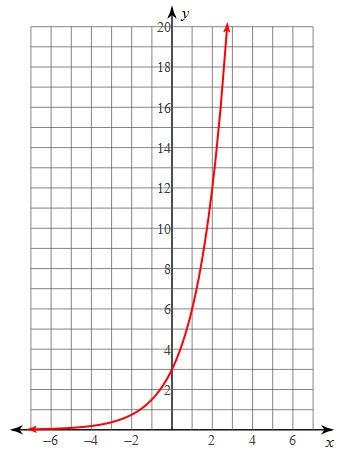


Is it a function?
It IS a function.
It IS NOT a function


Translate the function notation into a coordinate point.
f(−1)=5
(−1,5)
(1,5)
(5,1)
(5,−1)
Translate the coordinate pair into function notation.
f(0)=8
f(0)=−8
f(8)=0
f(−8)=0
Given the function
f(x)=x+3
Evaluate:
f(−2)
f(−2)=−1
f(−2)=1
f(−2)=5
f(−2)=−5
Given
g(x)=4x−2
Evaluate:
g(−7)g(−7)=−30
g(−7)=−26
g(−7)=−36
g(−7)=26
Given:
w(x)=−10x−5
Evaluate:
w(1)
w(1)=−15
w(1)=−5
w(1)=5
w(1)=15
Given:
f(x)=6x
Find x when f(x)=−24
x=−4
x=4
x=−144
x=−6
Given:
g(x)=3x−5
Find x when g(x)=4
x=3
x=−3
x=7
x=−3
Given:
h(x)=14−8x
Find x when h(x)=−2
x=2
x=−2
x=30
x=−30
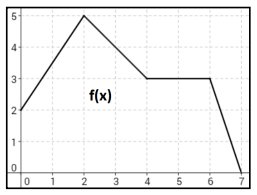
Given the graph,
find:
f(2)f(2)=5
f(2)=4
f(2)=3
f(2)=0
Given the graph,
find:
f(4)f(4)=3
f(4)=1
f(4)=2
f(4)=0
Given the graph,
find:
f(6)f(6)=3
f(6)=1
f(6)=2
f(6)=0
Given the graph,
find:
f(7)f(7)=3
f(7)=1
f(7)=2
f(7)=0
Given the graph,
find:
f(0)f(0)=7
f(0)=1
f(0)=2
f(0)=0
Given the graph,
find the value of x when:
f(x)=0x=1
x=0
x=7
x=2
Given the graph,
find the value of x when:
f(x)=5x=5
x=0
x=3
x=2

Given the graph,
find the value of x whenf(x)=5
x=7
x=6
x=5
x=3
Given the graph,
find the value of x whenf(x)=2
x=7
x=1
x=5
x=4

Select ALL of the functions.
{ (a,z) , (b,z) , (c,z) }


Select ALL of the functions.
{ (a,z) , (b,z) , (c,z) }
Evaluate the function for f(9) if f(x)=53x+8 .
567
−513
−567
513

Is the following graph a function? Explain.
Yes, because no x-value repeats.
Yes, because they are individual dots.
No, because the x repeats.
No, because it is not a line.