Wayground logo

Free Printable Worksheets

Font size

S
M
L
XL
Worksheets

Assessment: Lesson 4-1 and 4-2

Total questions: 78

Worksheet time: 2hrs 43mins

Name
Class
Date
1.
Which equation represents an inverse variation?
a)
y = 40/x
b)
y = 40x
c)
y/x = 40
d)
x = y/40
2.
y varies inversely as x, if y = -3 when x = -6, find y when x = 14.
a)
11
b)
-11
c)
9/7
d)
7/9
3.
Given that y varies inversely with x, if x =7 and y = 4, what is y when x = 2?
a)
14
b)
10
c)
2
d)
-14
4.
Given the following equation, identify the constant k.
y = 54/x
a)
There is one.
b)
k = x
c)
54
d)
y = k
5.
Given (32, 15) and (12, y). Find the constant k, and then find the missing y value.
a)
40
b)
48
c)
-40
d)
-48
6.
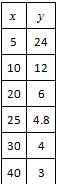
Does the table show an inverse variation?
a)
Yes
b)
No
7.
Which equation shows an inverse variation?
a)
kx=y
b)
y3=x
c)
6=yx
d)
y=k
8.
What type of variation is represented by this table?
a)
Direct
b)
Inverse
c)
Both 
d)
Neither
9.
Does the equation show an inverse variation? 
y=10/x
a)
yes
b)
no
10.

Describe the transformation of the function.

a)

shift left 3 units

b)

shift right 3 units

c)

shift up 3 units

d)

shift down 3 units

11.

Describe the transformation of the function.

a)

shift right by 3 units

b)

shift left by 3 units

c)

shift up by 3 units

d)

shift down by 3 units

12.

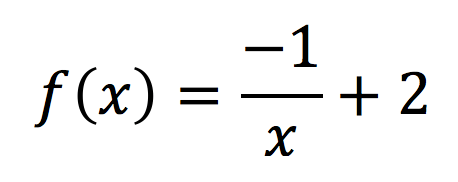
Describe the transformations of the function.

a)

Shifted right by 4 units

Shifted down by 7 units

Stretched Vertically

b)

Shifted right by 4 units

Shifted up by 7 units

Stretched Vertically

c)

Shifted right by 4 units

Shifted down by 7 units

Compressed Vertically
d)

Shifted left by 4 units

Shifted down by 7 units

Compressed Vertically

13.

Describe the transformations of the function.

a)

Shift up by 2 units

Reflected over the x-axis

b)

Shift down by 2 units

Reflected over the y-axis

c)

Shift up by 2 units

Reflected over the y-axis

d)

Shift left by 2 units

Reflected over the x-axis

14.

What is the vertical asymptote of the function?

a)

x = 2

b)

x = -2

c)

x = 0

d)

x = 1

15.

What is the vertical asymptote of the function?

a)

x = 7

b)

x = -7

c)

x = 6

d)

x = -6

16.

The given graphed function would have a vertical asymptote at

a)

x = 0

b)

y = 0

c)

x = 2

d)

y = 2

17.

The given graphed function would have a horizontal asymptote at

a)

x = 0

b)

y = 0

c)

x = 2

d)

y = 2

18.

The given graphed function would have a vertical asymptote at

a)

x = 0

b)

y = 0

c)

x = 2

d)

y = 2

19.

What is this function called?

a)

Quadratic

b)

Reciprocal

c)

Polynomial

d)

Exponential

20.

Which of the following could be the graph of y=−2xy=-\frac{2}{x}  

a)
b)
c)
d)
21.

Which of the following could be the graph of y=2xy=\frac{2}{x}  

a)
b)
c)
d)
22.

What is the horizontal asymptote of the following function?

a)

x = -2

b)

x = 2

c)

y = -3

d)

y = 3

23.

What is the vertical asymptote of the following function?

a)

x = -2

b)

x = 2

c)

y = -3

d)

y = 3

24.

What is the domain for the following function?

a)

All real numbers except 2.

b)

All real number except -2.

c)

All real numbers except 4.

d)

All real numbers.

25.
 Y varies directly with x, and y is 84 when x is 16. Which equation represents this situation?
a)
y=1344x
b)
y=100x
c)
y=5.25x
d)
y=4/21x
26.
Is the given table a direct variation? If so, what is the constant of variation?
a)
Yes; 1/3
b)
Yes; 3
c)
Yes; 5
d)
No
27.
What kind of equation is this?
xy=8
a)
Linear Equation
b)
Direct Variation
c)
Inverse Variation
d)
Joint Variation
28.
Is the given table a direct or inverse variation? What is the constant of variation?
a)
Direct, 12
b)
Inverse, 12
c)
Direct, 1/12
d)
Inverse, 1/12
29.
The number of hours to paint a house varies inversely with the number of painters working. A 2400-square foot house can be painted in 27 hours by 6 painters. How many painters would need to work in order to paint the house in 18 hours?
a)
8 painters
b)
10 painters
c)
9 painters
d)
11 painters
30.
The time it takes to fly from Los Angeles to New York varies inversely as the speed of the plane. If the trip takes 6 hours at 900 km/h, how long would it take at 800 km/h?
a)
5.33 hours 
b)
6.75 hours 
c)
12 hours 
d)
10 hours 
31.
The gas pressure in a chamber varies directly with the temperature in the chamber. If the pressure in the chamber is 150 atmospheres (atm) when the chamber is at 50 degrees, what is the pressure in the chamber when the temperature of the chamber is 75 degrees? 
a)
175 atm
b)
200 atm
c)
225 atm
d)
275 atm
32.
Which of the following represents direct variation?
a)
y = kx
b)
y = k/x
c)
y = x/k
d)
y = mx + b
33.
Which of the following represents indirect variation?
a)
y = kx
b)
y = k/x
c)
y = x/k
d)
y = mx + b
34.
x and y vary inversely. Given (5, 20), what is the constant k?
a)
4
b)
5
c)
25
d)
100
35.
Does the equation show an inverse variation? 
y=10/x
a)
yes
b)
no
36.
What kind of variation does this equation show?
y = 6x
a)
Inverse Variation
b)
Direct Variation
c)
No Variation
d)
Joint Variation
37.
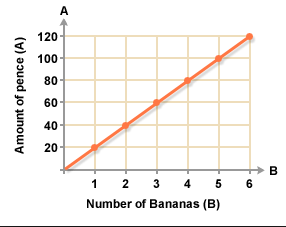
What kind of variation is shown in this graph?
a)
Inverse
b)
Direct
38.

Tell whether x and y show direct variation, inverse variation, or neither.

a)

direct variation

b)

inverse variation

c)

neither

39.

Tell whether x and y show direct variation, inverse variation, or neither.

a)

direct variation

b)

inverse variation

c)

neither

40.

Which equation represents inverse variation?

a)

y = x + ⅕

b)

y = (⅕) x + 5

c)

y = (⅕) x

d)

y=5xy=\frac{5}{x}

e)

y = 5 x

41.

Determine if the given equation is a direct variation, an inverse variation, or neither.

y=5xy=5x  

a)

Direct Variation

b)

Inverse Variation

c)

Neither

42.
Which equation represents an inverse variation?
a)

y=40xy=\frac{40}{x}

b)

y = 40x

c)

yx=40\frac{y}{x}=40

d)

x=y40x=\frac{y}{40}

43.
Given that y varies inversely with x, if x =7 and y = 4, what is y when x = 2?
a)
14
b)
10
c)
2
d)
-14
44.

Given the following equation, identify the constant k. y=54xy=\frac{54}{x}

a)

There is one.

b)

k = x

c)

54

d)

y = k

45.
Which equation shows an inverse variation?
a)
kx=y
b)
y3=x
c)
6=yx
d)
y=k
46.
What type of variation is represented by this table?
a)
Direct
b)
Inverse
c)
Both 
d)
Neither
47.

Does the equation show an inverse variation?  y=10xy=\frac{10}{x}

a)

yes

b)

no

48.

Which of the following are true for INVERSE variation? Select all that apply.

a)

y=3xy=3x

b)

y=2xy=\frac{2}{x}

c)

k=2k=2

d)

2=xy2=xy

e)

y=5x+9y=5x+9

49.

Tell whether x and y show direct variation, inverse variation, or neither.

a)

Direct Variation

b)

Inverse Variation

c)

Neither

50.

Tell whether x and y show direct variation, inverse variation, or neither.

a)

Direct Variation

b)

Inverse Variation

c)

Neither

51.

The time it takes to drive to Dallas is inversely proportional to your driving speed. It takes 3 hours to get to Dallas if you drive 60 mph. How long will the trip take if you drive 72 mph?

a)

2.5 hours

b)

2.6 hours

c)

2.8 hours

d)

3.5 hours

e)

3.6 hours

52.

The time that a group of carpenters takes to build a deck is inversely proportional to the number of carpenters. If 3 carpenters can build a deck in 36 working hours, how many carpenters are needed to build a deck in 27 working hours?

a)

2

b)

3

c)

4

d)

5

e)

6

53.
When dealing with direct and inverse variation, the K represents what?
a)
Kangaroo
b)
K-Mart's Blue Light Special
c)
Constant
d)
King Cobra Snake
54.
What does the Direct Variation Equation look like?
a)
y= kx
b)
y = mx + b
c)
y = b
d)
y = x
55.
Is the given table a direct variation? If so, what is the constant of variation?
a)
Yes; 1/3
b)
Yes; 3
c)
Yes; 5
d)
No
56.
What kind of equation is this?
xy=8
a)
Linear Equation
b)
Direct Variation
c)
Inverse Variation
d)
Joint Variation
57.
Is the given table a direct variation? If so, what is the constant?
a)
Yes; 1/4
b)
Yes; 4
c)
Yes; 2
d)
No
58.
What is the constant (k) in this inverse variation?
a)
12
b)
24
c)
48
d)
Not enough information given
59.

What is the constant (k) in this inverse variation? y=400xy=\frac{400}{x}

a)

x

b)

y

c)

400

d)

Not enough information given

60.

What are the asymptotes?

a)

x=1, x= 2, y =1, y= 2

b)

x= 2, x=-2, y = 1

c)

x=2 y =-1

d)

x=1 y =2, y =-2

61.
Which asymptote(s) are determined by looking at the denominator?
a)
vertical
b)
horizontal
c)
end behavior
d)
none
62.

What are the asymptotes?

a)

x = -1 y = -3

b)

x = 1 y = -3

c)

x = -1 y = 3

d)

x = 1, y = 3

63.

What is the end behavior as x approaches −∞-\infty

a)

y approaches negative infinity

b)

y approaches positive infinity

c)

y approaches 1

d)

y approaches 2

64.

Which of the following represent the graph?

a)
b)
c)
d)
65.

What is the domain for the following function?

a)

All real numbers except 2.

b)

All real number except -2.

c)

All real numbers except 4.

d)

All real numbers.

66.

What is the vertical asymptote of the following function?

a)

x = -2

b)

x = 2

c)

y = -3

d)

y = 3

67.

What is the horizontal asymptote of the following function?

a)

x = -2

b)

x = 2

c)

y = -3

d)

y = 3

68.

Which of the following could be the graph of y=2xy=\frac{2}{x}  

a)
b)
c)
d)
69.

Which of the following could be the graph of y=−2xy=-\frac{2}{x}  

a)
b)
c)
d)
70.

What is this function called?

a)

Quadratic

b)

Reciprocal

c)

Polynomial

d)

Exponential

71.

Which of the following represent the graph?

a)
b)
c)
d)
72.

What is the domain for the following function?

a)

All real numbers.

b)

All real numbers except for -2.

c)

All real numbers except for 2.

d)

All real numbers except for 4.

73.

What is the vertical asymptote for the following function?

a)

x=2x=2

b)

x=−2x=-2

c)

y=4y=4

d)

y=−4y=-4

74.

What is the horizontal asymptote for the following function?

a)

x=2x=2

b)

x=−2x=-2

c)

y=4y=4

d)

y=−4y=-4

75.

What y value can this graph not reach because of a horizontal asymptote?

a)

-1

b)

1

c)

3

d)

0

76.

What x value can this graph not reach because of a vertical asymptote?

a)

1

b)

-15

c)

3

d)

15

77.

Is there a vertical asymptote for 1/x ?

a)

yes

b)

no

78.

What are the asymptotes of y = 1/x ?

a)

y = 1 and x = 1

b)

y = -1 and x = -1

c)

y = 15 and x = 15

d)

y = 0 and x = 0