wayground logo

Free Printable Worksheets

Font size

S
M
L
XL
Worksheets

U3L3 - Muscle Movements and Contractions Quiz Review

Total questions: 36

Worksheet time: 35mins

Name
Class
Date
1.

Reorder the following steps (1-5) of a muscle contraction

a)

Nerve Impulse reaches Neuromuscular Junction

b)

Acetylcholine (ACH) Released by Motor Neuron

c)

ACH binds to Muscle Receptor Sites

d)

Action Potential charge travels down muscle cell

e)

Impulses reaches the SR and Ca+ channels open

1)
2)
3)
4)
5)
2.

Reorder the following (6-10) of the muscle contraction

a)

Ca+ ions diffuse from the SR and bind to troponin molecules

b)

Tropomyosin molecules move and expose specific sites on actin where myosin heads can bind

c)

Cross-bridges form, linking actin and myosin

d)

Actin filaments are pulled toward the center of the sarcomere by pulling of the cross-bridges, increasing the overlap of the thin and thick filaments

e)

The muscle fiber shortens as contractions occurs

1)
2)
3)
4)
5)
3.

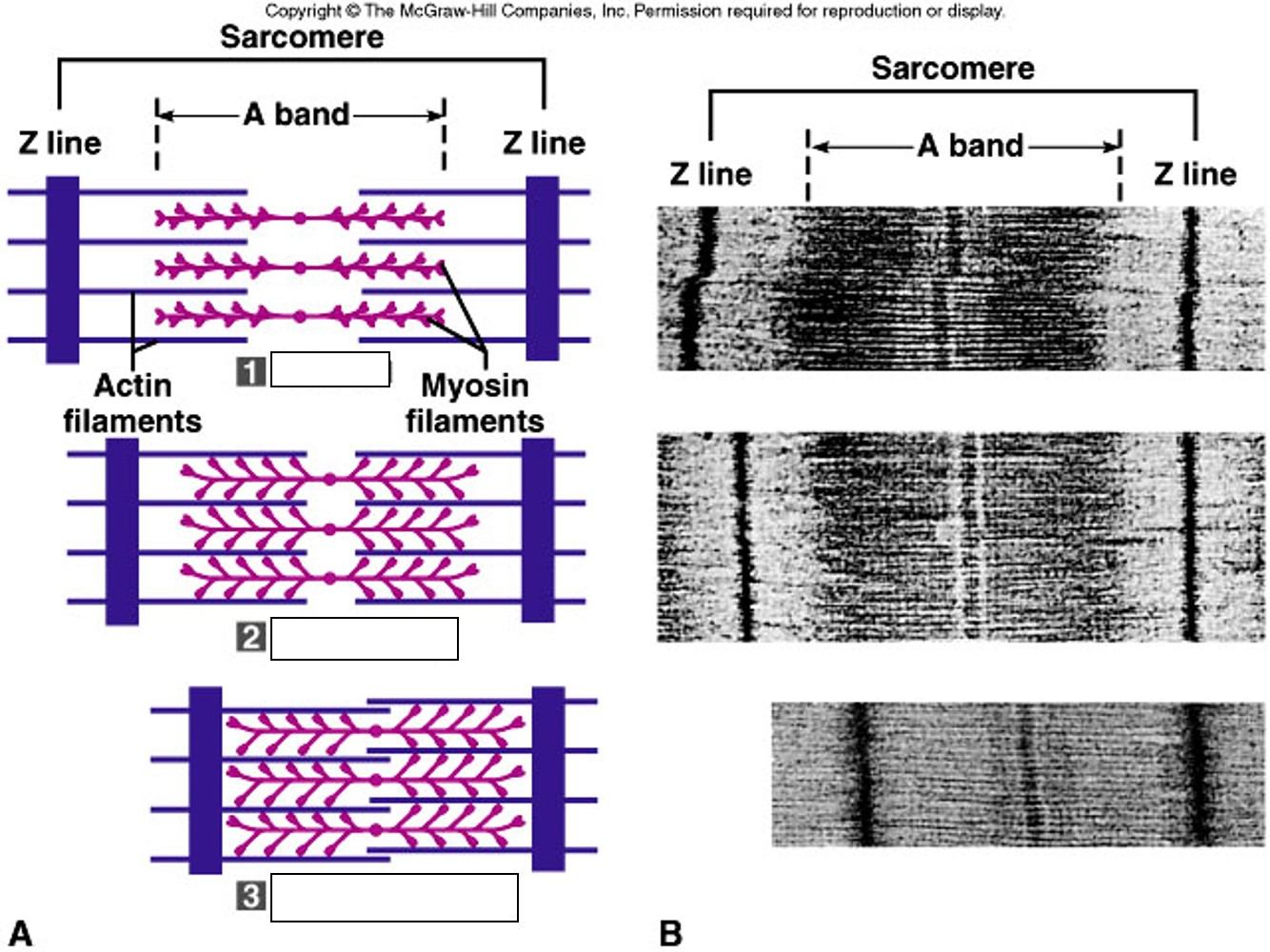
The part of the sarcomere that C (Blue) refers to is the...

a)

Actin

b)

Myosin

c)

Troponin

d)

Tropomyosin

4.
The part of the sarcomere that D (Red) refers to is the?
a)

Actin

b)

Myosin

c)

Troponin

d)

Tropomyosin

5.
What state is the sarcomere in #1
a)

Relaxed

b)

Contracting

c)

Fully Contracted

d)

None of the above

6.

What state is the sarcomere in #2

a)

Relaxed

b)

Partially Contracted

c)

Fully Contracted

d)

None of the above

7.
What state is the sarcomere in #3
a)

Relaxed

b)

Contracting

c)

Fully Contracted

d)

None of the above

8.
What happens to the Z lines during a sarcomere contraction?
a)

It disappears

b)

gets closer together

c)

It gets bigger

d)

None of these

9.
The functional unit of the muscle cell is the: 
a)

Sarcomere

b)

Osteon

c)

Myofilament

d)

Muscle fiber

10.
Thin filaments in a myofibril are
a)

Sarcomeres

b)

Sarcoplasm

c)

Actin

d)

Myosin

11.
Thick filaments are in a myofibril are
a)

ATPase

b)

Sarcoplasmic reticulum

c)

Actin

d)

Myosin

12.

How may sarcomeres are shown above?

a)

6

b)

5

c)

4

d)

3

13.
Which is more true to cause muscle contraction?
a)
Actin Pulls on the myosin
b)
Myosin Pulls on the Titin
c)
Myosin Pulls on Actin
d)
Actin Pulls on Titin
14.
Which ion, when present, changes the conformation of tropomyosin?
a)
Calcium
b)
Sodium
c)
Potassium
d)
Lithium
15.
In order for tropomyosin to change conformation, calcium has to bind with...
a)
Voltage Gated Ion Channel
b)
Ligand Gated Ion Channel
c)
Troponin Protein
d)
Actin Protein
16.
What opens the Calcium Ion Transport Channel embedded in the pre-synaptic terminal?
a)
Binding of Acetylcholine
b)
Binding of Calcium Ion
c)
An Action Potential
d)
Binding of Sodium Ion
17.
Calcium that will eventually enter the muscle cell to bind with troponin is stored in the...
a)
T-Tubule of the Muscle Cell
b)
Sarcoplasmic Reticulum of the Muscle Cell
c)
The Sarcolemma of the Muscle Cell
d)
The interstitial space outside the muscle cell near the pre-synaptic terminal.
18.
Which of the following occurs first in muscle contraction?
a)
Calcium Ion Enters the Pre-synaptic Terminal
b)
Acetylcholine Enters the Synaptic Cleft
c)
Sodium Ion Enters the Sarcolemma
d)
Calcium Ion Enters the Sarcoplasm (Cytoplasm).
19.
Which of the following occurs first in muscle contraction?
a)
Myosin /Actin Cross bridge shifts to move actin.
b)
Phosphate is released form the myosin globular head
c)
Calcium Enters the Sarcoplasm (Cytoplasm) of the muscle cell.
d)
ADP is released form the myosin globular head.
20.
Which of the following occurs first in muscle contraction?
a)
Myosin globular head 'uncoils' releasing stored energy.
b)
Cross Bridges are formed between actin and myosin
c)
Tropomyosin changes shape (conformation) to expose myosin binding sites.
d)
Calcium Binds with Troponin
21.
a neurotransmitter that stimulates skeletal muscles
a)
acetylcholine (Ach)
b)
ATP
c)
cross bridges
d)
neuromuscular junction
22.
the only energy source that can be used to directly power muscle activity
a)
acetylcholine (Ach)
b)
ATP
c)
cross bridges
d)
neuromuscular junction
23.
the heads of the myosin myofilaments are called __ when they link the thick and the thin filament together 
a)
acetylcholine (Ach)
b)
ATP
c)
cross bridges
d)
neuromuscular junction
24.
point where an axon terminals of a nerve cell and the sarcolemma of a skeletal muscle join
a)
acetylcholine (Ach)
b)
ATP
c)
cross bridges
d)
neuromuscular junction
25.

Put steps of contraction in order.

a)

rest, nerve action, ACh released, transmitted, Ca released

b)

ACh released, Ca released, nerve action, transmitted, rest

c)

rest, nerve action, Ca released, ACh released, transmitted

d)

ACh released, Ca released, transmitted, nerve action, rest

26.

When the action reaches the muscle cell, it travels down the....

a)

Sarcolemma

b)

T Tubules

c)

Sarcoplasmic Reticulum

d)

Calcium Channel

27.

After calcium is released from the SR, it binds to _________

a)

troponin

b)

tropomyosin

c)

actin

d)

myosin

28.

Troponin moves the ____________ uncovering binding sites.

a)

actin

b)

troponin

c)

tropomyosin

d)

myosin

29.

A calcium deficiency would

a)

create uncoordinated muscle contractions

b)

allow muscle contraction, but not relaxation

c)

prevent contraction by preventing myosin from binding to actin

d)

have no effect on contraction

30.

Another name for the prime mover is

a)

antagonist

b)

agonist

c)

synergist

d)

fixator

31.

A muscle that helps the agonist is called a

a)

antagonist

b)

agonist

c)

synergist

d)

fixator

32.

What is the opposing muscle group for the quadriceps?

a)

biceps

b)

lower back

c)

hamstrings

d)

obliques

33.

In knee flexion, which is the agonist? (the one contracting or getting shorter)

a)

hamstrings

b)

quadriceps

34.

What is the agonist and what is the antagonist in a bicep curl?

a)

biceps are the agonist, triceps are the antagonist

b)

triceps are the agonist, biceps are the antagonist

35.

A muscle can be a agonist for one movement and an antagonist for a different movement

a)

true

b)

false

36.

The agonist and antagonist work in __________ to create movement

a)

tandem

b)

random

c)

opposition

d)

synchronization