wayground logo

Free Printable Worksheets

NEW

Font size

S
M
L
XL
Worksheets

12.3 Air Currents

Total questions: 26

Worksheet time: 42mins

Name
Class
Date
1.

The rotation of the Earth causes winds to bend due to the...

a)

coriolis effect

b)

doldrums

c)

trade winds

d)

westerlies

2.

what is the main cause of the coriolis effect?

a)

earth’s rotation

b)

trade winds

c)

the sun and ocean

d)

temperature

3.
In which direction do prevailing westerlies flow?
a)
from east to west
b)
from west to east
c)
from north to south
d)
from south to north
4.
Steady winds that flow from east to west between 30°N latitude and the equator and 30°S latitude and the equator.
a)
Prevailing westerlies
b)
Horse latitudes
c)
Trade winds
d)
Polar easterlies
5.
Cold winds that blow from east to west between latitude lines 60°N and the North Pole and 60°S and the South Pole.
a)
Prevailing westerlies
b)
Trade winds
c)
Horse latitudes
d)
Polar easterlies
6.
Which global winds have the greatest impact on the weather in the US?
a)
trade winds
b)
prevailing westerlies
c)
doldrums
d)
polar easterlies
7.
I am a fast-moving ribbon of AIR that moves from west to east in the Northern Hemisphere around the Earth.
a)
California Current
b)
Gulf Stream
c)
Jet Stream
d)
Atlantic Ocean
8.
What type of winds blow constantly, predictably, and over long distances?
a)
land breezes
b)
mountain breezes
c)
global winds
d)

sea breezes

9.

What is the initial source for global winds and convection in the atmosphere?

a)

heat from the Earth's core

b)

the rotation of the Earth

c)

Moon's gravity

d)

unequal heating of the Earth by the sun

10.

Identify the tool used to measure wind direction

a)

Wind Vane

b)

Anenometer

c)

Thermometer

d)

Rain Guage

11.
In which direction do prevailing westerlies flow?
a)
from east to west
b)
from west to east
c)
from north to south
d)
from south to north
12.
The tropical winds running from 0 to 30 degrees latitude are called:
a)
subtropical westerlies
b)
polar westerlies
c)
trade winds
d)
polar winds
13.

Winds occur because hot air rises and cool air sinks in a process called...

a)

conduction

b)

convection

c)

radiation

d)

magnetism

14.

Winds that blow from the North and South pole toward 600 latitude are called...

a)

trade winds

b)

westerlies

c)

polar easterlies

d)

horse latitudes

15.

At the equator and at 600 latitude, warm air rises creating a windless area known as the...

a)

doldrums

b)

horse latitudes

c)

westerlies

d)

polar easterlies

16.

Winds that blow from 300 latitude to the equator are called...

a)

westerlies

b)

polar easterlies

c)

trade winds

d)

horse latitudes

17.

Winds always blow from areas of _________ pressure to areas of _________ pressure.

a)

high, high

b)

low, low

c)

low, high

d)

high, low

18.
How does the air move in a land breeze?
a)
From east to west
b)
From west to east
c)
From the land to the ocean
d)
From the ocean to the land
19.
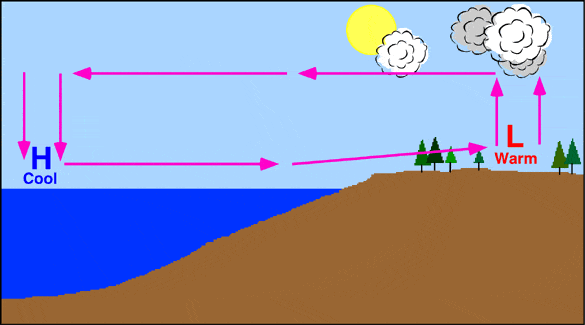
Is this a land or a sea breeze?
a)
land breeze
b)
sea breeze
20.
How does the air move in a sea breeze?
a)
wind moves from north to south
b)
wind moves from ocean to the land
c)
wind moves from the land to the ocean
d)
wind moves from south to north
21.
Do sea breezes typically happen during the day or night?
a)
Day
b)
Night
22.
Why do land breezes occur at night?
a)
Land cools off slower than water, so the air above water is cooler.
b)
Water cools off faster than land, so the air above land is warmer.
c)
Land heats up slower than water, so the air stays cooler during the day.
d)
Water cools off slower than land, so the air above water is warmer.
23.
Which best describes why winds at the beach change direction between day and night? **
a)
because the temperatures over land and over water change 
b)
because warm air over land sinks and stays in place over land
c)
because cool air rises and is replaced by warm air from the ocean 
d)
because cool air sinks and stays in place over land 
24.
What causes wind to blow?
a)
Differences in longitude 
b)
Shock waves from clouds 
c)
Differences in air temperature and pressure 
d)
The rotation of the earth
25.
Why does warm air rise?
a)
Warm air is more dense than cooler air.
b)
Warm air has more pressure than cooler air.
c)
Warm air is less dense than cooler air.
d)
Warm air has a higher dew point than cooler air.
26.
Which term best describes how the earth's atmosphere is heated?
a)
Spirally
b)
Unevenly
c)
Circularly
d)
Kinetically