wayground logo

Free Printable Worksheets

NEW

Font size

S
M
L
XL
Worksheets

Classification

Total questions: 20

Worksheet time: 16mins

Name
Class
Date
1.

Branch of science responsible for classifying and naming organisms

a)

taxonomy

b)

classification

c)

binomial nomenclature

d)

dichotomous key

2.

The Kingdom which is unicellular, has no nucleus and lives almost everywhere

a)

Protista

b)

Fungi

c)

Bacteria

d)

Archaea

3.

This Kingdom is eukaryotic, purely heterotrophic and its organisms are yeasts, molds, and mushrooms.

a)

Animalia

b)

Fungi

c)

Bacteria

d)

Archaea

4.

The Kingdom has some members that are autotrophic, yet some are heterotrophic. The Kingdom is mostly unicellular and lives mostly in water environments.

a)

Protista

b)

Fungi

c)

Plantae

d)

Animalia

5.

System for providing a scientific name for every organism is:

a)

a dichotomous key

b)

binomial nomenclature

c)

classification

d)

domain

6.
The scientific name for water bear is Hypsibius dujardini.  What is its genus?
a)
Hypsibius 
b)
dujardini
c)
water 
d)
tardigrade
7.
The rules for naming an organism are:
a)
Capitalize Genus, lowercase species, underline or italicize entire word
b)
Capitalize both Genus and species, underline or italicize the entire word
c)
write it how ever you want
d)
Capitalize Genus, lowercase species, make the entire word in bold print
8.

(Taxonomy) Which is the correct way to write an organisms scientific name?

a)

Ailuropoda Melanoleuca

b)

ailuropoda melanoleuca

c)

Ailuropoda melanoleuca

d)

ailuropoda Melanoleuca

9.

The closer related two organisms are, the more _________ they share.

a)

levels of taxonomy

b)

adaptations

c)

food

d)

scientific names

10.

Using this chart, which organisms are closely related? 

a)

american badger and leopard

b)

coyote and gray wolf

c)

european otter and leopard

d)

coyote and american badger

11.
The 8 levels of classification, most broad to most specific.
a)
Domain, Genus, Family, Order, Class, Phylum, Kingdom, Species
b)
Domain, Species, Kingdom, Genus, Phylum, Family, Class, Order
c)
Domain, Kingdom, Phylum, Class, Order, Family, Genus, Species
d)
Order, Kingdom, Species, Domain, Phylum, Family, Class, Genus
12.
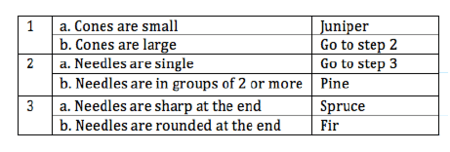
A dichotomous key for trees is provided. Hikers found a tree that has large brown cones and single sharp needles. What species of tree have the hikers found?
a)
Juniper
b)
Pine
c)
Spruce
d)
Fir
13.
A student discovers an arachnid with a segmented abdomen, long legs, and a tail with no stinger. The student uses the dichotomous key below to identify it. Which arachnid has the student found?
a)
Whip Scorpion
b)
Wind Scorpion
c)
Daddy long legs
d)
Scorpion
14.
What step do we always start with when using dichotomous keys?
a)
1
b)
2
c)
3
d)
4
15.
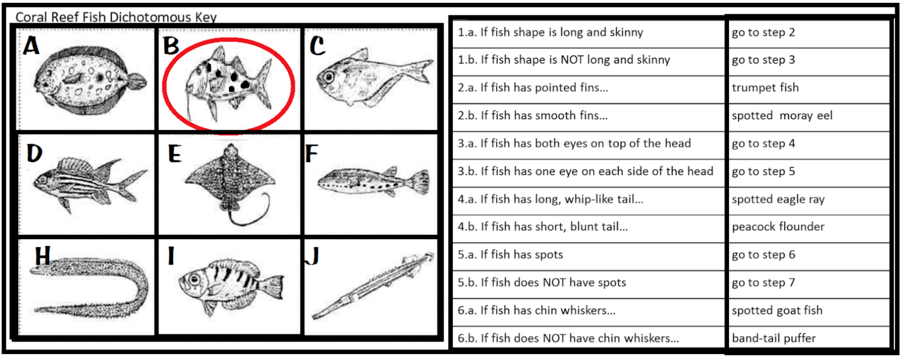
Using this dichotomous key, identify the name of the circled Fish, J.
a)
peacock flounder
b)
band-tail puffer
c)
trumpet fish
d)
spotted goat fish
16.
Using this dichotomous key, identity the name of the circled fish.
a)
band-tail puffer
b)
spotted goat fish
c)
peacock flounder
d)
trumpet fish
17.

According to the dichotomous key below, what is the name of the pink creature?


1a. mouth open………….go to 2

1b. mouth not open……..go to 4

2a. Arms…………………….go to 3

2b. No arms….Alienus quadlegicus

3a. Hairy……………..Alienus haircus

3b. Not hairy…..Alienus tritoothicus

4a. No horns………………..go to 5

4b. Horns…………...Alienus stripicus

5a. No legs…….…..Alienus biobicus

5b. Legs………………Alienus fuzzicus

a)

Alienus quadalegicus

b)

Alienus tritoothicus

c)

Alienus stripicus

d)

Alienus fuzzicis

18.


What is the answer? Click on the picture to zoom in question.

a)

F.

b)

G.

c)

H.

d)

J.

19.

Use the dichotomous key to identify the leaf pictured below.

a)

Pecan

b)

Locust

c)

Birch

d)

Magnolia

20.

What is the species for this fennec fox?

a)

Vulpes

b)

zerda

c)

Canidae

d)

Chordata